

A fractional executive assistant is a senior executive assistant who works part of one leader's week, usually 5 to 20 hours, for $35 to $65 an hour in the US. That puts a 10-hour weekly retainer at about $1,500 to $2,800 a month. The model turns executive support into a variable cost you scale up for launches, fundraising or heavy travel.
Once you need more than 10 to 15 hours a week, a full-time EA from the Philippines or South Africa usually costs less. A dedicated Philippine EA runs about $1,250 a month for 40 hours a week. This guide covers five things:
- What the role is and how it differs from a virtual assistant, a full-time EA and a chief of staff.
- What fractional support costs, with 2026 price ranges and a 15-hour vs. 40-hour comparison.
- The shared retainer trap and six questions to ask any provider.
- An 8-step setup for your first 30 days.
- Five questions that tell you whether fractional, full-time or a VA fits.

What Is a Fractional Executive Assistant?
A fractional executive assistant gives one executive senior support for part of the week. They own outcomes: a protected calendar, a sorted inbox and meetings that end with owners and deadlines. A virtual assistant, by contrast, completes set tasks from a list.
The role works through cognitive offloading. Psychologists Evan Risko and Sam Gilbert define cognitive offloading as "the use of physical action to alter the information processing requirements of a task so as to reduce cognitive demand" (Trends in Cognitive Sciences, 2016). A fractional EA carries that load for you. They capture requests, sort them, route them and close the loop. You make fewer small decisions and spend more time on the large ones.
| Role | Weekly hours | Owns | Best for |
|---|---|---|---|
| Virtual assistant | Any | Single tasks with clear instructions | Data entry, bookings, research, CRM updates |
| Fractional executive assistant | 5 to 20 | Calendar, inbox, meeting follow-through | Founders, consultants and board members with a lighter load |
| Full-time executive assistant | 40 | The executive's whole operating rhythm | Leaders with daily coordination and heavy meeting volume |
| Chief of staff | 40+ | Strategic projects across the leadership team | CEOs who need a program leader |
Agencies also sell "shared" plans, where one assistant splits time across several clients. The shared retainer trap section below explains what that means for your hours.
How Many Hours Does a Fractional Executive Assistant Need?
Scope sets the hours. Start small, measure for four weeks and add hours when the backlog grows. The table gives starting estimates by scope.
| Scope | Hours a week | Typical leader |
|---|---|---|
| Inbox triage and calendar rules | 5 to 10 | Solo consultant or early founder |
| Plus meeting ops, follow-ups and travel | 10 to 20 | Founder with a team of 5 to 20 |
| Plus stakeholder updates, projects and personal logistics | 20 to 30 | Scale-up CEO or a leader running two ventures |
| Daily live coverage and every meeting prepped | 30+ | Hire full time |
How Much Does a Fractional Executive Assistant Cost?
A US-based fractional executive assistant typically costs $35 to $65 an hour. At 10 hours a week, that comes to about $1,500 to $2,800 a month. At 20 hours a week, it reaches about $3,000 to $5,600 a month.
The floor comes from wages. The US Bureau of Labor Statistics puts the median wage for executive secretaries and executive administrative assistants at $76,590 a year (May 2025), or about $36.80 an hour before benefits. A provider's hourly rate has to cover that pay, payroll costs and its own margin. Rates vary by provider, seniority and region, so treat these ranges as a starting benchmark and compare real quotes.
| Model | How you pay | Typical cost | Watch for |
|---|---|---|---|
| Hourly block (US-based) | Prepaid blocks, such as 10 or 20 hours | $35 to $65 an hour | A different assistant per request; rates that rise at renewal |
| Monthly retainer, 10 hours a week | A fixed fee for about 43 hours a month | About $1,500 to $2,800 a month | Unused hours that expire at month end |
| Monthly retainer, 20 hours a week | A fixed fee for about 87 hours a month | About $3,000 to $5,600 a month | An assistant shared with several other clients |
| Full-time direct hire (Philippines or South Africa) | A one-time recruitment fee, then a salary paid to the assistant | $700 to $3,300+ a month for 40 hours a week, or about $4 to $19 an hour | You manage the assistant yourself |
Retainer figures use 4.33 weeks a month. Direct-hire salaries are Exec Assistants' 2026 ranges for full-time remote EAs; see our pricing page for every level.
Calculate your effective hourly rate
A retainer's real price depends on the hours you use. Divide the monthly fee by the hours you actually used. If you buy 40 hours and use 28, your effective rate rises 43%. Track hours used for the first two months before you lock in a bucket size.
Compare 15 fractional hours with 40 full-time hours
A full-time offshore executive assistant usually costs less than a part-time US retainer and gives you almost three times the hours. The table compares a common fractional plan with two full-time direct hires.
| Option | Hours a month | Monthly cost | Year one | Cost per hour |
|---|---|---|---|---|
| US fractional EA, $45 an hour, 15 hours a week | About 65 | $2,925 | $35,100 | $45.00 |
| Full-time Philippine EA, mid level, 40 hours a week | About 173 | $1,250 | $16,997 with the $1,997 fee | About $7.20 |
| Full-time South African EA, mid level, 40 hours a week | About 173 | $1,800 | $23,597 with the $1,997 fee | About $10.40 |
Year-one cost
Hours you get each month
Rule of thumb: once you need more than about 10 to 15 hours a week for three months in a row, price a full-time offshore hire. A dedicated EA from the Philippines or South Africa often costs less than half of a US retainer and covers your whole week.
Full-time, 40 hours a week
A dedicated Philippine EA for less than half the cost of a 15-hour US retainer.
One $1,997 recruitment fee, then you pay your EA directly with no monthly markup.
What Is the Shared Retainer Trap?
The shared retainer trap happens when you buy a bucket of hours from an agency and your assistant splits the week across many clients. The monthly price looks affordable. In practice, you get part of a person's attention, and the agency keeps a large share of every hour you pay for.
Here is how a pooled plan usually works. The agency sells you 20 hours a month. It assigns an assistant who serves five or six other clients on the same schedule. Your requests join a queue, and a backup assistant covers when your main assistant is busy.
Illustrative margin math: if a provider bills you $45 an hour and pays its assistant $15 an hour, it keeps $30 of every hour, or two-thirds of your spend. Over a 20-hour monthly plan, that gap adds up to $600 a month that never reaches the person doing the work.
That structure costs you in three ways:
- Slower responses. Your urgent request waits behind other clients' work.
- Lost context. An assistant juggling six calendars can't learn your priorities, stakeholders and preferences in depth.
- Turnover risk. Assistants paid a small slice of your rate move on, and your training leaves with them.
Ask any fractional provider these six questions before you sign:
- How many other clients will my assistant support?
- Will I get one named assistant for the whole contract?
- What happens to hours I don't use?
- What share of my hourly rate goes to the assistant?
- Who covers when my assistant is sick or on leave, and how fast?
- Can I hire my assistant directly later, and is there a buyout fee?
For a full side-by-side of service terms, read our guide to dedicated vs. shared executive assistants.
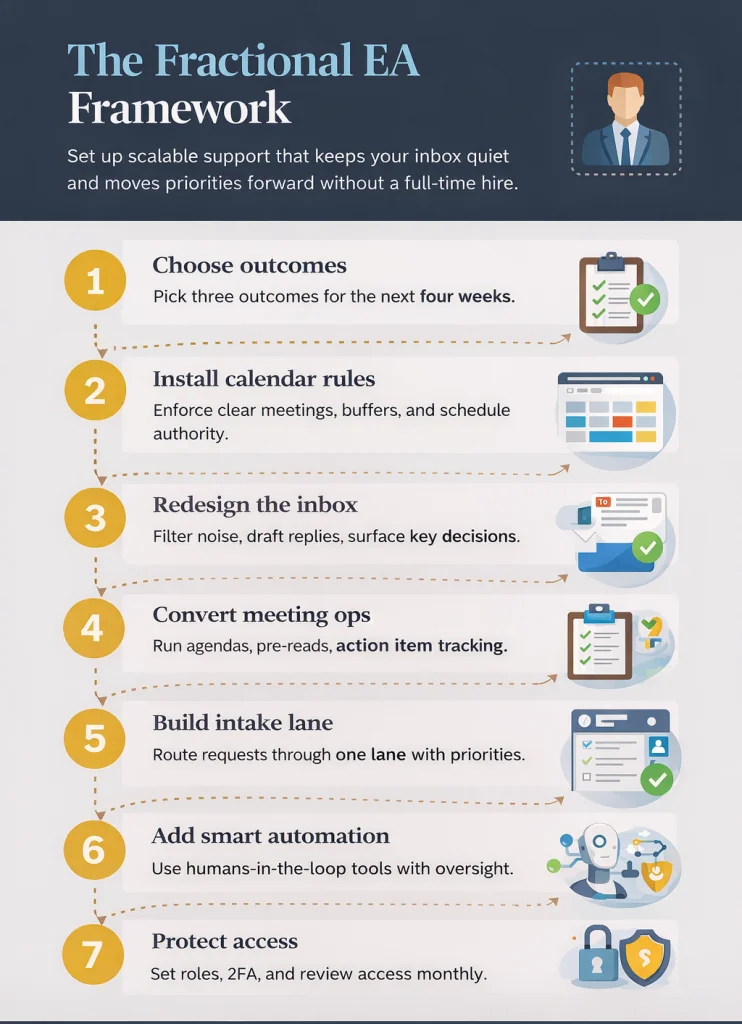
How to Set Up a Fractional Executive Assistant in 8 Steps
This setup runs over your first 30 days. Each step names the action, the tools and the result you should see.
1. Choose three outcomes
Pick three outcomes for the next four weeks. "Three protected strategy blocks every week" beats "help with my inbox." Outcomes stop scope creep and keep the hours focused.
2. Install calendar rules
Write the rules your assistant enforces in Google Calendar or Outlook: meeting types, 15-minute buffers, no-meeting mornings and who can book you. Give scheduling authority with the rules. You stop renegotiating your week.
3. Redesign the inbox around decisions
Your assistant sorts Gmail or Outlook into three labels: Decide, Waiting and FYI. They draft replies, move FYI items into a daily digest and surface only real decisions at set times.
4. Convert meetings into follow-through
Your assistant sends agendas, requests pre-reads, captures decisions and logs every action item with an owner and a due date in Asana or Notion. Nothing leaves a meeting without an owner.
5. Build one request intake lane
Route every request through one place, such as a Slack workflow or a Google Form, with priority and deadline fields. Your assistant reviews the queue twice a day. Random pings stop.
6. Add automation with human review
Zapier or Make routes form entries into tasks. Otter.ai or Fireflies.ai drafts meeting summaries. Notion stores SOPs, preferences and a decision log. Your assistant checks every automated output before it reaches you or a client.
7. Protect access
Share logins through 1Password or Bitwarden. Turn on multi-factor authentication for every critical account. Use Gmail delegation and role-based permissions, then review access every month. Part-time support still needs full-time security habits. Our guide to vetting, NDAs and data security covers the full checklist.
8. Run a 15-minute weekly review
Review open decisions, cut low-value requests, tighten one rule and add one SOP each week. Track hours used against the bucket. Small fixes compound into a calmer week.
Free tool
How many hours would you hand over?
The Delegation Audit scores your week and estimates the hours an assistant could take.
Fractional EA, Full-Time EA or Virtual Assistant? Five Questions
Leaders often ask, "Do I need a fractional executive assistant or a virtual assistant?" Five questions settle it. Each answer points to one model.
| Question | If yes | If no |
|---|---|---|
| 1. Does the work touch investors, clients or your board? | Executive assistant (fractional or full time) | Virtual assistant |
| 2. Will the work fill more than 20 hours a week within three months? | Full-time executive assistant | Fractional executive assistant |
| 3. Do you need someone online during your working hours every day? | Full-time executive assistant | Fractional support with async updates |
| 4. Can you write the whole scope on one page? | Virtual assistant or fractional EA | Executive assistant who builds the system with you |
| 5. Do you need someone to lead projects across teams? | Chief of staff | Executive assistant |
Many leaders start with a fractional EA and move to full time as the load grows. If question 5 got a yes, read our comparison of a virtual executive assistant vs. chief of staff.

Seven Mistakes That Waste Fractional Hours
| Mistake | Fix | If ignored |
|---|---|---|
| Buying hours with no outcomes set | Set three weekly outcomes and review them | Scope grows and results flatten |
| Withholding scheduling authority | Give written rules and real control | Calendar churn never stops |
| Keeping everything live | Move updates into written digests | Meetings grow and attention splits |
| Skipping the action register | Track owners and due dates in one list | Follow-ups slip and trust drops |
| Delegating personal tasks without limits | Set approval thresholds in writing | Rework rises |
| Automating without review | Keep a human check on drafts and summaries | Errors spread fast |
| Never writing SOPs | Add one SOP a week in Notion | You repeat the same explanations |
Three Examples of Fractional Support
Illustrative examples based on composite clients.
Scale-up founder, 15 hours a week. The founder handled every thread and calendar conflict. The fractional EA installed a daily decision digest, enforced scheduling rules and ran the weekly review. The founder got back three strategy blocks a week.
Portfolio professional, 10 hours a week. A leader ran two ventures, sat on a board and kept a speaking calendar. The EA merged three calendars, built one intake lane and kept travel rules and stakeholder notes in Notion. Double bookings stopped.
Solo consultant, 6 hours a week. A consultant delayed invoices and lost follow-ups after travel. The EA set a weekly cadence for follow-ups, QuickBooks invoicing and travel prep. Invoices went out on time.

Frequently Asked Questions
What is a fractional executive assistant?
A fractional executive assistant is a senior executive assistant who works part of one leader's week, usually 5 to 20 hours. They own calendar control, inbox triage and meeting follow-through.
How much does a fractional executive assistant cost?
A US-based fractional executive assistant costs about $35 to $65 an hour. A 10-hour weekly retainer runs about $1,500 to $2,800 a month, and a 20-hour retainer about $3,000 to $5,600. A full-time EA from the Philippines costs $700 to $2,000+ a month for 40 hours a week.
Does Exec Assistants provide fractional executive assistants?
Exec Assistants recruits dedicated executive assistants from the Philippines and South Africa, and most clients hire full time for a one-time $1,997 fee. A full-time offshore EA often costs less than a 15-hour US retainer. If you only need part-time hours, raise it on your discovery call and we will tell you what works.
How many hours should I start with?
Start with 5 to 10 hours a week for calendar rules and inbox triage. Add hours when meetings and stakeholder work grow. Past about 20 hours a week, price a full-time hire.
What should I delegate first?
Delegate calendar rules, inbox sorting, meeting follow-up and the action register first. These four tasks cut the most context switching. Our inbox-to-investor-ready workflow shows the inbox handover step by step.
How does a fractional executive assistant protect confidential information?
They use a password manager such as 1Password or Bitwarden, multi-factor authentication, role-based permissions and a monthly access review. Sign an NDA before day one.
Can a fractional executive assistant use AI tools safely?
Yes, with a human check on every output. Zapier, Slack workflows, Otter.ai and Fireflies.ai speed up capture and routing. Your assistant reviews drafts and summaries before they reach anyone.
Can a fractional executive assistant handle personal tasks?
Yes, with written limits. Set approval thresholds for spending and define which personal accounts the assistant can access.
When should I hire a full-time executive assistant instead?
Hire full time when you need daily live coverage, heavy meeting prep or more than about 20 hours of support a week. Start with a clear executive assistant job description.
Can a fractional executive assistant help with ADHD-style overwhelm?
Yes. Task capture, calendar structure, inbox sorting and steady follow-through reduce the number of open loops you hold. The assistant becomes the external system that remembers for you.
Next step
Get 40 hours a week for less than a 15-hour retainer
Exec Assistants recruits dedicated executive assistants from the Philippines and South Africa for a one-time $1,997 fee. You get a vetted shortlist in 7 to 10 days and pay your EA directly.