

Most executives who hire their first Filipino executive assistant make the same mistake. They post a generic “virtual assistant” ad, pick the candidate with the longest software list, and spend the next month fixing errors. The talent pool rarely causes the problem. The job post, the pay level, and the missing handover plan do.
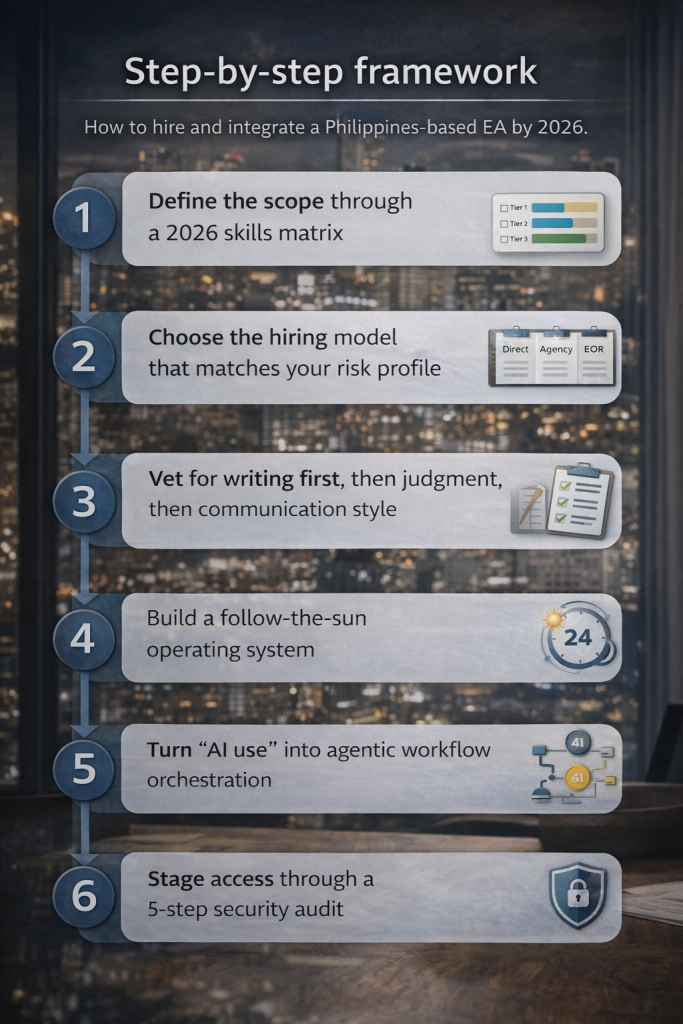
This guide walks through the full hire: what a Philippine EA does, what one costs in 2026 once you add benefits and night shift pay, which hiring model keeps you compliant with Philippine labor law, and how to run a working day across a 12-hour time gap.

Why Hire an Executive Assistant From the Philippines?
Three things make the Philippines a strong source of executive support: English skills, a deep professional services workforce, and pay levels that let a small business afford senior talent.
English Proficiency: The 2025 EF EPI Results
The 2025 EF English Proficiency Index scored the Philippines at 569, a “high proficiency” rating. That score placed the country 28th in the world and second in Asia, behind only Malaysia, and well above the global average of 488. For an executive assistant, that fluency shows up in client emails, meeting notes, and replies drafted in the executive’s own voice.
A 1.9 Million-Person IT-BPM Workforce
The IT and Business Process Association of the Philippines (IBPAP) reports that the country’s IT-BPM industry earned more than $40 billion in 2025 and employed about 1.9 million people, up 4% from 2024. Many of the strongest EA candidates started in that sector, in back-office and client service roles in Metro Manila, Makati, Bonifacio Global City, Cebu City, and Clark. Those jobs trained them in written procedures, quality checks, and US business hours.
Internet Speed and Infrastructure in 2026
Ookla’s Speedtest Global Index put the Philippines’ median fixed broadband speed at 114.34 Mbps in August 2026, ranking 62nd of 149 markets. That speed handles video calls and cloud tools with ease. Reliability matters more than speed, though, and we cover backup power and internet in the operations section below.

What Does a Filipino Executive Assistant Do Day to Day?
A Philippine EA takes over the work that keeps an executive’s day running, so the executive can spend more hours on decisions, clients, and growth.
Inbox Management and Daily Briefs
The EA works through the executive’s Gmail or Outlook inbox overnight. They answer routine scheduling and status emails, file receipts and reports, and flag anything that needs the executive’s judgment. The executive wakes up to a short brief with three sections: what the EA finished, what needs a decision today, and what can wait.
Calendar Control and Focus Time
Research from Gloria Mark, a professor at the University of California, Irvine, found that people now hold attention on a single screen for an average of 47 seconds, down from 150 seconds in 2004. Every meeting request and message chips away at focus. An EA protects it by batching meetings into set blocks, adding buffers between calls, and defending two or three hours of uninterrupted work each day.
Follow-Ups and Project Tracking
Executives lose hours chasing updates. The EA tracks open action items in a tool like ClickUp, Asana, or Notion, gives each item an owner and a due date, and sends reminders before deadlines slip. After each meeting, the EA sends a recap with decisions and next steps within the hour.
Reviewing AI-Assisted Work
In 2026, most EAs use AI tools like ChatGPT, Claude, Gemini, and Perplexity for research and first drafts, and Otter.ai or Fireflies.ai for meeting notes. The EA’s value comes from checking that output before it reaches the executive. A good EA confirms every number against its source, opens every link, and rewrites anything that doesn’t sound like the executive.
Automations That Save Real Time
A skilled EA also sets up simple automations. Here’s one common example: when a client books a call through Calendly, Zapier creates a prep task in ClickUp, pulls the client’s last three emails into the task, and posts a reminder in Slack the day before. The EA builds that flow once, and it runs on every booking after that.
How Much Does an Executive Assistant in the Philippines Cost in 2026?
Two numbers matter: the salary you agree on and the extra costs that come with the hiring model you choose.
Local Salary Data vs Global-Client Pay
Indeed reports an average Philippine executive assistant salary of ₱26,275 a month as of July 2026, or about $420 at September 2026’s exchange rate of roughly ₱62.5 to the dollar. That figure reflects local employers. EAs who support overseas executives, work night shifts, and handle senior-level tasks earn well above it. Our salary and cost guide by country puts experienced Filipino EAs serving global clients at $1,000 USD to $2,000 USD a month.
Philippine EA Pay by Experience Level
| Level | Monthly pay (USD) | Monthly pay (PHP, at ₱62.5) | Typical work |
|---|---|---|---|
| Entry EA | $700 to $1,000 | ₱43,750 to ₱62,500 | Scheduling, inbox sorting, travel, data entry |
| Experienced EA | $1,000 to $1,500 | ₱62,500 to ₱93,750 | Project follow-up, client emails, meeting prep, simple automations |
| Senior EA | $1,500 to $2,000+ | ₱93,750 to ₱125,000+ | Writing in the executive’s voice, cross-team coordination, budget tracking, AI output review |
Hidden Costs: 13th-Month Pay, Contributions, and Night Differential
If you employ an EA under Philippine law, directly or through an Employer of Record, the salary grows. Here’s a worked example for an experienced EA earning ₱62,500 ($1,000 USD) a month and working 9 a.m. to 5 p.m. US Eastern time, which runs from 9 p.m. to 5 a.m. in Manila:
| Cost item | Rule | Monthly cost |
|---|---|---|
| Base salary | Agreed pay | ₱62,500 |
| 13th-month pay | PD 851: one-twelfth of yearly basic pay | ₱5,208 |
| Night shift differential | Labor Code Art. 86: 10% for hours from 10 p.m. to 6 a.m. (7 of 8 hours here) | ₱5,469 |
| SSS (employer share) | 10% of the monthly salary credit, capped at ₱35,000, plus ₱30 EC premium | ₱3,530 |
| PhilHealth (employer share) | Half of the 5% premium | ₱1,563 |
| Pag-IBIG (employer share) | 2% of up to ₱10,000 | ₱200 |
| Total | ₱78,470 (about $1,255) |
That total leaves out the EOR provider’s service fee, health insurance (HMO) coverage, and any equipment or internet allowance. Many global employers add HMO coverage because top candidates expect it. Plan for a real cost 25% to 30% above base salary, and factor these extras in before you make an offer.
Currency Swings and Pay Agreements
The peso fell about 7.65% against the dollar in the 12 months to September 2026. If you set pay in pesos, a weaker peso lowers your American dollar cost. If you set pay in dollars, a weaker peso raises your EA’s take-home pay. Many employers fix pay in dollars and review it once a year, which keeps the EA’s income stable and your budget predictable.

Is It Legal to Hire an Executive Assistant From the Philippines?
Yes. Foreign businesses can legally hire Filipino EAs through three models. Each one puts the legal responsibility in a different place.
Direct Contractor Hire
You find, contract, and pay the EA yourself as an independent contractor. This model gives you the most control and the lowest cost. The EA registers with the Bureau of Internal Revenue (BIR) as a self-employed professional, files their own taxes, and can choose the 8% flat income tax on gross receipts above ₱250,000 a year if their income stays under ₱3 million.
The risk comes from how the relationship works day to day. Philippine law looks at substance, and the job title or contract label doesn’t settle the question. DOLE Department Order 174 bans labor-only contracting. A 2017 DOLE circular exempts true individual independent contractors from DO 174’s registration rules, but the courts’ four-fold test still applies. That test asks who selected the worker, who pays the wages, who can dismiss the worker, and, most importantly, who controls how the worker does the job. If you set fixed hours, direct each task, and keep the EA working for you alone for years, the relationship can look like employment. In that case, the EA could claim employee rights, including security of tenure, 13th-month pay, and statutory contributions.
To lower that risk, write a contract built around deliverables and outcomes, let the EA use their own equipment, and get advice from a Philippine labor lawyer before the relationship passes six months.
Recruitment Agency or Managed Service
A specialist firm sources, tests, and shortlists candidates, and some firms also replace an EA who leaves. Exec Assistants works this way: we charge a one-time recruitment fee, you choose from a shortlist, and you then pay the EA directly. This model shortens the search and lowers the chance of a bad hire. Because you still contract with the EA, the direct contractor rules above still apply to you.
Employer of Record (EOR)
An EOR, such as Deel or Remote, hires the EA as a local employee on your behalf. The EOR registers the employee with SSS, PhilHealth, and Pag-IBIG, withholds income tax, pays the 13th-month bonus, and follows DOLE rules. You direct the work and pay the EOR a monthly fee. This model removes most compliance risk for a business with no Philippine company.
What Changes If the EA Becomes an Employee
Under Article 296 of the Labor Code, probation can last no longer than six months. An employee who works past that point becomes a regular employee by law. From then on, you can dismiss them only for a just or authorized cause, and a just-cause dismissal requires two written notices and a chance to respond. The Telecommuting Act (RA 11165) gives remote employees the same pay rights as office staff, including overtime and night shift differential.
How Do You Work Across the Philippines Time Zone?
The Philippines runs on Philippine Standard Time (UTC+8) and doesn’t observe daylight saving time.
| Your location | Time difference with Manila | 9 a.m. your time is… |
|---|---|---|
| New York | 12 hours (summer), 13 hours (winter) | 9 p.m. or 10 p.m. in Manila |
| Los Angeles | 15 hours (summer), 16 hours (winter) | Midnight or 1 a.m. in Manila |
| London | 7 hours (summer), 8 hours (winter) | 4 p.m. or 5 p.m. in Manila |
| Sydney | 2 hours (winter), 3 hours (summer) | 7 a.m. or 6 a.m. in Manila |
Night Shift vs Overnight Handoff
You have two options. Your EA can work your business hours on a night shift, which gives you live support and triggers night differential pay if the EA works as an employee. Or your EA can work Manila daytime hours and finish tasks while you sleep. Many US executives mix the two: the EA starts a few hours before the executive’s day ends, overlaps for one or two hours of live calls, and works through the executive’s night.
The Daily Handoff Document
A shared document in Google Docs or Notion keeps the handoff clean. Before signing off, the EA fills in three sections:
- Done: Finished tasks, with links.
- Needs you: Decisions, approvals, and drafts to review.
- Blocked: Anything waiting on someone else, with the next follow-up date.
The executive reads it first thing, answers the “Needs you” items, and the EA picks them up at the start of the next shift. For anything with a lot of context, a three-minute Loom video beats a long chain of Slack messages.
Backup Power and Internet
PAGASA, the Philippine weather bureau, tracks about 20 tropical cyclones in Philippine waters each year, and eight or nine of them cross the country, mostly between July and October. Grid strain also causes outages. In May 2026, Meralco ran rotating brownouts of two to three hours that hit about 920,000 customers in and around Metro Manila.
Ask every candidate about their backup plan. A reliable EA has a UPS for their router and laptop, a second internet connection from a different provider or a mobile data plan, and a written plan for longer outages. Some employers pay a small monthly allowance to cover a backup line.

How Do You Find and Vet a Filipino Executive Assistant?
Strong candidates come from IT-BPM companies, corporate executive support roles, and experienced virtual assistants who want to move into senior work. Interviews alone won’t show you their judgment. Paid work samples will.
Write the Job Post Around Outcomes
List what the EA will own, such as “keep my calendar free of conflicts and protect three focus hours a day” or “send every meeting recap within an hour.” A post that lists outcomes attracts people who think about results. A post that lists software attracts people who list software.
Five Tests That Show Real Skill
| Test | What you give the candidate | What a strong answer looks like |
|---|---|---|
| Writing summary | A messy 12-email thread | Two sentences and one clear recommended action |
| Voice match | Five sentences you wrote | A 150-word reply that sounds like you |
| Calendar conflict | Two urgent meetings and a deadline | Three options, each with its trade-off |
| Process build | A description of your current chaos | A simple step-by-step system they would set up in week one |
| Reference call | Two questions for past employers | “Did they flag a risk early?” and “Did they ever push back, and how?” |
Score each test from 1 to 5 and compare candidates on the same scale.
Ask for Pushback Directly
Many Filipino professionals come from workplaces with strict hierarchies, where questioning a manager feels risky. If you want an EA who flags problems and challenges bad plans, say so in writing on day one. Then thank them the first time they do it. If you want an EA who runs the system rather than waits for instructions, start with the consultation.
How Do You Keep Data Safe With a Remote EA in the Philippines?
The Philippines’ Data Privacy Act of 2012 (RA 10173), enforced by the National Privacy Commission, requires anyone who processes personal data to protect it and to use it only for stated purposes. Your EA will handle client names, emails, and possibly financial details, so build security into the setup from the first day.
Grant Access in Stages
- Week 1: Task tools and team chat only.
- Week 2: Calendar access, once the EA shows good scheduling judgment.
- Week 4: Email, starting with drafts you review. Full send rights come after about ten clean drafts.
- Later: Finance tools, after a separate security talk.
Tools and Rules
- Share every login through a password manager such as 1Password or Bitwarden. Never send passwords through Slack or email.
- Turn on two-factor authentication for email, calendar, the password manager, and every finance tool.
- Sign a written agreement that covers confidentiality, intellectual property ownership, and data handling.
- Set one firm rule: the EA never moves money. Every payment request comes to you.
Our guide on vetting, NDAs, and data security covers contracts and background checks in more detail.
Common Mistakes That Cost Executives Their First Philippine EA
- Paying entry-level rates for senior work. A ₱45,000 offer for a job that needs writing, judgment, and night shifts drives good candidates away and makes the ones you hire leave within months.
- Skipping the benefit math. Executives who forget 13th-month pay and night differential face a surprise bill or an unhappy EA at year-end.
- Running everything through chat. Slack threads bury tasks within days. Keep work in a task tool with owners and dates.
- Giving full access on day one. Staged access protects you and gives the EA time to learn your standards.
- Using AI without a review step. An EA who forwards AI drafts unchecked will eventually send you a confident, wrong number.

Executive Assistant Philippines FAQs
How much should I pay a Filipino executive assistant in 2026?
Experienced EAs who support overseas executives earn $1,000 USD to $2,000 USD a month, and entry-level EAs start around $700 USD. If you employ the EA under Philippine law, add about 25% to 30% for 13th-month pay, SSS, PhilHealth, Pag-IBIG, and night differential.
Do I have to pay 13th-month pay to a contractor?
PD 851 covers employees. A true independent contractor falls outside it. Many global employers still pay a 13th-month bonus to contractors in December, because Filipino professionals expect it and it helps keep good EAs.
What is the best hiring model for a first-time employer?
A recruitment firm helps you find the right person quickly. An EOR gives you the strongest compliance protection if you plan a long-term, full-time role with set hours. Many businesses combine the two, using a recruiter to find the EA and an EOR to employ them.
Can a Philippine EA work US hours?
Yes. Night shifts are standard in the Philippine IT-BPM industry. Remember that employees who work between 10 p.m. and 6 a.m. earn a 10% night differential for those hours.
How long does it take to hire a Philippine EA?
A recruitment firm sends you a shortlist of candidates it has already tested, which saves you the screening work. A direct search takes longer, since you read, test, and interview every applicant yourself.
Hire an Executive Assistant From the Philippines
A strong Filipino EA can run your inbox, calendar, follow-ups, and AI-assisted research while you sleep, at a cost that fits a small business. Exec Assistants tests every candidate on writing, judgment, and systems before you see a profile. Book a free consultation to hire a virtual executive assistant, and leave with a clear role scope, a pay range, and a daily handoff template built for your time zone.