

Both roles sit closest to the top of an organization. Both report directly to a senior executive. Both get asked, at some point, “Isn’t that basically the same job?” It isn’t. An executive assistant manages a leader’s time and communication. A chief of staff manages the leader’s priorities across the entire organization. That distinction- execution support versus strategic partnership- decides which one your business actually needs, and confusing the two leads to hiring the wrong role for the problem you’re trying to solve.
Key Takeaways for Business Leaders
- A chief of staff holds cross-functional authority to coordinate priorities across departments. An executive assistant manages the leader’s own time, communication, and logistics, without that cross-departmental mandate.
- The chief of staff title has military origins, tracing to nineteenth-century command structures, and only entered mainstream corporate use within the last two to three decades.
- Neither role holds formal line authority over other employees, yet both function as influential positions, a pattern organizational psychology explains through referent and informational power rather than positional power.
- A chief of staff role often functions as a career accelerant toward a VP or C-suite position. An executive assistant role is typically a career specialization in its own right, not a stepping stone, and that difference isn’t a hierarchy of importance.
- Small and early-stage businesses frequently can’t justify a full chief of staff hire yet, and a strong virtual executive assistant absorbs a meaningful share of that workload in the meantime.
- Knowing which gap you’re actually trying to close- a time and communication bottleneck or a cross-functional execution gap- determines which of the two roles solves your actual problem.

What Does a Chief of Staff Actually Do?
Chief of Staff: Defined by Cross-Functional Strategic Authority
A chief of staff runs the operating rhythm of a leadership team: setting the agenda for executive meetings, tracking whether cross-departmental initiatives are actually moving, and often making calls that affect more than one department on the executive’s behalf. The role isn’t about managing the leader’s calendar. It’s about managing whether the organization’s priorities are actually getting executed, which requires visibility and influence across functions an assistant role was never designed to hold.
Where the Title Came From: A Military Command Structure
The term “chief of staff” originates in nineteenth-century military organization, most notably the Prussian General Staff system that reorganized how large armies coordinated complex operations across multiple divisions. A chief of staff in that structure didn’t command troops directly. They coordinated the commanding officer’s strategy across every division that needed to execute a piece of it. The position moved into the highest levels of government in the twentieth century, most visibly through the White House Chief of Staff role, before large corporations, particularly in technology, began adopting a business version of the same coordination function in the 1990s and 2000s.

What Does a Virtual Executive Assistant Actually Do?
Executive Assistant: Defined by Time and Communication Management, Not Strategy
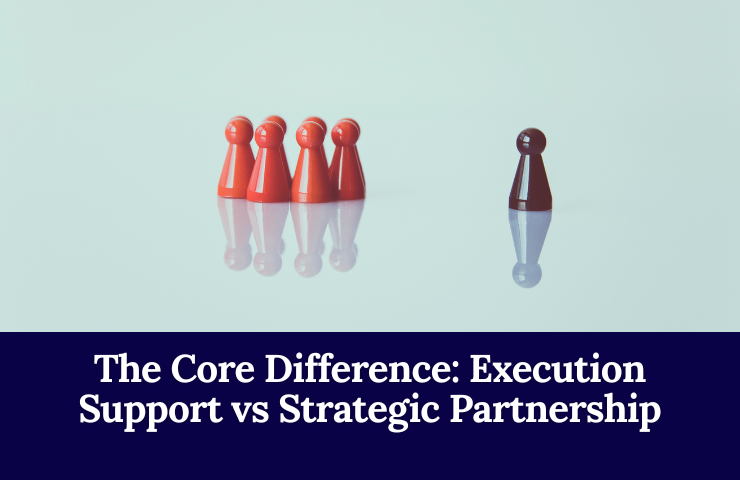
A virtual executive assistant protects and manages the executive’s time: calendar decisions, inbox triage, meeting preparation, travel logistics, and communication drafted on the executive’s behalf. The role requires real discretion and judgment, the same discretion that separates an executive assistant from an administrative assistant. Still, that discretion operates on the leader’s personal workflow, not on cross-departmental strategy execution. An executive assistant makes the leader’s day work. A chief of staff makes the organization’s priorities work.
The Core Difference: Execution Support vs Strategic Partnership
Tyler Parris’s Definition of the Modern Chief of Staff
Consultant Tyler Parris, author of the 2015 book Chief of Staff: The Strategic Partner Who Will Revolutionize Your Organization, defines the modern corporate chief of staff as an extension of the executive’s judgment across the organization, someone empowered to make decisions in the executive’s name on issues that cross department lines. Parris’s framing draws a sharp line from the executive assistant role: an EA extends the executive’s time. A chief of staff extends the executive’s authority.
Boundary Spanning: Why a Chief of Staff Operates Across Departments an EA Doesn’t Touch
Organizational researcher Michael Tushman described what he called boundary-spanning roles in a 1977 paper published in Administrative Science Quarterly, positions that exist specifically to coordinate information and priorities across the boundaries separating different parts of an organization. A chief of staff is a textbook boundary spanner: pulling status updates from finance, product, and sales, then synthesizing them into a single view for the executive and pushing decisions back out across those same boundaries. A virtual executive assistant, by contrast, typically operates within a single boundary, the executive’s own workflow, rather than spanning the organization’s internal divisions.
Why Neither Role Has Formal Authority, and Why That Still Works
French and Raven’s Bases of Power Applied to Both Roles
Psychologists John French and Bertram Raven published an influential framework in 1959 identifying the distinct sources of power a person can hold in an organization: Legitimate power tied to formal position, reward and coercive power tied to control over outcomes, expert power tied to specialized knowledge, and referent power tied to personal relationships and trust. Neither an executive assistant nor a chief of staff typically holds legitimate, reward, or coercive power over other employees. Both roles function almost entirely on referent power, trust built through proximity to the executive, and what French and Raven’s later work called informational power, influence that comes from controlling access to information rather than controlling people directly.
Referent and Informational Power: How Proximity Becomes Influence
This shared power base explains why both roles can feel disproportionately influential relative to their formal rank. A chief of staff who says “the CEO wants this prioritized” carries weight without holding a VP title, because the organization understands the proximity behind the statement. An executive assistant who says “she needs this by end of day” carries similar weight for the same reason. The difference is scope: A chief of staff’s informational power extends across the whole organization’s priorities. An executive assistant’s informational power is concentrated on the executive’s immediate schedule and communication.

Career Trajectory: One Role Is a Stepping Stone, the Other Is a Specialization
Sheryl Sandberg’s Path From Chief of Staff to COO
Sheryl Sandberg served as chief of staff to U.S. Treasury Secretary Lawrence Summers in the late 1990s before moving into technology, eventually becoming Google’s vice president of global online sales and operations and later chief operating officer of Facebook. Her career illustrates a well-documented pattern in chief of staff hiring, particularly in venture-backed startups covered by publications like First Round Review: the role is frequently used as a structured proving ground for future executive leadership, giving a high-potential hire visibility across an entire organization’s operations before they take on a functional leadership role of their own.
Why “Executive Assistant” Rarely Works the Same Way, and Why That’s Not a Weakness
An executive assistant career path runs differently. The role is a professional specialization with its own advancement track, from administrative assistant to executive assistant to, in some organizations, a senior or chief of staff-adjacent position after years of building organizational knowledge. It’s rarely used as a two-year rotation before a VP title the way a chief of staff role often is. That’s not a mark against the EA path. It reflects a genuinely different skill emphasis: sustained excellence in judgment, discretion, and time management rather than a broad strategic rotation across every function in the business.

Where the Two Roles Overlap in a Small or Growing Business
Why a Startup Often Can’t Afford Both Roles Yet
A company with fewer than fifty employees rarely has the organizational complexity, or the budget, to justify a dedicated chief of staff position. The cross-departmental coordination problem a chief of staff solves usually doesn’t exist yet at that scale, since the founder can still track every department’s priorities directly.
What a Virtual Executive Assistant Absorbs From the Chief of Staff Job Description Early On
In practice, a strong virtual executive assistant at this stage often absorbs pieces of what would eventually become a chief of staff’s job: Preparing the agenda for a weekly leadership sync, tracking whether action items from the last meeting actually got done, and flagging when two departments are working at cross purposes. None of this requires the assistant to hold cross-departmental authority. It requires them to notice and surface the gap so the executive can resolve it, which is a meaningfully smaller mandate than a chief of staff’s but a real precursor to one.

Which One Does Your Business Need Right Now?
Signs You Need a Chief of Staff
Multiple departments report to you directly, priorities regularly conflict between teams without anyone catching it early, and you find yourself personally chasing whether last quarter’s initiatives actually got executed. That’s a cross-functional execution gap, and it requires someone with a mandate that spans departments, not just your own calendar.
Signs You Need a Virtual Executive Assistant
Your actual bottleneck is your own time and communication: your inbox, your calendar, your meeting prep, the decisions only you are making about your own schedule. That’s the gap a virtual executive assistant closes directly. For most businesses below fifty employees, it’s the higher-priority hire before a chief of staff role makes sense at all. If your work involves confidential or regulated material, an executive assistant for law firms brings the same time-management discretion with additional confidentiality protocols built in.
Signs You Might Need Both, Eventually
As the organization grows, the two roles stop competing for the same budget line and start solving genuinely different problems side by side, one managing the executive’s time, the other managing the organization’s execution. Most companies that reach this point hired the executive assistant role first, precisely because the time-management gap tends to appear before the cross-functional coordination gap does.
Exec Assistants doesn’t place chief of staff roles; that position typically gets filled through direct executive search, given how tightly it’s tied to a specific organization’s internal politics and priorities. What Exec Assistants does place, through a direct-hire model sourced from South Africa and the Philippines, is the executive assistant role that most growing businesses actually need first: someone managing your time and communication with real judgment, freeing you to make the cross-functional calls yourself until the day a chief of staff role genuinely earns its place on the org chart. If that’s the role you need, the executive’s guide to virtual executive assistants covers cost, hiring, and management in full.
Book a discovery call to talk through which gap you’re actually trying to close.