

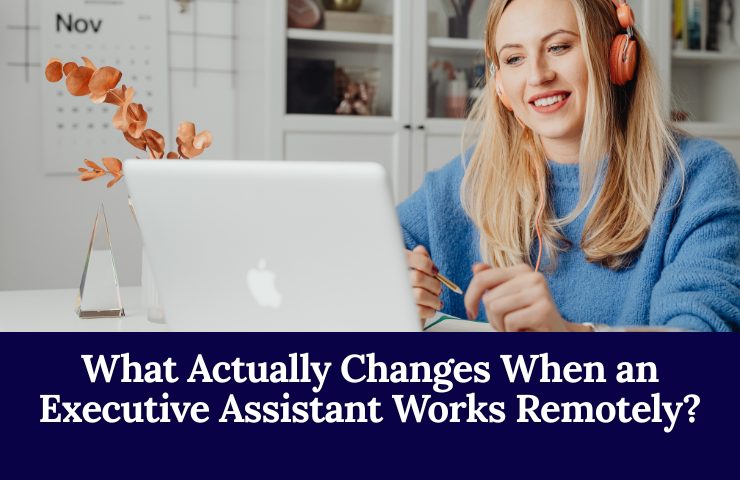
The job description reads either way identically: manage the calendar, screen the inbox, prepare the board deck, and represent the executive in meetings they can’t attend. What changes when that assistant works from a home office in Cape Town instead of the desk outside your own isn’t the job. It’s the cost structure, the trust-building timeline, the communication rhythm, and the risk profile if the arrangement doesn’t work out. This article compares the two models on each of those dimensions, not on the assumption that remote automatically means cheaper or that in-house automatically means better.
Key Takeaways for Business Leaders
- Salary is the smallest part of the cost difference. Gartner’s Total Cost of Ownership framework, built originally for IT purchasing decisions, applies directly to hiring: the sticker price rarely reflects the full cost. The executive’s guide to virtual executive assistants walks through that full cost, plus how to hire and manage the role once you’ve made the call.
- In-house assistants build working trust faster in the first few weeks, a pattern organizational researcher Bruce Tuckman’s group development model predicts, but that early advantage closes within a few months for most virtual hires.
- Video calls aren’t the fix for remote communication gaps. Stanford research on video-call fatigue explains why heavy reliance on video actually degrades a remote working relationship rather than replacing in-person presence.
- Work-life boundaries shift differently for each model, a pattern described by work/family border theory, and the shift affects the assistant and the executive in different ways.
- Time zone coverage is the one area where in-house has a structural edge, and nearshore hiring is the direct fix rather than a full workaround.
- A single in-house hire is a single point of failure. A direct-hire virtual model with a replacement guarantee changes that risk calculation entirely.
What Actually Changes When an Executive Assistant Works Remotely?
Same Core Duties, Different Delivery Model
Calendar management, inbox triage, meeting preparation, and travel coordination look the same on paper whether the assistant sits down the hall or logs in from another continent. The delivery mechanism changes: A virtual executive assistant works through shared tools like a cloud calendar, a shared inbox, and a project tracker instead of walking over to your desk. The task list survives the transition. The medium does not.
What Doesn’t Change: Discretion and Independent Judgment
The quality that actually defines an executive assistant- the authority to make judgment calls on the executive’s behalf without checking first- doesn’t depend on physical location at all. An assistant who can draft a sensitive email response or reschedule a conflicting meeting exercises that judgment whether they’re in the next room or in a different time zone. Location changes logistics. It doesn’t change the core function of the role.

The Real Cost Difference: Salary Isn’t the Full Picture
Gartner’s Total Cost of Ownership Framework Applied to Hiring
In 1987, Gartner analyst Bill Kirwin coined the term Total Cost of Ownership, or TCO, to argue that IT departments were comparing purchase prices instead of comparing the full lifecycle cost of a system, including maintenance, support, and eventual replacement. The same framework applies directly to hiring. Comparing an in-house salary to a virtual assistant’s hourly rate is a purchase-price comparison. The TCO comparison includes office space, equipment, local payroll taxes, benefits, management overhead, and the cost of eventually replacing the hire, none of which show up on the salary line but all of which show up on the bill.
What In-House Adds: Office Space, Equipment, and Local Overhead
An in-house executive assistant needs a desk, a computer, software licenses tied to a physical office network, and often a parking spot or commuting stipend, depending on the market. None of these costs appear in the salary figure a business owner mentally budgets against, which is exactly why TCO thinking matters here: The number you compare against a virtual assistant’s rate should be the fully loaded number, not the offer letter number.
Commercial Real Estate Data on the Cost of a Desk
Commercial real estate research firms, including CBRE and JLL, have repeatedly estimated occupancy cost per employee somewhere between $10,000 and $18,000 a year in major US metro markets, once rent, utilities, and shared common space are factored per desk. That figure exists before a single dollar of salary or benefits gets added, and it applies regardless of whether the in-house assistant is highly productive or not, since it’s a fixed cost of the seat itself, not a variable cost of the work.
What the Private Staffing Market Says About Rates
Staffing firm Robert Half publishes an annual salary guide covering administrative and executive support compensation across US metro markets, and the range varies sharply by city, reflecting local cost of living far more than it reflects the actual complexity of the work being done. A virtual hiring model breaks that link between geography and rate, since the assistant’s local cost of living, not the executive’s, sets the baseline, which is the direct mechanism behind the savings a virtual model produces.

Building Trust and Relationship Speed: In-House vs Virtual
Tuckman’s Stages of Group Development Applied to a New Hire
Psychologist Bruce Tuckman described four stages every working relationship passes through in a 1965 paper: Forming, storming, norming, and performing. Forming is early politeness and uncertainty. Storming is friction as expectations get tested. Norming is the point where a working rhythm settles in. Performing is full productivity without friction. An in-house hire moves through these stages faster in the early weeks, aided by incidental hallway conversations, overheard context, and the ability to read body language during a disagreement.
Why In-House Assistants Reach “Performing” Faster, and Why That Gap Closes
The early speed advantage in-house hires enjoy is real but temporary. Once a virtual executive assistant has been through a structured onboarding period, typically involving a stretch of executive shadowing and a documented set of standard operating procedures, the relationship reaches Tuckman’s “performing” stage on a similar timeline, just through deliberate structure rather than incidental proximity. The gap that matters isn’t permanent capability. It’s how intentional the first month has to be to close it.

Communication Load: Why Virtual Doesn’t Mean More Video Calls
The Zoom Fatigue Research and Why Constant Video Isn’t the Answer
Stanford researcher Jeremy Bailenson, who directs the university’s Virtual Human Interaction Lab, published a 2021 paper in the journal Technology, Mind, and Behavior arguing that heavy video call use causes a specific kind of exhaustion he called nonverbal overload: the cognitive strain of monitoring your own image, maintaining exaggerated eye contact, and reading everyone’s face simultaneously in a way in-person conversation never requires. This matters directly for a virtual executive assistant relationship, because the instinct to replace physical presence with constant video calls actually produces worse communication fatigue than the remote arrangement it was meant to fix.
Asynchronous Work as the Actual Substitute for Physical Presence
The better substitute isn’t more video; it’s a better asynchronous structure: A shared task tracker, clearly documented decision rules, and short recorded updates instead of live meetings for anything that doesn’t require real-time back-and-forth. A virtual executive assistant relationship built around async tools reserves video calls for the handful of conversations that genuinely need them, which produces less fatigue than either constant video calls or the ambiguity of no structured communication at all.

Work-Life Boundaries: A Question Both Models Have to Answer
Work/Family Border Theory and Why Location Shapes Boundaries
Organizational researcher Sue Campbell Clark published a paper in 2000 in the journal Human Relations describing what she called work/family border theory: People manage the boundary between work and home differently depending on how physically and psychologically separate the two domains are. An office-based assistant crosses a clear physical border every day, commuting in and out. A remote assistant, working from home, has to build that boundary deliberately, since the physical cue of leaving a building no longer exists to mark the transition.
How This Plays Out Differently for the Executive and for the Assistant
For the executive, hiring a virtual executive assistant often means the boundary blurs in the other direction: an assistant reachable across a wider stretch of the day can start to feel available at all hours, unless working hours are explicitly defined during onboarding. For the assistant, the same blurred boundary can lead to burnout if the business doesn’t set clear start and stop times. Clark’s theory doesn’t argue that remote work is worse for boundaries, only that the boundary has to be built on purpose rather than inherited from a commute.

Availability and Time Zone Coverage: Where In-House Has a Natural Edge, and Where Virtual Closes It
The After-Hours Coverage Question
An in-house assistant who works in the same building shares the same working day by default. A fully offshore virtual assistant, with little or no time zone overlap, can create real coverage gaps for anything that needs a same-day answer during the executive’s own working hours.
Nearshore Time Zone Alignment as the Practical Fix
This is the one dimension where the fix is structural rather than procedural. Sourcing from a nearshore region, South Africa, for a UK or European employer, closes most of the overlap gap outright, since the working day lines up closely enough for real-time collaboration on anything that genuinely needs it. Exec Assistants sources specifically from South Africa and the Philippines;s for this reason, it matches the region to the client’s own business hours rather than defaulting to whichever market happens to be cheapest.
Risk and Redundancy: What Happens When the Assistant Is Out Sick or Quits
Single Point of Failure in an In-House Model
An in-house executive assistant who resigns leaves an immediate, visible gap: The calendar, the inbox, and the institutional knowledge walk out the door with them, and a new hire has to rebuild all of it from scratch, usually under time pressure,e while the executive absorbs the interim workload personally.
Replacement Guarantees in a Direct-Hire Virtual Model
A direct-hire virtual model can build a structural answer to this risk directly into the arrangement. Exec Assistants reports a retention rate above 93% across its placements and backs its direct-hire fee with a replacement guarantee in the early months of a hire, which converts an open-ended risk into a bounded one. That guarantee doesn’t exist in a typical in-house hiring process, where the cost of a bad fit is absorbed entirely by the business that made the hire.

Which Model Fits Your Business?
Signs In-House Still Makes Sense
If your executive assistant’s role requires constant physical presence, greeting visitors, managing a physical mailroom, and handling in-person logistics for an office-based team, the in-house model still fits the actual job better than a remote one would.
Signs a Virtual Executive Assistant Is the Better Fit
If the role is calendar, inbox, communication, and coordination work that already happens primarily through a screen, regardless of where the assistant sits, the location stops being functionally necessary. The cost, redundancy, and time zone arguments above start to favor a virtual hire. A virtual executive assistant or, for confidential legal work specifically, an executive assistant for law firms, gives you the same judgment and discretion an in-house hire would, without the fixed overhead a desk requires.
The honest answer for most growing businesses isn’t that one model is universally better. It’s that the in-house premium- the desk, the local payroll overhead, the single point of failure- has to buy something the business actually needs: physical presence, same-building coordination, in-person client meetings, rather than being paid by default because it’s the familiar option. If it isn’t buying that, book a discovery call and price out what the same role costs structured as a direct-hire virtual placement instead.