

The short answer
A small business owner without executive support loses three things: money, strategic opportunities and speed. The money loss is easy to measure. At $150 an hour, 12 hours of weekly admin costs $86,400 a year.
The strategic loss shows up as missed partnerships and burnout. The speed loss shows up as slow follow-up, which quietly kills deals. A full-time remote executive assistant from the Philippines costs about $16,997 in year one. At that rate, the hire pays for itself in about 9.4 weeks.
Most small business owners know they are busy. Few know what the busyness costs them.
Here is the situation. You started the business to sell, build or lead. Then the admin arrived. Email, scheduling, invoices, travel and follow-ups now fill your week.
Here is the complication. That admin carries a price tag, and you pay it three times. You pay in hours. You pay in missed opportunities. You pay in slow response times that cost you customers.
So the real question is simple. What exactly are you losing, and when does executive support pay for itself? This guide answers both questions with current data, a formula you can run in five minutes and a checklist to score your own business.

Vistage CEO Confidence Index, Q2 2026
70% of small and midsize business CEOs experience burnout at least occasionally.
28% say it happens frequently or daily. Vistage surveyed 1,351 US CEOs and senior leaders. Read the Vistage report.
What Does a Small Business Lose Without Executive Support?
A small business without executive support loses money, strategy and speed. Each loss has its own cause and its own metric. The table below maps them.
| Loss type | What it looks like | How to measure it | Related entities |
|---|---|---|---|
| Financial loss | The owner does $25-an-hour work at a $150-an-hour value | Owner hourly value × admin hours × 48 weeks | Opportunity cost, effective hourly rate, Time etc, Xero |
| Strategic loss | No time to think, plan or pursue partnerships | Hours of uninterrupted focus per week | Gallup, Harvard Business School, Eisenhower Matrix |
| Operational loss | Slow replies, stale CRM records, late invoices | Lead response time, days sales outstanding | HubSpot, Salesforce, QuickBooks, Harvard Business Review |
| Human loss | Burnout, weekend catch-up, rushed decisions | Weekly hours worked, Sunday work sessions | Vistage, Microsoft Work Trend Index |
You can calculate the financial loss today. The other three compound over time. Together, they explain why many small businesses plateau at the limit of the owner's personal capacity.
Time etc and Censuswide survey
Entrepreneurs spend 36% of their workweek on small admin tasks.
That equals about 16.4 hours of an average 45.5-hour week, based on 251 US entrepreneurs.
How Much Does It Cost to Not Have an Executive Assistant?
The cost of not having an executive assistant equals your hourly value multiplied by the admin hours you keep. For most owners, that figure lands between $40,000 and $120,000 a year.
How many hours do small business owners spend on admin?
Small business owners spend about 36% of their workweek on small administrative tasks. Time etc commissioned Censuswide to survey 251 US entrepreneurs in September 2023. The entrepreneurs reported an average 45.5-hour workweek. Admin took 36% of it, or about 16.4 hours. See the Time etc survey.
Xero's August 2026 "time tax" guide repeats the same 36% figure. It names bookkeeping, invoicing and compliance as the biggest drains.
Sixteen hours is two full working days. Every week, the owner spends those two days on work a trained assistant could own.
The founder admin cost formula
Use this formula to price your own admin habit:
Annual admin cost = Owner hourly value × Weekly admin hours × 48 weeks
To find your hourly value, divide your annual income target by your annual working hours. A founder who targets $300,000 and works 2,400 hours a year has an hourly value of $125.
| Owner hourly value | 8 admin hours a week | 12 admin hours a week | 16 admin hours a week |
|---|---|---|---|
| $100 an hour | $38,400 | $57,600 | $76,800 |
| $150 an hour | $57,600 | $86,400 | $115,200 |
| $250 an hour | $96,000 | $144,000 | $192,000 |
These figures count direct time only. They leave out the deals you never chased and the projects you never started. The real cost sits higher.
Why context switching makes the cost worse
Context switching adds a hidden surcharge to every admin task. Gloria Mark, a professor at the University of California, Irvine, studies attention at work. In a Gallup interview, she reported that workers took an average of 23 minutes and 15 seconds to return to an interrupted task.
The interruptions keep coming. Microsoft's 2025 Work Trend Index report on the "infinite workday" found that meetings, emails or chats interrupt employees every two minutes during core hours. That adds up to 275 interruptions a day.
So a "quick" two-minute email reply can cost the owner 20 minutes of focus. Ten of those a day wipe out a morning.

Free tool
Find out which tasks you should hand off first.
Sort your week into delegate and keep in under 10 minutes.
What Strategic Opportunities Do Founders Miss Without an EA?
Founders without an EA miss the work only they can do: strategy, relationships and big decisions. Admin squeezes that work out first, because nobody notices the gap until growth stalls.
Even well-supported CEOs struggle to find thinking time
Harvard Business School professors Michael Porter and Nitin Nohria tracked how 27 CEOs spent their time. The CEOs' own assistants logged every 15 minutes, around the clock, for 13 weeks. Porter and Nohria published the results in Harvard Business Review in 2018.
The CEOs worked 62.5 hours a week on average. Meetings took 72% of their working time. And these leaders had full executive teams and assistants behind them.
A small business owner runs the same kind of calendar with no support at all. The thinking time disappears even faster.
Delegation separates fast-growing companies from slow ones
In 2014, Gallup studied 143 CEOs on the Inc. 500 list of fast-growing private companies. Companies led by CEOs with high "Delegator" talent generated 33% more revenue in 2013. Their three-year growth rate ran 112 percentage points higher. Read the Gallup study.
The lesson is plain. Strong founders hand off tasks early, and their companies grow faster for it.
"What is important is seldom urgent, and what is urgent is seldom important."
Dwight D. Eisenhower, 1954
The Eisenhower Matrix grew out of that idea. Without an EA, the urgent inbox wins every day. The important partnership call slips to next week, then next month.
Burnout erodes decision quality
Vistage surveyed 1,351 US CEOs and senior leaders of small and midsize businesses for its Q2 2026 CEO Confidence Index. Seventy percent said they experience burnout at least occasionally. Twenty-eight percent said it happens frequently or daily.
Burned-out leaders make slower, safer and weaker decisions. They also stop prospecting, networking and hiring. Burnout carries a real strategic cost, even though it never appears on a profit and loss statement.
Mads Singers, founder of Exec Assistants
"Giving people tasks doesn't help them take ownership. It doesn't take it off your plate, it adds more stuff to your plate."
Hand over whole workflows with clear outcomes, and your EA takes real work off your plate.
How Does Slow Follow-Up Hurt Small Business Revenue?
Slow follow-up hurts revenue because buyers move on within hours. When the owner holds the inbox, every reply waits for a gap in the owner's day.
Speed to lead decides who wins the deal
James Oldroyd, Kristina McElheran and David Elkington audited how 2,241 US companies answered web leads. They published the findings in "The Short Life of Online Sales Leads" in Harvard Business Review. Firms that contacted a lead within an hour proved nearly seven times as likely to qualify it as firms that waited an hour longer. Companies that answered took 42 hours on average.
Recent data shows the same pattern. Hennessey Digital's 2025 lead form response time study tested 1,333 US law firms. The median firm answered online leads in 13 minutes. Only 25% replied in under five minutes. And 26% sent no reply within seven days.
A law firm owner who answers leads between court dates falls into that slow group. So does an agency owner who answers between client calls. An EA can triage inbound leads within minutes and book the call straight into the owner's calendar.
Messy CRM records hide revenue
CRM hygiene means keeping contact records, deal stages and next steps current. Tools like HubSpot, Salesforce and Pipedrive only work when someone updates them.
Owners rarely have time to log every call. Deals then go stale without anyone noticing. An EA owns CRM hygiene. The EA logs notes after calls, sets follow-up tasks and flags any deal with no activity in 14 days.
Admin delays slow the whole team
Slow admin also hurts cash flow and the team. Unsent invoices in QuickBooks or Xero stretch days sales outstanding. Unanswered approvals stall team members. Late vendor replies delay projects.
Each delay looks small on its own. Across a month, they add up to lost revenue, frustrated staff and unhappy clients.
Delegation guide
See exactly which tasks to hand to an EA first.
The top tasks founders delegate, grouped by time saved.
What Does Executive Support for a Small Business Include?
Executive support for a small business covers the systems that run around the owner. An executive assistant owns whole workflows and keeps them moving without reminders. A task-based virtual assistant handles single jobs you assign one by one.
The table below shows what an EA owns, the tools the EA uses and the loss each function prevents.
| Function | What the EA owns | Common tools | Loss it prevents |
|---|---|---|---|
| Inbox triage | Sorts, drafts, files and escalates email using set rules | Gmail, Microsoft Outlook, Superhuman | Missed leads, slow replies |
| Calendar time-blocking | Protects focus blocks, sets meeting rules, books calls | Google Calendar, Calendly, Reclaim.ai | Fragmented days, lost strategy time |
| Meeting operations | Builds agendas, takes notes, tracks action items | Zoom, Google Meet, Otter.ai, Notion | Decisions that never get executed |
| CRM hygiene | Logs calls, updates deal stages, sets follow-ups | HubSpot, Salesforce, Pipedrive | Stale deals, forgotten prospects |
| Travel logistics | Books flights and hotels, builds itineraries | Google Flights, TripIt, Expensify | Lost hours, costly last-minute bookings |
| Finance admin | Chases invoices, prepares expense reports | QuickBooks, Xero, Bill.com | Late payments, weak cash flow |
| Asynchronous communication | Runs daily briefs and status updates | Slack, Loom, Asana | Constant interruptions, meeting overload |
| SOP documentation | Turns repeat work into written processes | Google Docs, Notion, Scribe | Knowledge locked in the owner's head |
| Secure access management | Manages shared logins and permissions | 1Password, Google Workspace | Security gaps, access bottlenecks |
In practice, the relationships are simple. An executive assistant manages calendar infrastructure. Inbox triage protects founder focus time. CRM hygiene protects pipeline revenue. Asynchronous communication cuts meeting load. Each function removes one source of loss.
For a deeper look at the role, read our guide to what a virtual executive assistant does.

Gallup, Inc. 500 study
CEOs with high Delegator talent generated 33% more revenue.
Gallup compared 143 Inc. 500 CEOs. Strong delegators also posted a three-year growth rate 112 percentage points higher.
What Does Executive Support Look Like in a Real Small Business?
The example below is a hypothetical composite. It shows how the three losses play out and how an EA reverses them.
Before: Sarah runs everything
Sarah owns a 12-person digital marketing agency in Austin, Texas. She values her time at $150 an hour. She tracks one typical week and finds 15 hours of admin:
- 5 hours on email in Gmail
- 3 hours scheduling and rescheduling calls
- 2 hours booking travel for two client visits
- 3 hours updating HubSpot and chasing proposals
- 2 hours chasing invoices in QuickBooks
That admin costs her $2,250 a week, or $108,000 a year. Last month, two inbound leads waited three days for a reply. One signed with another agency. Sarah also works most Sunday nights to catch up.
After: an EA owns the operating layer
Sarah hires a full-time remote EA from the Philippines at $1,250 a month. In the first 30 days, the EA takes over inbox triage and scheduling. By day 60, the EA owns HubSpot updates, travel and invoice follow-up. By day 90, the EA runs a daily async brief in Slack.
| Metric | Before | After 90 days |
|---|---|---|
| Owner admin hours per week | 15 | 4 |
| Lead response time | Up to 3 days | Same business day |
| Proposals followed up within 48 hours | Some | All |
| Sunday work sessions per month | 4 | 0 to 1 |
| Year-one EA cost | None | $16,997 |
| Owner time recovered per year | None | 528 hours (about $79,200) |
Sarah now spends those 11 recovered hours a week on sales calls and client strategy. At $1,650 of recovered time a week, the EA pays for itself in about 10 weeks.
Why small business EA hires fail (and how to prevent it)
- No SOPs. The EA has to guess how you like things done. Record a short Loom video for each recurring task in the first two weeks, then let the EA turn each one into a written SOP.
- No daily async check-in. Small questions pile up and work stalls. Agree on a 10-minute daily brief in Slack or email: what moved, what is stuck and what needs your decision.
- Micromanaging the inbox. Owners who keep answering email themselves undo the handover. Set triage rules, give the EA delegated access in Gmail or Outlook and review the rules weekly for the first month.
For a full handover plan, see our guide on how to onboard an outsourced executive assistant.
Founder bottleneck audit
Find the tasks that keep you stuck in four steps.
Audit your week, map each bottleneck and hand over access safely.
When Has a Small Business Outgrown Solo Operations?
A small business has outgrown solo operations when the owner's admin costs more than an assistant would. Use the checklist below to score your business. Give yourself one point for each "yes."
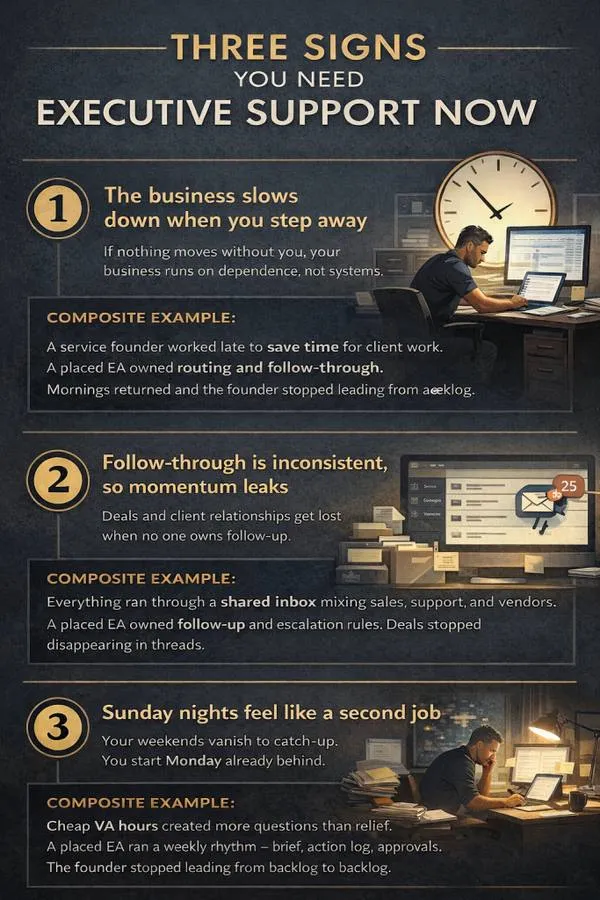
The Solo Operations Checklist
- I spend more than 10 hours a week on email, scheduling or admin.
- Leads or clients sometimes wait more than 24 hours for a reply.
- My CRM is out of date, or I don't use one.
- The business stalls when I take a day off.
- I work most weekends to catch up on admin.
- I have delayed a strategic project for more than three months.
- Invoices go out late, or I chase payments myself.
- My hourly value is at least five times what an EA costs per hour.
0 to 2 pointsYou can manage for now. Document your processes so you're ready later.
3 to 5 pointsYou are paying the admin tax. Start planning a hire in the next quarter.
6 to 8 pointsYou have outgrown solo operations. Every month of delay costs you thousands.
For a closer look at the warning signs, read 5 signs you're ready to hire an executive assistant remotely.
The executive assistant ROI formula
Use this formula to find your break-even point:
Weeks to break even = Year-one EA cost ÷ (Owner hourly value × Admin hours handed off per week)
Take a founder who values their time at $150 an hour and hands off 12 hours a week. Their year-one EA cost is $16,997. The math gives $16,997 ÷ $1,800 = 9.4 weeks. After that, every recovered hour adds to profit.
Peter Drucker, The Effective Executive
"Until we can manage time, we can manage nothing else."
Fractional or full time, the right amount of support starts with an honest count of your hours.
Is Fractional Executive Support Enough for a Small Business?
Fractional executive support works for owners with 10 to 20 hours of steady admin a week. Owners with more admin, or with admin spread across the whole day, usually need a full-time EA.
| Support model | Typical hours | Best for | Main limit |
|---|---|---|---|
| Virtual assistant (task-based) | 5 to 20 a week | Simple, repeat tasks | Needs constant direction |
| Fractional executive assistant | 10 to 20 a week | Owners with a narrow admin load | Limited availability for urgent work |
| Full-time remote executive assistant | 40 a week | Owners who need daily ownership of inbox, calendar and follow-up | Higher monthly cost |
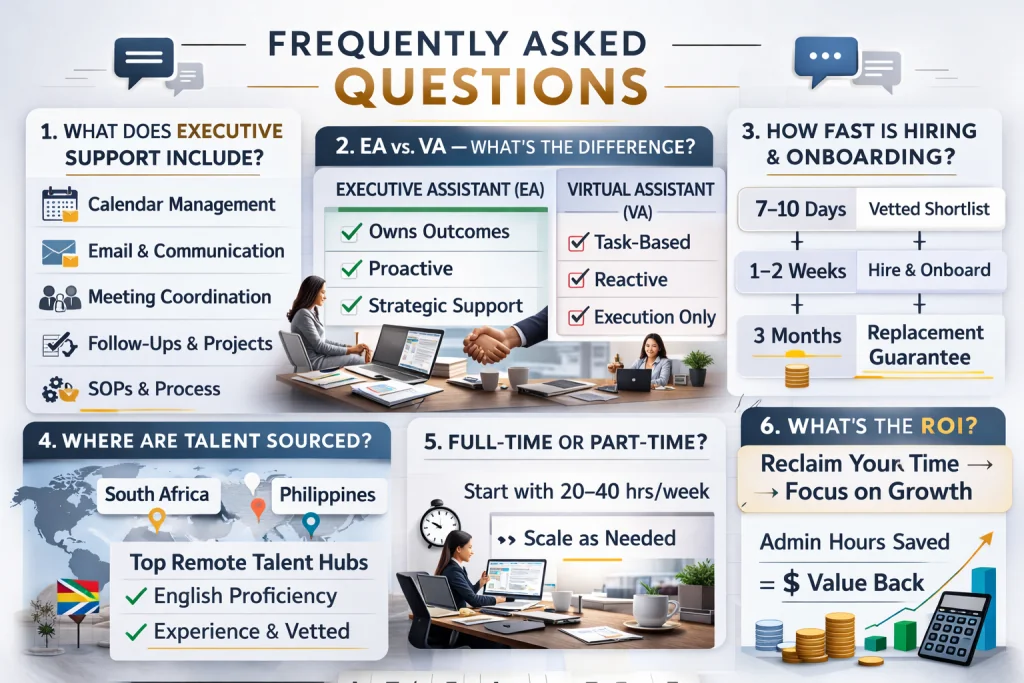
Most Exec Assistants clients hire full time, because a full-time EA can own entire workflows. We discuss part-time needs on the discovery call. For a full comparison, read our guide to the fractional executive assistant model.
US Bureau of Labor Statistics, May 2025
The median US executive assistant earns $76,590 a year.
A mid-level remote EA from the Philippines costs about $15,000 a year in salary. See the BLS data.
What Does Executive Support for a Small Business Cost in 2026?
A full-time remote executive assistant costs between $700 and $3,300 a month in salary, depending on country and seniority. That sits far below the US median.
The US Bureau of Labor Statistics puts the median wage for executive secretaries and executive administrative assistants at $76,590 a year (May 2025). That works out to about $36.80 an hour before benefits and payroll taxes.
| Seniority | Philippines | South Africa |
|---|---|---|
| Entry level | $700 to $1,000 | $730 to $1,330 |
| Mid level | $1,000 to $1,500 | $1,330 to $2,300 |
| Senior | $1,500 to $2,000+ | $2,300 to $3,300+ |
Year-one example (mid-level Philippine EA):
- Recruitment fee: $1,997, paid once
- Salary: $1,250 × 12 months = $15,000
- Year-one total: $16,997
Budget extra for payroll costs if you employ the EA through a local entity or an employer of record. See the full breakdown on our pricing page and in the salary and cost guide by country.
Exec Assistants
Get a vetted executive assistant shortlist in 7 to 10 days.
One $1,997 fee. You hire your EA directly and pay no monthly markup.
How Does Exec Assistants Place Executive Support for Small Businesses?
Exec Assistants places full-time remote executive assistants with small business owners through direct hire. We charge a $1,997 recruitment fee, once. You then pay your EA's salary directly, with no monthly markup.
Our process runs in four steps:
- Discovery call. We map your admin load, tools and time zone.
- Sourcing and vetting. We recruit from the Philippines and South Africa. Candidates complete skills tests and interviews.
- Shortlist. You receive a vetted shortlist within 7 to 10 days.
- Hire and onboard. You interview, choose and onboard your EA. A replacement guarantee covers the first three months.
Your EA works only for you. Institutional knowledge stays inside your business, and accountability stays clear. See our virtual executive assistant service for the full details.
Frequently Asked Questions About Executive Support for Small Business
What is executive support for a small business?
Executive support for a small business takes administrative and coordination work off the owner. It covers inbox triage, calendar management, meeting operations, CRM updates, travel and finance admin. An executive assistant usually provides it, either full time or part time.
How many hours a week do small business owners spend on admin?
Small business owners spend about 36% of their workweek on admin. In a Time etc survey of 251 US entrepreneurs, that equaled about 16.4 hours of a 45.5-hour week. Xero's 2026 guide cites the same 36% share.
What is the cost of not having an executive assistant?
The cost of not having an executive assistant equals your hourly value times your weekly admin hours times 48 weeks. A founder valued at $150 an hour with 12 hours of admin loses $86,400 a year. Missed deals and burnout add to that total.
Can a small business afford an executive assistant?
Most small businesses can afford a remote executive assistant. A mid-level Philippine EA costs about $1,250 a month. With the $1,997 recruitment fee, year one costs about $16,997. A US executive assistant earns a median of $76,590 a year.
How long does it take for an executive assistant to pay for itself?
An executive assistant usually pays for itself in 8 to 12 weeks. Divide the year-one cost by the value of the hours you hand off each week. At $150 an hour and 12 hours a week, a $16,997 EA breaks even in about 9.4 weeks.
What is the difference between a virtual assistant and an executive assistant?
A virtual assistant completes specific tasks you assign. An executive assistant owns whole workflows, such as your inbox, calendar and follow-up, and manages them proactively. Read our full comparison of virtual assistants and executive assistants.