
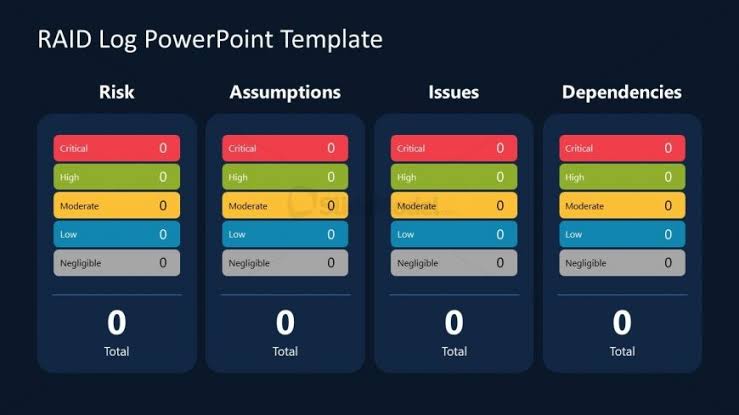
A RAID log template gives your project one place to track risks, assumptions, issues and dependencies. Each entry gets an owner, a rating, a response and a due date. The template below works in Excel, Google Sheets, Smartsheet or any project management tool.
| RAID item | Question it answers | Example |
|---|---|---|
| Risk | What could go wrong? | The vendor may deliver the software late |
| Assumption | What are we taking as true? | The client approves designs within 3 days |
| Issue | What has gone wrong? | The lead developer is out sick this week |
| Dependency | What must happen first? | Legal must sign the contract before kickoff |
Want someone to run your RAID log every week? A remote project coordinator from Exec Assistants maintains your RAID log, chases owners and flags threats to milestones.
What Is a RAID Log?
A RAID log is a project document that records four types of items: risks, assumptions, issues and dependencies. Project teams use it to spot trouble early and assign an owner to every open item.
The International Organization for Standardization (ISO) defines risk in ISO 31000:2018 as “the effect of uncertainty on objectives.” A RAID log turns that uncertainty into a visible list. Each line names the threat, rates it and assigns a response.
The Four Parts of a RAID Log
- Risks: Future events that may harm the project. A risk has a probability and an impact.
- Assumptions: Facts the plan treats as true without full proof. Every assumption carries hidden risk.
- Issues: Problems already affecting the project. An issue needs action now.
- Dependencies: Tasks, people or deliverables the project relies on. A late dependency delays the work that follows it.
Risk vs Issue
A risk sits in the future and may or may not happen. An issue is happening today. When a risk occurs, the team moves it from the risk list to the issue list and starts the response plan.
Why RAID Logs Matter
Projects rarely go to plan. Bent Flyvbjerg’s research, published in “How Big Things Get Done” (2023), drew on a database of about 16,000 projects. He found that only about 0.5% of projects, roughly 1 in 200, came in on budget, on time and delivered the promised benefits.
A RAID log gives the team an early warning system and a record of every decision. Teams that see trouble early have more time and more options to fix it.
Free RAID Log Template
Copy these columns into a spreadsheet or a project management tool. Use one sheet with a “Type” column, or four tabs, one per RAID category.
Core RAID Log Columns
| Column | What to enter |
|---|---|
| ID | A short code such as R-01, A-01, I-01 or D-01 |
| Type | Risk, assumption, issue or dependency |
| Description | One clear sentence describing the item |
| Date raised | The date the team logged the item |
| Raised by | The person who flagged it |
| Owner | The one person responsible for the next action |
| Probability | 1 to 5 (risks only) |
| Impact | 1 to 5 |
| Score | Probability multiplied by impact |
| Response | The action plan |
| Due date | When the next action is due |
| Status | Open, in progress, closed or escalated |
| Last updated | The date of the latest review |
Risk Section Template
| ID | Description | Owner | Probability | Impact | Score | Response | Status |
|---|---|---|---|---|---|---|---|
| R-01 | Software vendor may deliver the integration 2 weeks late | Project coordinator | 3 | 4 | 12 | Weekly vendor check-in, backup vendor shortlisted | Open |
| R-02 | Key designer may leave during the project | Design lead | 2 | 4 | 8 | Document design files in shared drive | Open |
Assumption Section Template
| ID | Assumption | Owner | Validate by | Status |
|---|---|---|---|---|
| A-01 | Client approves each design round within 3 business days | Account manager | Kickoff meeting | Open |
| A-02 | Current hosting plan handles launch traffic | IT lead | Load test, week 6 | Open |
Issue Section Template
| ID | Issue | Owner | Impact | Action | Due date | Status |
|---|---|---|---|---|---|---|
| I-01 | Lead developer out sick this week | Project manager | 4 | Move two tasks to a second developer | Friday | In progress |
Dependency Section Template
| ID | Dependency | Depends on | Owner | Needed by | Status |
|---|---|---|---|---|---|
| D-01 | Kickoff needs a signed contract | Legal team | Project coordinator | March 3 | Open |
| D-02 | Content migration needs final sitemap | SEO lead | Project coordinator | Week 4 | Open |
How to Score Risks in a RAID Log
Scoring tells the team which risks deserve attention first. Most teams use a probability-impact matrix.
The 5×5 Probability-Impact Matrix
Rate probability from 1 (rare) to 5 (almost certain). Rate impact from 1 (minor) to 5 (severe). Multiply the two to get a score from 1 to 25.
| Score | Rating | Action |
|---|---|---|
| 15 to 25 | High | Escalate to the project manager this week |
| 8 to 14 | Medium | Assign an owner and a response plan |
| 1 to 7 | Low | Monitor at the weekly review |
Risk Response Strategies
PMI’s PMBOK Guide describes standard responses to threats. Pick one for each risk.
- Avoid: Change the plan to remove the risk.
- Mitigate: Reduce the probability or the impact.
- Transfer: Shift the risk to a third party, such as an insurer or a vendor contract.
- Accept: Note the risk and plan a contingency.
- Escalate: Pass the risk to someone with more authority when it sits outside the project’s control.
How to Create a RAID Log in 6 Steps
Step 1: Pick Your Tool
Use Excel or Google Sheets for small projects. Use Smartsheet, Asana, Jira or Monday.com when your team already tracks work there. Our guide to project management tools compares the options.
Step 2: Set Up the Columns
Copy the core columns above. Add a filter on Type, Owner and Status so each person sees their own items.
Step 3: Run a RAID Workshop at Kickoff
Bring the core team together for 45 to 60 minutes. Ask four questions in turn: What could go wrong? What are we assuming? What is already wrong? What do we depend on?
Step 4: Assign One Owner per Item
Every line needs one named owner. Shared ownership slows action. The same rule sits at the heart of the RACI matrix, which gives each task exactly one accountable person.
Step 5: Review Every Week
Review the RAID log in the weekly status meeting. Update scores, close resolved items and add new ones. Our guide to meeting preparation shows how to build the review into the agenda.
Step 6: Report the Top Items
Add the top three risks and any open issues to the weekly status report. Rate each with red, amber or green (RAG) so leaders see the state at a glance.
How to Run a Weekly RAID Review
A short weekly review keeps the RAID log alive. Plan 15 minutes inside your regular status meeting.
Minutes 0 to 5: Review High Scores
Start with every item scored 15 or higher. Ask each owner for a one-line update and a next date.
Minutes 5 to 10: Check Issues and Dependencies
Confirm progress on open issues. Check every dependency due in the next two weeks, especially those on the critical path.
Minutes 10 to 15: Add, Close and Escalate
Add new risks raised during the week. Close resolved items. Escalate anything the team cannot solve to the project manager or sponsor.
After the meeting, the project coordinator updates the log, sends a short summary and adds the top items to the status report.
What Is RAID Analysis?
RAID analysis is the exercise of building the first RAID log, usually at project kickoff. The team works through each category in turn and rates every item.
Good RAID analysis surfaces hidden assumptions, such as client approval speed or vendor capacity. It also maps external dependencies that sit outside the team’s control. Repeat the analysis at each major phase gate, since new risks appear as the project moves forward.
Who Owns the RAID Log?
The project manager stays accountable for the RAID log. The project coordinator usually maintains it day to day.
The Project Manager’s Role
The project manager approves risk responses, decides on escalations and accepts or rejects changes to the plan.
The Project Coordinator’s Role
The project coordinator logs new items, chases owners for updates, updates scores and prepares the RAID summary for the weekly meeting. Our guide on project coordinator vs project manager explains this split in detail.
The Team’s Role
Every team member raises new risks and issues as soon as they spot them. A RAID log works best when raising a risk feels safe and normal.
Project Management Theory Behind the RAID Log
Three ideas explain why RAID logs work.
Risk and Uncertainty
Economist Frank Knight separated risk from uncertainty in 1921. Risk, in his view, has odds you can estimate. Uncertainty has odds nobody can know. A RAID log handles the first and makes the second visible, so the team can watch it.
The Planning Fallacy
Daniel Kahneman and Amos Tversky described the planning fallacy in 1979. People underestimate how long tasks take and how much they cost, even when past projects ran late. Logged assumptions force the team to test those optimistic beliefs early.
Dependencies and the Critical Path
The critical path is the longest chain of dependent tasks in a project. Morgan Walker of DuPont and James Kelley of Remington Rand developed the method in the late 1950s. Any late dependency on the critical path delays the end date, so dependency tracking protects the schedule.
RAID Log Variations
Teams adapt the RAID log to fit their needs.
RAIDD Log
A RAIDD log adds a fifth category: decisions. Each decision records who made it, when and why. This version suits projects with many stakeholders and frequent scope debates.
RAID Log With Actions
Some teams replace assumptions with actions, creating a “risks, actions, issues, decisions” log. This version suits fast operational projects with few planning assumptions.
Separate Risk Register
Large organizations often keep a formal risk register apart from the issue log. A project management office (PMO) may require this format for audit and governance.
Different Views on RAID Logs
Practitioners disagree on how much process a RAID log needs.
The Formal Governance View
Large programs and regulated industries use detailed RAID logs with scoring, sign-offs and audit trails. This view protects the organization and supports compliance.
The Lightweight Agile View
Many Agile teams skip a separate RAID log. They track impediments on the Scrum or Kanban board and discuss them in daily standups. Supporters say this keeps action fast and visible.
The Practical Middle View
Most small and mid-size teams keep a single-sheet RAID log with an owner, a score and a due date, reviewed weekly. This view balances visibility with low admin time. It is the approach most Exec Assistants clients use.
Common RAID Log Mistakes
- No owner: Items without an owner never close.
- Never updated: A RAID log reviewed once at kickoff becomes a museum piece.
- Vague descriptions: “Delays possible” helps nobody. Write who, what and when.
- Too many items: A 200-line log hides the 5 that matter. Close and archive resolved items.
- No link to the status report: Leaders only act on risks they see.
RAID Log Examples by Project Type
Website Launch RAID Log
- Risk: Content arrives late from three departments.
- Assumption: The current hosting plan handles launch traffic.
- Issue: The staging site is down.
- Dependency: SEO redirects need the final sitemap.
Office Move RAID Log
- Risk: Internet installation runs late.
- Assumption: The landlord finishes the build-out on schedule.
- Issue: Two desks arrived damaged.
- Dependency: IT setup needs power and network access first.
Product Launch RAID Log
- Risk: App store review takes longer than planned.
- Assumption: Pricing stays fixed through launch.
- Issue: A critical bug appeared in final testing.
- Dependency: The marketing campaign needs the final release date.
Who Should Maintain Your RAID Log?
RAID logs save projects when someone updates them every week. For many founders and team leaders, that job lands on their own desk.
A dedicated project coordinator keeps the log current, chases owners and flags threats to milestones before they hit the schedule. See what to look for in our project coordinator job description, test candidates with our project coordinator interview questions, and check pay in our remote project coordinator salary guide.
Hand off the RAID log. Exec Assistants recruits vetted, full-time remote project coordinators from the Philippines and South Africa. Salaries start from $1,000 a month, plus a one-time $1,997 recruitment fee. See pricing or hire a project coordinator.
Frequently Asked Questions
What does RAID stand for in project management?
RAID stands for risks, assumptions, issues and dependencies. Some teams use decisions or actions in place of assumptions.
What is the difference between a RAID log and a risk register?
A risk register tracks risks only. A RAID log tracks risks, assumptions, issues and dependencies in one place.
How often should you update a RAID log?
Review it at least once a week, usually in the status meeting. Update it right away when a new risk or issue appears.
Who updates the RAID log?
The project coordinator usually maintains the RAID log. The project manager stays accountable for it and approves risk responses.
Which RAID log items need escalation?
Escalate any risk scored 15 or higher on the 5×5 matrix, any issue that threatens a milestone and any dependency outside the team’s control that runs late.
Can I keep a RAID log in Excel?
Yes. Excel and Google Sheets work well for small projects. Larger teams often use Smartsheet, Jira, Asana or Monday.com.
Get a Project Coordinator in 7 to 10 Days
Tell us about your projects, tools and hours. We send a shortlist of vetted coordinators from the Philippines and South Africa who already know how to run a RAID log, a status report and a weekly review.