
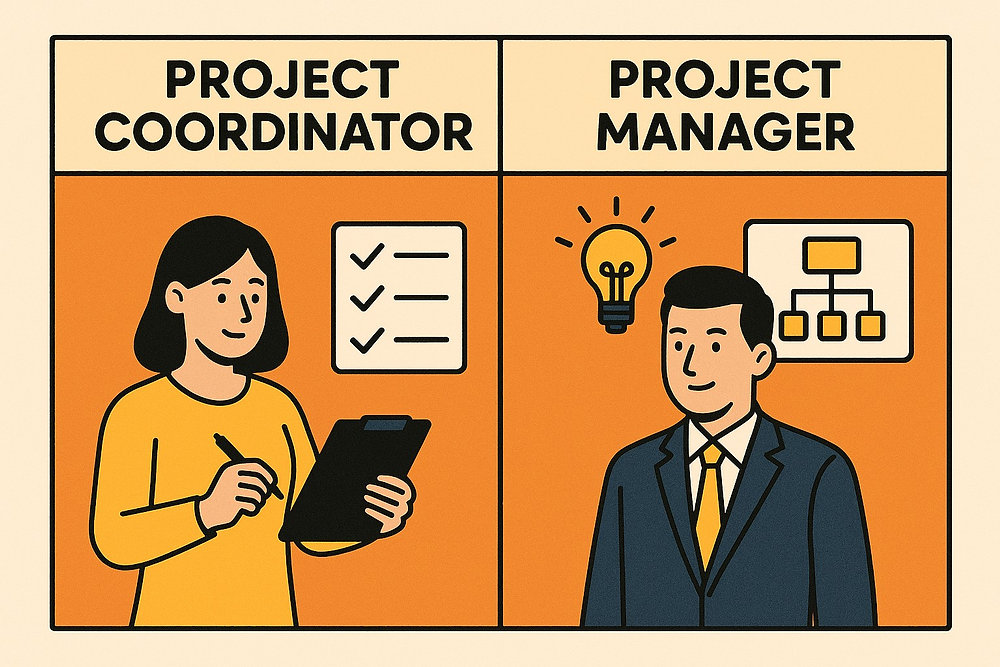
A project manager owns the outcome: scope, budget and the final call on trade-offs. A project coordinator runs the daily work that gets there: schedules, tasks, meetings and follow-ups. The table below shows every key difference at a glance.
| Factor | Project manager | Project coordinator |
|---|---|---|
| Main focus | Project outcome, scope, budget and risk | Schedule, tasks, meetings and documents |
| Decision rights | Approves changes, trade-offs and spend | Logs changes and routes them for approval |
| Reports to | The project sponsor | The project manager or PMO |
| Typical deliverables | Project charter, budget, risk strategy | Gantt timeline, RAID log, status report, minutes |
| Career stage | Mid to senior level | Entry to mid level |
| Common certification | PMP | CAPM |
| US pay benchmark | $100,750 median (BLS, May 2024) | About $62,350 average (Indeed, 2026) |
This guide serves two readers. Founders and managers will learn which role to hire first. Project professionals will see how each role pays, what it takes to qualify and how coordinators move up.
Already acting as your own project manager? A remote project coordinator can take the schedules, status reports and follow-ups off your desk.

Project Coordinator vs Project Manager: The Core Difference
The project manager decides. The project coordinator organizes and follows up. Authority, pay, and career stage all trace back to this split.
Authority is the right to make decisions. Accountability means answering for the result. The project manager holds both. The coordinator holds responsibility for execution and reports to the project manager.
What Does a Project Manager Do?
A project manager leads a project from start to finish. The Project Management Institute (PMI) defines a project as a temporary effort that creates a unique product, service or result. The project manager makes sure that effort delivers business value.
Project Manager Responsibilities Across the Project Life Cycle
The project life cycle has five stages. The project manager owns each one.
- Initiating: Writes the project charter with the sponsor, covering goals, scope, budget and success measures.
- Planning: Approves the project plan, budget and risk strategy.
- Executing: Assigns work and removes blockers.
- Monitoring and controlling: Reviews progress, approves change requests and decides on trade-offs.
- Closing: Confirms delivery with the sponsor and signs off the project.
Project Manager Authority in Practice
The project manager can shift budget between workstreams. The project manager can move a deadline after talking to the sponsor or cut a feature to protect a launch date. When a project fails, the sponsor asks the project manager why.
PMI’s 2025 Pulse of the Profession report, “Boosting Business Acumen,” found that only 18% of project professionals show high business acumen. PMI links strong business acumen to better results on goals, budget and schedule. Business judgment is the skill that makes a project manager worth the salary.

What Does a Project Coordinator Do?
A project coordinator keeps the project moving day to day. The coordinator turns the manager’s plan into tracked tasks, booked meetings and current documents. Some teams call the role a project administrator or project assistant.
Daily Project Coordinator Tasks
- Board checks: Reviews Asana, Jira, Monday.com or ClickUp for overdue tasks.
- Follow-ups: Messages task owners before deadlines pass.
- Timeline updates: Adjusts dates when a dependency moves.
- Risk logging: Adds new risks and issues to the RAID log.
Weekly Project Coordinator Tasks
- Status meeting: Schedules it, sends the agenda 24 hours ahead and runs it.
- Minutes: Records decisions, owners and due dates, then sends action items within 24 hours.
- Status report: Drafts the weekly report for the project manager and sponsor.
Project Coordinator Deliverables
- Work breakdown structure (WBS): Splits the project into smaller work packages.
- Gantt chart: Shows every task on a timeline. Henry Gantt developed the format in the 1910s.
- RAID log: Tracks risks, assumptions, issues and dependencies, and flags threats to milestones.
- RAG status report: Rates scope, schedule and budget as red, amber or green.
- Meeting minutes: Gives every attendee the same record of decisions and next steps.
Key Differences Between a Project Coordinator and a Project Manager
The two roles share tools and meetings. Five factors separate them.
Decision Rights: Who Approves a Change Request
A client asks to add a landing page to a website project. The coordinator logs the request, estimates the extra hours and updates the RAID log. The project manager weighs the cost, talks to the client and approves or declines. The coordinator then updates the plan and tells the team.
Scope, Budget and Risk Ownership
The project manager sets the budget and decides the risk response. The coordinator logs spend, chases vendor invoices and keeps the risk register current. Overruns reach the project manager early because the coordinator flags them every week.
Stakeholder Management and Communication
The project manager manages expectations with sponsors, executives, clients and steering committees. The coordinator manages communication with agendas, minutes, updates and reminders.
Communication load grows fast. Fred Brooks showed in “The Mythical Man-Month” (1975) that a team of n people has n(n-1)/2 communication channels. A 10-person project has 45 channels. A 20-person project has 190. The coordinator keeps those channels organized, so the project manager can focus on the conversations that need a decision.
Planning Horizon
The project manager plans across the whole project: launch quarters, phase budgets and resourcing. The coordinator plans across days and weeks: who owes what by Friday and which task blocks the next review.
Project Coordinator vs Project Manager Skills
| Skill area | Project manager | Project coordinator |
|---|---|---|
| Core strength | Leadership, negotiation, business judgment | Organization, follow-up, documentation |
| Planning | Sets milestones and the critical path | Maintains the timeline and dependencies |
| Communication | Persuades sponsors and resolves conflict | Writes clear updates, agendas and minutes |
| Tools | Reviews dashboards and reports | Builds boards, templates and automations |
Both roles work in Asana, Jira, Monday.com, Smartsheet, Microsoft Project, Confluence and Slack. Our guide to project management tools compares the main options.

Project Coordinator vs Project Manager Salary in 2026
Pay follows accountability. Project managers earn more because they own the decisions and the result.
Project Manager Salary in the US
The US Bureau of Labor Statistics (BLS) groups project managers under “project management specialists.” The median annual wage is $100,750 (May 2024 data). The lowest 10% earned under $59,830, and the top 10% earned over $165,790.
BLS projects 6% employment growth from 2024 to 2034, with about 78,200 openings each year.
Project Coordinator Salary in the US
Indeed reports an average project coordinator salary of about $62,350 in the United States in 2026. The figure draws on roughly 6,600 salaries from job postings. The typical range runs from about $43,000 to $90,000.
Remote Project Coordinator Salary by Country
Many US firms hire a full-time remote coordinator from the Philippines or South Africa. These coordinators work US business hours or an agreed overlap window.
| Level | Philippines | South Africa |
|---|---|---|
| Mid-level | $1,000 to $1,500 a month | $1,330 to $2,300 a month |
| Senior | $1,500 to $2,000+ a month | $2,300 to $3,300+ a month |
Project admin taking over your week? Exec Assistants recruits vetted, full-time remote project coordinators from the Philippines and South Africa. You pay your coordinator’s monthly salary directly, from $1,000 a month, plus a one-time $1,997 recruitment fee. See pricing or explore the service.
Key Project Management Concepts Behind Each Role
Four concepts explain why projects need both a decision-maker and an organizer.
The Triple Constraint
The triple constraint links scope, time and cost. Add scope, and the project needs more time or more money. The project manager decides which side moves. The coordinator measures all three every week.
The RACI Matrix
RACI stands for responsible, accountable, consulted and informed. Each task gets exactly one accountable person. The project manager is usually accountable for major deliverables. The coordinator is often responsible for status reports, meeting logistics and document control. Our article on the CEO delegation matrix applies the same ownership logic to executive work.
The Critical Path Method
The critical path is the longest chain of dependent tasks. Any delay on it delays the whole project. DuPont and Remington Rand developed the method in the late 1950s. The project manager defines the critical path. The coordinator watches it daily and raises an alert when a critical task slips.
Parkinson’s Law
C. Northcote Parkinson wrote in 1955 that work expands to fill the time available. Loose deadlines invite slow progress. The coordinator counters this with firm due dates, early reminders and visible task boards.
PMI’s PMBOK Guide Eighth Edition, published in November 2025, frames project work around six principles and seven performance domains. The project manager answers for every domain. The coordinator carries much of the routine schedule, communication and documentation work inside them.

Different Views: Does Every Project Need Both Roles?
Practitioners split on this question. Three views come up most often.
The Agile and Scrum View
The Scrum Guide (2020) defines three accountabilities: Developers, a Product Owner and a Scrum Master. It names no project manager or coordinator. Many Agile teams still add a coordinator to prepare sprint planning, update the board and track velocity.
The Small Business View
Small firms rarely hire a full-time project manager. The founder or a department head plays that role. That leader still needs someone to run the schedule, meetings and follow-ups.
A coordinator fills that gap at a fraction of a project manager’s cost. This is the most common setup we see among the founders and agency owners we work with.
The Enterprise PMO View
Large organizations run a project management office (PMO) that sets standards, templates and reporting rules. Coordinators often sit in the PMO and support several project managers at once.
Demand keeps rising across all three models. PMI’s 2025 Global Project Management Talent Gap report projects a shortfall of up to 29.8 million project professionals by 2035.
When to Hire a Project Coordinator or a Project Manager
Hire for the gap that slows your projects most.
Signs You Need a Project Manager
- No clear owner: Nobody answers for the outcome of your biggest projects.
- Constant trade-offs: Scope, budget and deadlines conflict every week.
- High stakes: Large budgets, legal exposure or many outside parties.
- Sponsor demands: Leadership wants one person accountable for results.
Signs You Need a Project Coordinator
- You already lead the project: You or a team leader act as project manager.
- Deadlines slip: Nobody chases open tasks.
- Reporting eats your week: Status updates take hours.
- Meetings drift: Calls end without owners and due dates.
- Many projects at once: You run three or more active projects.
If most of the second list fits, a coordinator is the faster and cheaper fix. A remote project coordinator can start inside your existing tools within weeks.
Project Coordinator vs Project Manager Examples
Example 1: A Marketing Agency With 12 Client Projects
The agency owner acts as project manager, sets scope with each client and approves budgets. A coordinator updates every project board, books client calls and sends weekly status reports. The owner reviews one dashboard on Mondays and makes decisions in a 30-minute block. See how this works for agency owners.
Example 2: A Startup Product Launch
The head of product acts as project manager and owns a 10-week launch date. The coordinator builds the WBS, maps dependencies across engineering, marketing and sales, and runs the weekly launch meeting. When the pricing page slips, the coordinator flags it on the critical path, and the head of product moves resources to protect the date.
Example 3: An Office Move
A 60-person company moves offices. The COO acts as project manager and owns the budget and lease. The coordinator manages movers, IT setup and furniture delivery, and logs risks such as a late internet installation.
Project Coordinator vs Project Manager Certifications and Career Path
CAPM for Project Coordinators
The Certified Associate in Project Management (CAPM) is PMI’s entry-level credential. It requires no prior project experience. It proves a coordinator knows the core terms, processes and frameworks.
PMP for Project Managers
The Project Management Professional (PMP) is PMI’s senior credential. A candidate with a four-year degree needs 36 months of experience leading projects, plus 35 hours of project management education or an active CAPM.
From December 1, 2026, those education hours must come from a PMI Authorized Training Partner or another approved provider.
Career Path From Coordinator to Manager
Coordination is a common entry point into project management. A typical path runs from project coordinator to associate project manager or project analyst, then to project manager. Each step adds decision rights. Coordinators who build business acumen tend to move up faster, in line with PMI’s 2025 findings.

How a Remote Project Coordinator Supports a Project Manager
The project manager keeps the decisions. The coordinator takes the follow-up work.
| Task | Owner |
|---|---|
| Project goals, scope and budget approval | Project manager |
| Project plan, timeline and RACI matrix | Coordinator drafts, project manager approves |
| Task follow-ups and deadline reminders | Coordinator |
| Weekly status report | Coordinator drafts, project manager reviews |
| Meeting agendas and minutes | Coordinator |
| Change request approval | Project manager |
Exec Assistants has helped 1,000+ businesses hire remote support since 2014. Our project coordination assistants work full time inside your existing tools. For the meeting side of the role, see our guide to meeting preparation. For day-to-day management, see our guide to managing a remote executive assistant.
Frequently Asked Questions
Is a project coordinator the same as a project manager?
They are two separate roles. A project manager owns the project outcome, scope and budget. A project coordinator supports the project manager with schedules, tasks, meetings and documents.
Which role ranks higher, project coordinator or project manager?
The project manager ranks higher. The coordinator usually reports to the project manager or to a PMO.
Can a project coordinator become a project manager?
Yes. Many project managers start as coordinators. The CAPM credential and 36 months of project leadership experience prepare a coordinator for the PMP.
Do small businesses need a project coordinator?
Many do. Founders and team leaders often act as their own project manager. A coordinator handles the follow-up work that fills their week.
How much does a project coordinator cost compared to a project manager?
In the US, project coordinators average about $62,350 a year (Indeed, 2026). Project management specialists earn a median of $100,750 (BLS, May 2024). A remote coordinator from the Philippines earns $1,000 to $2,000+ a month. See our pricing for the full breakdown.
Get Your Project Coordinator in 7 to 10 Days
Tell us about your projects, your team and your tools. We send a shortlist of vetted coordinators from the Philippines and South Africa who fit your workflow and your hours.