
In 2014, Stanford economist John Pencavel published a study through the IZA Institute of Labor Economics analyzing archival data from World War I British munitions factories. The research, titled “The Productivity of Working Hours,” demonstrated that output per hour worked falls sharply above 49 hours per week and approaches zero around 55 hours. Workers logging 70-hour weeks produced no more measurable output than those working 55-hour weeks: the additional hours generated exhaustion, not results.
The munitions workers had quotas and physical output that could be counted precisely. Modern executives have P&L statements, organizational health, strategic decisions, and relationships whose quality is harder to quantify but even more sensitive to cognitive degradation. If factory output per hour drops to near zero past 55 hours, the quality of a CEO’s strategic thinking on hour 61 of a given week degrades in proportion. Most organizations never measure this because the deterioration is invisible until it shows up as a bad hire, a missed negotiation, or a strategic direction the leadership team later cannot explain.
This matters to executives in every sector. In Alabama’s industrial corridors specifically, where executives in Birmingham’s financial services hub, Huntsville’s defense technology economy, and Mobile’s port complex manage organizations of extraordinary complexity alongside active civic obligations to programs including Leadership Alabama and the Business Council of Alabama, the hours problem is not abstract. These leaders are already running at or above the threshold where Pencavel’s research shows additional hours stop producing additional value. The systems that protect their peak cognitive time are not conveniences. They are a competitive infrastructure.
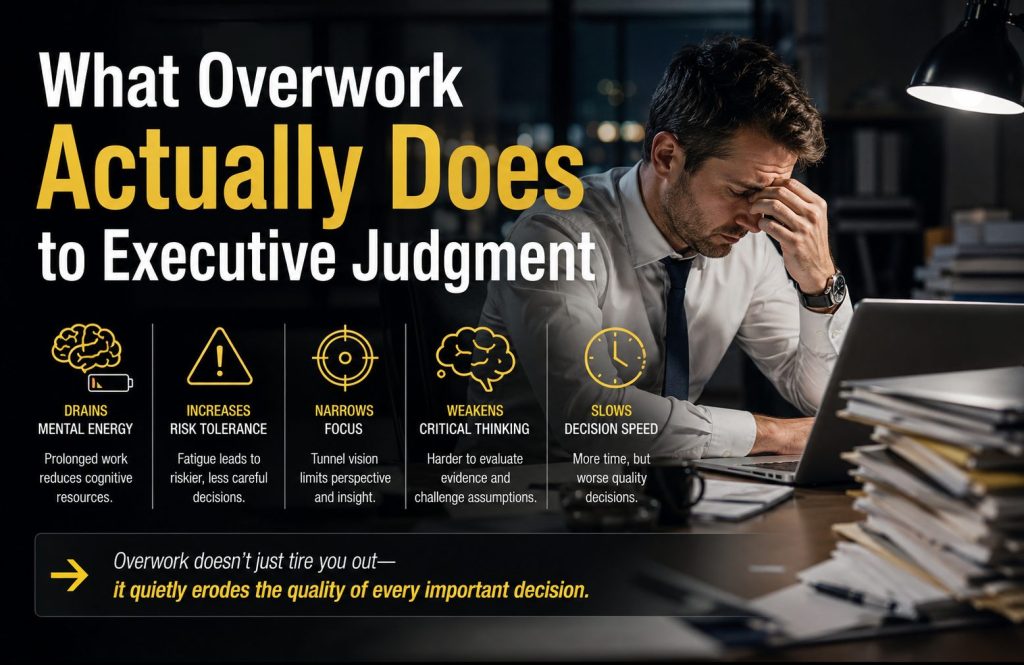
What Overwork Actually Does to Executive Judgment
The mechanism behind the productivity cliff is well-established across several decades of research. Roy Baumeister developed what he calls ego depletion through peer-reviewed experiments at Case Western Reserve University and Florida State University, demonstrating that self-regulation, deliberate decision-making, and disciplined reasoning all draw on a shared cognitive resource that depletes with use and requires recovery to restore.
It is worth noting that Baumeister’s ego depletion model has faced significant replication challenges in the years since its original publication. A 2016 multilab study by Martin Hagger and colleagues, published in Perspectives on Psychological Science, raised substantial questions about whether the specific mechanism Baumeister proposed holds up under rigorous experimental conditions. However, the operational finding remains consistent across independent research streams: sequential decision-making degrades performance quality over time, regardless of the precise neurological mechanism. The effect is real, even if its architecture is still being debated.
The most vivid evidence for this phenomenon in a high-stakes professional context comes from a 2011 study published in the Proceedings of the National Academy of Sciences. Researchers Shai Danziger, Jonathan Levav, and Liora Avnaim-Pesso analyzed 1,112 parole board rulings made by Israeli judges across a single day, producing one of the cleanest demonstrations of decision fatigue in the published literature. At the start of each session, judges approved parole in approximately 65% of cases. Approval rates fell steadily throughout the session, reaching near zero just before a scheduled break. After the break, the rate reset to 65 percent and began declining again.
Decision fatigue, as this pattern is now identified in cognitive science and organizational research, does not reduce a professional’s expertise or knowledge. It changes the quality of the cognitive process they apply to that expertise. Depleted judges defaulted to the lowest-effort outcome: deny the application, maintain the status quo, avoid the effortful reasoning that a grant of parole required. The same mechanism operates in boardrooms, contract negotiations, hiring decisions, and strategic reviews conducted by executives who have already processed hundreds of small decisions before the consequential one arrives.
McKinsey’s 2023 research on organizational productivity found that senior leaders spend up to 41 percent of their working hours on administrative tasks that could be delegated. These tasks are not high-stakes. They are email threads, scheduling disputes, approval chains, and status requests whose individual cognitive cost is modest but whose cumulative drain on executive decision quality is significant. An executive who processes their inbox for two hours before reaching their first strategic decision has already spent a measurable portion of their daily cognitive capacity on work; a well-configured virtual assistant or executive assistant should own it entirely.
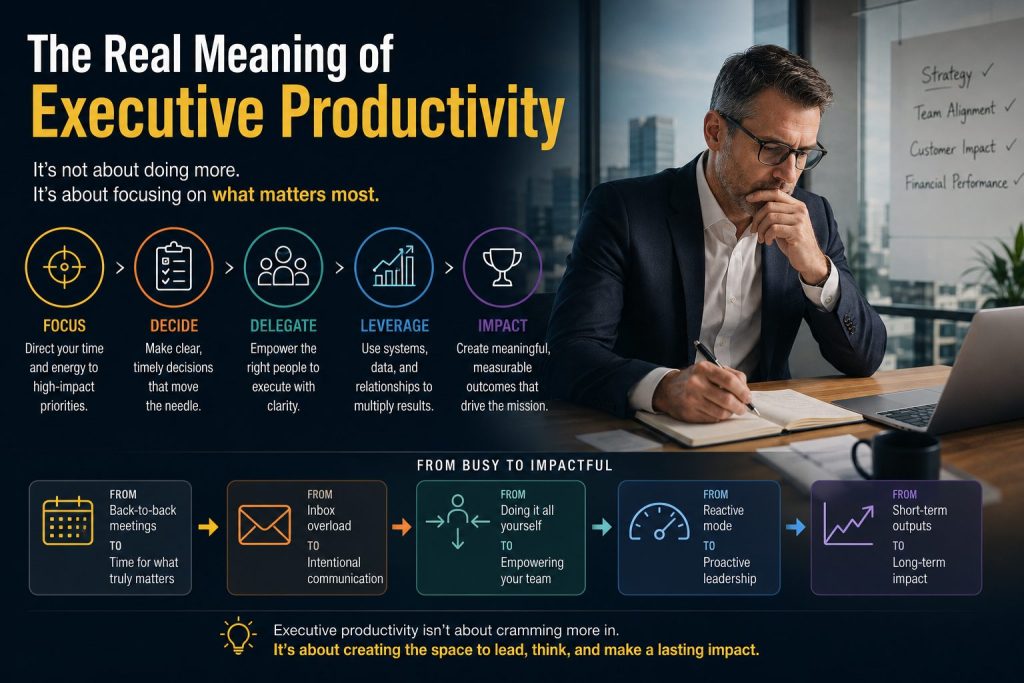
The Real Meaning of Executive Productivity
True executive productivity hinges on the strategic leverage of a leader’s decisions, not their volume. This distinction produces entirely different calendars when executives take it seriously.
Greg McKeown, whose 2014 book Essentialism drew on consulting work with organizations including Apple, Google, and the United Nations, frames the core question as a shift from “How can I accomplish more?” to “What is the highest-value contribution only I can make?” The first question fills every available hour. The second protects most of them.
McKinsey’s 2012 analysis of knowledge worker time use found that employees spend an average of 28% of their working week on email alone. For executives, that figure frequently runs higher because the executive’s inbox functions as an organizational escalation point. Every unresolved issue below the executive’s level eventually surfaces in their inbox when the reporting structure lacks the authority or the systems to resolve it without escalation. An inbox the CEO handles personally signals an organizational design failure, not a time management failure.
The executive who measures productivity in emails processed and meetings attended confuses activity with impact. The executive who measures productivity in strategic decisions made, relationships advanced, and organizational capability built treats their cognitive capacity as the finite and valuable resource it is.

Energy Architecture: Why the Calendar Should Follow Biology
The body does not maintain constant cognitive readiness across 12 hours of work. Nathaniel Kleitman, whose foundational research at the University of Chicago established modern sleep science, identified what he called the Basic Rest-Activity Cycle: a roughly 90-minute rhythm of alertness and relative fatigue that continues throughout waking hours, not only during sleep. Peretz Lavie at the Technion Israel Institute of Technology confirmed these rhythms affect cognitive performance across the working day in independent research.
Peak alertness for most adults occurs in the first 90 to 120 minutes after full waking, with a secondary peak in the late morning, a dip in the early afternoon, and a partial recovery in the mid-afternoon. These are not preferences or habits. They are physiological patterns that remain consistent across populations in multiple peer-reviewed studies.
Shopify CEO Tobi Lütke reserves mornings entirely for deep, generative work with no meetings and no email. His calendar is not flexible on this point because flexibility is precisely what erodes the protection. Jeff Weiner, who led LinkedIn from a 400-person company to the organization Microsoft acquired for $26.2 billion in 2016, has written publicly about scheduling blank buffer blocks between meetings specifically to allow recovery and preparation. Weiner calls those blocks the difference between reactive leadership and intentional leadership.
A calendar built around availability optimizes for other people’s needs at the expense of the executive’s cognitive performance. Building the calendar around energy cycles first, then scheduling meetings and decisions into appropriate windows, produces more high-quality output in fewer hours than any volume of willpower can extract from an overfull schedule.
The Shallow Work Tax That Most Executives Never Calculate
Cal Newport’s 2016 book Deep Work distinguished between two categories of professional activity that most organizations never separate. Shallow work consists of tasks that are low-cognitive-cost, easily replicated, and important enough to require someone’s attention but not important enough to require the executive’s. Deep work consists of tasks requiring sustained, uninterrupted cognitive effort that produce outcomes difficult to replicate: strategic analysis, complex negotiation, relationship investment, and creative problem-solving.
Shallow work expands to fill available time and crowds out deep work, not because executives choose it but because it is always present, always urgent-feeling, and immediately rewarding in a way that deep work is not. Completing an email produces satisfaction. Working on a strategic initiative for two hours without a clear resolution produces discomfort, even when it generates far more organizational value.
Gloria Mark at the University of California, Irvine, has studied workplace interruptions for over two decades. Her research, published across multiple peer-reviewed formats including work presented at the ACM CHI conference, found that workers take an average of 23 minutes and 15 seconds to return to a task at full cognitive engagement after an interruption. In an environment where executives receive dozens of notifications, messages, and inbound requests per hour, the compounding cost to deep work capacity is enormous and almost never calculated.
The executive who protects 90-minute uninterrupted morning blocks does not simply recover 90 minutes. They recover the cognitive environment that makes those 90 minutes productive, which is a categorically more valuable outcome than the time saved alone. A virtual assistant who owns the inbox during those blocks, applying a documented triage framework to route and respond without executive input, creates that environment systematically rather than requiring the executive to defend it personally each morning.
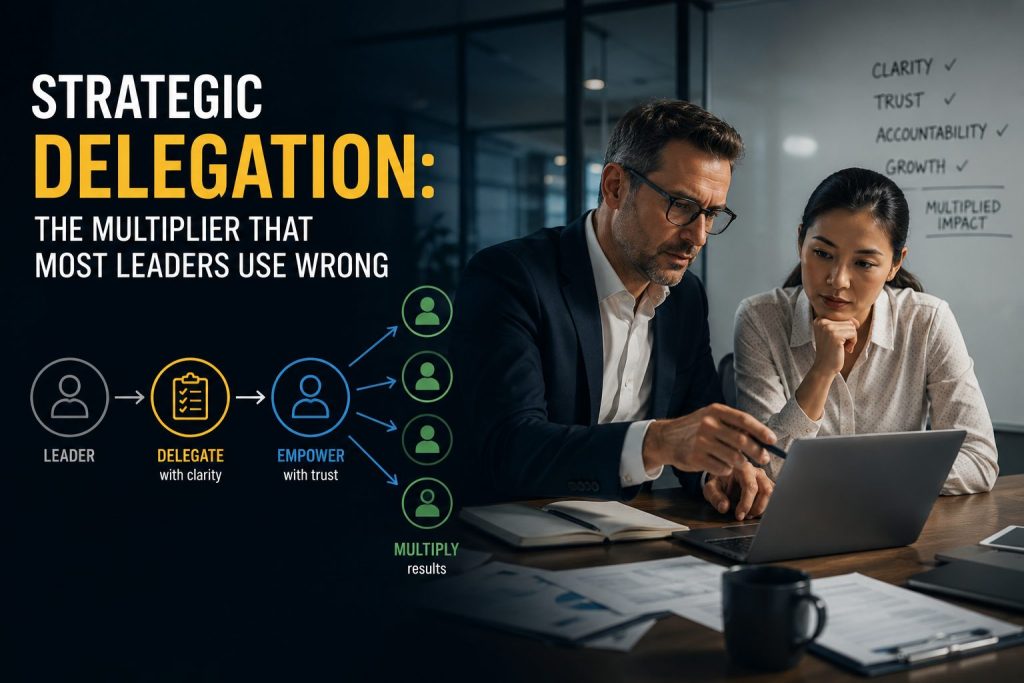
Strategic Delegation: The Multiplier That Most Leaders Use Wrong
Most executives delegate reactively, handing off tasks when they run out of time rather than when they identify a better-suited person or a more leveraged use of their own attention. This produces delegation that relieves pressure without building capacity.
Gallup’s CEO Talent report identified delegation as one of five core talents separating high-performing CEOs from average ones. CEOs scoring in the top third of Gallup’s delegation assessment achieved 33 percent higher revenue growth than those in the bottom third. The revenue differential was not driven by the hours freed up. It was driven by what those hours produced when the CEO concentrated them on Zone 1 work- the decisions and relationships that only they can handle- rather than on administrative task processing.
Strategic delegation assigns responsibility, not just tasks. The reactive version says “send this proposal.” The strategic version says, “own this client relationship for the next quarter and tell me what support you need.” The first creates a transaction. The second creates a leader. Organizations that delegate the second way build bench strength and free executive attention simultaneously.
This principle applies at the regional scale as acutely as at the global one. Alabama executives managing defense contract portfolios in Huntsville, financial services operations in Birmingham, or port logistics in Mobile face the same delegation deficit that limits performance at any scale. An executive at a 200-person manufacturing operation in Lincoln, Alabama, carries the same cognitive load pattern Pencavel identified in the archival data: hours past 55 stop producing better decisions. The civic obligations these leaders carry through Leadership Alabama, ALI Leadership, and Business Council of Alabama engagement add a layer of demand that makes strategic delegation not optional but structurally necessary for sustained performance.
Jeff Bezos built Amazon’s single-page memo format, the two-pizza team rule, and his shareholder letter practice around a single operational insight: the quality of organizational decision-making at scale depends on systems that produce good decisions without requiring him to be present for each one. His documented commitment to 8 hours of sleep per night connects directly to the same framework: protecting the conditions that make his few daily decisions excellent, rather than trading sleep for marginal additional output volume.
The Recovery Science That Separates Sustainable Leaders
Bill Gates takes two Think Weeks per year, periods of complete organizational disconnection during which he reads research papers, reflects on strategic direction, and thinks without real-time pressure. The practice is not a vacation. It is a deliberate recovery mechanism that Gates has credited publicly with some of Microsoft’s most consequential strategic decisions.
The neuroscience supporting this runs through research on the brain’s default mode network, identified by Marcus Raichle at Washington University in St. Louis in the early 2000s, in peer-reviewed research. Raichle demonstrated that the brain’s resting state is metabolically active and cognitively productive in ways that were not recognized when work was assumed to produce value and rest was assumed to waste it. The default mode network activates during quiet and rest, consolidates learning, generates creative connections, and resolves problems that resist direct analytical attack.
Hans Van Dongen at the Penn Sleep Center published research in the journal Sleep in 2003 demonstrating that adults sleeping six hours per night across two weeks showed cognitive impairment equivalent to 24 hours of total sleep deprivation, while consistently underestimating their own impairment. The executives most affected by sleep restriction are also the least likely to recognize it, because the metacognitive capacity required to assess one’s own performance degrades alongside the performance itself.
Arianna Huffington’s 2016 book The Sleep Revolution synthesized this research across dozens of peer-reviewed studies. The consistent finding: cognitive impairment from inadequate sleep appears in working memory, emotional regulation, and judgment under uncertainty at restriction levels most executives would consider manageable.
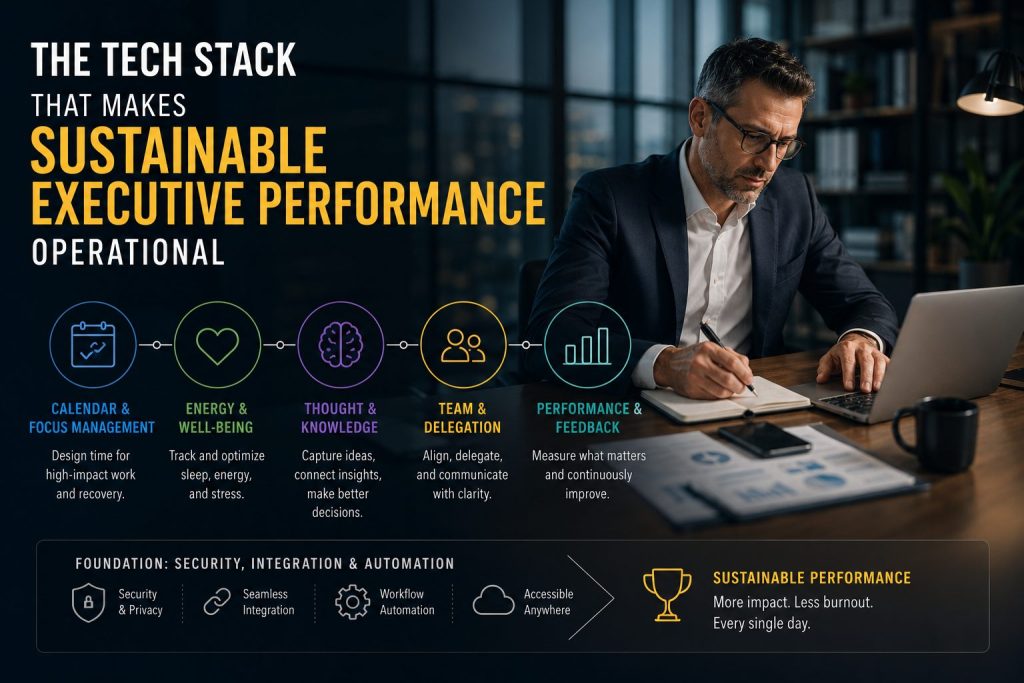
The Tech Stack That Makes Sustainable Executive Performance Operational
The principles above describe what the highest-performing executives do differently. The mechanics of sustaining these practices at scale depend on specific tools and support structures that protect the executive’s cognitive environment from the constant pressure that would otherwise erode it.
The following tools form the operational core of an executive productivity system built around the research principles this article covers:
Tool Function Productivity Lever
Notion SOP library, decision logs, and briefing templates. Remove information retrieval from executive time.
Reclaim.ai / Motion Deep works on block protection, defensive scheduling, and enforces energy-aligned calendar architecture.
Superhuman / Missive: Split-inbox triage, VA-managed response queue, eliminates inbox from executive morning hours.
Slack EA-curated channel structure, notification controls, and reduces shallow work interruptions.
ClickUp / Asana Zone 3 delegation tracking and dependency mapping keep project status out of executive attention.
Loom Weekly VA briefings replacing status meetings. Converts synchronous meetings to async review
Zapier / Make Zone 4 workflow automation, webhook triggers, eliminates manual data tasks from all human attention.
The human layer governing this system, whether an executive assistant or a virtual assistant operating a documented SOP framework, is the difference between a productivity philosophy and a functioning operational infrastructure. The EA who owns the inbox during deep work blocks, manages the calendar against the energy architecture, and prepares briefing documents before every strategic engagement creates the environmental conditions the cognitive science requires, week after week, without the executive having to defend those conditions personally.
For the specific onboarding process, task categorization frameworks, and technology configuration that allow Alabama executives to implement this system across the complexity of their operating environments, the operational case study How Alabama Executives Reclaim 15+ Hours Weekly With a VA documents the exact frameworks, tool configurations, and 30-day onboarding sequence that produce measurable time recovery.
What Changes When Executives Apply This
Pencavel’s archival data established the ceiling. Danziger’s parole board research established the mechanism. Baumeister’s decades of work established the cognitive model. Gloria Mark’s interruption research established the recovery cost. Gallup’s CEO data established the revenue outcome. Every line of research points in the same direction: the executive who protects peak cognitive hours, recovers deliberately, delegates strategically, and builds systems that route administrative decisions away from their direct attention outperforms the executive who substitutes additional hours for operational architecture.
Working less is not a concession to limitation. In the context of what the evidence shows about hours, judgment quality, and organizational performance across time, protecting cognitive capacity is the most strategically defensible investment a leader can make.
The hours past 55 cost more than they produce. The executives who have figured that out are not working less because they lack ambition. They are working within the limits the research defines because they intend to lead well for a long time.