

Between July 2025 and January 2026, AI tools helped 38.5% of candidates cheat in 19,368 live interviews, according to The Interview Guys’ State of Hiring Fraud 2026 report. The rate tripled in three months.
That number changes how you should outsource an executive assistant (EA). A polished CV and one video call no longer prove much. And the hire is only the first risk. Most outsourced EA arrangements fail after the hire, through vague roles, rushed onboarding, and careless password sharing.
This guide covers the nine mistakes we see most often and the fix for each one.

What Are the Most Common Mistakes When Outsourcing an Executive Assistant?
Quick answer: The nine most common mistakes are weak vetting, a vague job description, no onboarding plan, unsafe password sharing, the wrong communication rhythm, no KPIs, choosing on hourly rate alone, ignoring warning signs and delegating without follow-up. Here’s what each one costs and how to fix it:
| Mistake | What it costs you | The fix |
|---|---|---|
| One-call vetting | A fake or AI-coached hire | Live scenario test plus reference calls |
| “Manage my inbox” job description | Constant questions and slow decisions | A RACI chart with spending limits |
| No onboarding plan | An EA who quits or stalls by day 90 | A written 30/60/90-day plan |
| Passwords sent over Slack or email | A data breach | A password manager and least-privilege access |
| Live daily calls across time zones | Burnout on both sides | Async updates plus a short daily overlap |
| No KPIs | Problems found weeks too late | A five-metric weekly scorecard |
| Picking the cheapest hourly rate | A costly rehire | Compare total cost, including a bad hire |
| Ignoring early warning signs | A slow, expensive exit | A two-week fix-or-replace process |
| Delegating and walking away | Work drifts off course | Weekly 15-minute reviews |
Why Do Outsourced Executive Assistant Arrangements Fail?
Most failures trace back to one idea from economics: principal-agent theory. A principal (you) hires an agent (your EA) to act for you. Problems start when the agent knows things you don’t, and you can’t see all their work. Economists call this gap information asymmetry.
Remote work widens that gap. You can’t glance across the office to see what your EA is doing. So you need systems that close it: clear roles, written processes, shared metrics, and safe access.
The upside is large. In their Harvard Business Review research, Julian Birkinshaw and Jordan Cohen found that knowledge workers spend about 41% of their time on tasks other people could handle competently. When they trained people to drop, delegate, or redesign those tasks, participants saved about six hours of desk work and two hours of meetings each week.
Andy Grove, the former CEO of Intel, warned in High Output Management: “Delegation without follow-through is abdication.” Every mistake below breaks that rule in some way. Our CEO delegation matrix shows how to sort your tasks before you hand any over.

How Do You Vet an Outsourced Executive Assistant and Spot Hiring Fraud?
The mistake: you hire after a single video call and a CV review.
Why it matters now: fraud has moved from CVs into the interview itself. In the Interview Guys data, 61% of the candidates flagged for cheating still scored above the pass mark. Gartner predicts that by 2028, 1 in 4 candidate profiles worldwide could be fake. In a Gartner survey of 3,000 job seekers, 6% admitted to interview fraud, either posing as someone else or having someone pose as them.
“Candidate fraud creates cybersecurity risks that can be far more serious than making a bad hire,” said Jamie Kohn, senior research director at Gartner.
AI-assisted cheating means a candidate runs a hidden tool during the interview. The tool listens to your questions and shows them written answers in real time. Standard questions like “Tell me about your strengths” are easy for these tools.
The fix: a four-step vetting process
- Run a live scenario test. Share a messy calendar with five conflicts across New York, London, and Manila time. Ask the candidate to fix it in 15 minutes while sharing their screen, explaining each choice out loud.
- Ask follow-up “why” questions. AI tools handle the first answer well. They struggle when you push on a detail: “Why did you move that meeting first?”
- Call two references. Don’t accept letters. A live call lets you ask, “What did they do when the executive was unreachable?”
- Verify identity and match checks to access. Confirm a government ID on camera. Run deeper background checks for roles that touch bank accounts or legal files.
Questions that expose weak or coached candidates:
- “Your executive is on a flight. A client emails asking to move tomorrow’s board meeting. What do you do in the next 10 minutes?”
- “Walk me through the last time you said no to someone senior on your executive’s behalf.”
- “Here’s a 40-email inbox. Which five do you answer first, and why?”
For more, see our executive assistant interview questions that predict performance.

What Should an Executive Assistant Job Description Include?
You write “manage my inbox and calendar” and stop there.
That line gives your EA a task with no rules:
- Which emails need a same-day reply?
- Can they decline a meeting?
- Can they book a $600 flight without asking?
A RACI chart with decision rights
A RACI chart lists each task and assigns four roles:
- Responsible Who does the work
- Accountable Who owns the result
- Consulted Who gives input before the work happens
- Informed Who hears about it afterward
Add decision rights, the limits of what your EA can approve alone.
| Task | EA’s role | Decision rights |
|---|---|---|
| Inbox triage | Responsible | Reply to routine requests; flag VIP emails within 30 minutes |
| Calendar | Responsible | Decline internal meetings without an agenda |
| Travel | Responsible | Book flights up to $800 without approval |
| Vendor invoices | Consulted | Check and queue invoices; you approve payment |
| Legal or financial negotiations | Informed | Read-only; never reply |
The right rights depend on your work:
- An executive assistant for startup founders might own investor update drafts.
- An executive assistant for a law firm stays “Informed” on anything privileged.
- An executive assistant for agency owners often tracks client scope and chases invoices.
A one-page chart like this removes most “Can I do this?” messages in the first month.
How Do You Onboard a Remote Executive Assistant in the First 90 Days?
The mistake: you give a 90-minute verbal briefing on day one and expect your EA to remember it.
Researchers call the process of turning a new hire into a productive team member organizational socialization. Talya Bauer’s research on this process points to three drivers of success in the early months:
- Role clarity: knowing exactly what the job involves
- Self-efficacy: believing you can do the job well
- Social acceptance: feeling like part of the team
Most companies get this wrong. Gallup found that only 12% of employees strongly agree their organization does a great job of onboarding new staff.
The fix: a written 30/60/90-day plan built on SOPs
A standard operating procedure (SOP) is a written, step-by-step guide to a recurring task. SOPs let your EA work without waiting for you to wake up.
- Days 1 to 30: Your EA shadows your work and drafts replies for your approval. Record a short Loom video for each recurring process, such as travel booking, invoice handling, and meeting prep. Store each one in Notion or ClickUp.
- Days 31 to 60: Your EA owns routine scheduling and inbox triage. They write new SOPs as they learn, and you review them.
- Days 61 to 90: Your EA owns your calendar and inbox end to end and sends you a daily summary. You meet weekly to adjust the RACI chart.
Example: Founder A explains travel preferences on a call. Three weeks later, they explain them again. Founder B records a four-minute Loom once. Founder B never has that conversation twice, and every future assistant inherits the video.
Our full guide on how to onboard an outsourced executive assistant breaks each stage down further.

How Do You Securely Share Passwords and Access With an Executive Assistant?
The mistake: you paste your Gmail or banking password into Slack because it’s faster.
This mistake carries the highest cost. Verizon’s 2025 Data Breach Investigations Report analyzed 12,195 confirmed breaches. It found that third parties played a part in 30% of breaches, double the year before. The human element, meaning mistakes, stolen logins, and scams that trick people, played a part in about 60%. Stolen or misused credentials were the most common way attackers got in, at 22%.
Real incidents show the risk. In May 2025, Coinbase disclosed that criminals bribed overseas customer support contractors to steal customer data. The contractors had more access than their jobs needed.
Key terms:
- Principle of least privilege: give each person the minimum access they need to do their job, and nothing more.
- Role-based access control (RBAC): set permissions by role (for example, “EA”) instead of person by person.
- Two-factor authentication (2FA): a second check at login, such as a code from an app, on top of the password.
The fix, part 1: set up access the safe way
- Have your EA sign an NDA (non-disclosure agreement) before they get any access. An NDA is a contract that bars them from sharing your confidential information.
- Share logins through a password manager such as 1Password or Bitwarden. Your EA can log in without seeing the password, and you can revoke access in one click.
- Use delegation features instead of sharing your password. Gmail lets you add a delegate to your inbox. Google Calendar lets you grant “make changes to events” access.
- Turn on 2FA for every account your EA touches.
The fix, part 2: protect your money
- Use dual authorization for payments. Dual authorization means one person sets up a payment and a second person approves it. Your EA prepares payments in your bank’s portal, and only you can release them.
- Issue a virtual card with spending limits. A virtual card is a card number for online purchases, with limits you set. Corporate card platforms such as Brex and Ramp let you cap spending, for example $500 a month for software and $1,500 per trip for travel, and lock each card to approved merchant types.
- Give your EA view-only access to accounting tools like QuickBooks or Xero unless the role covers bookkeeping.
The fix, part 3: plan offboarding before day one
Offboarding means removing a person’s access when they leave. Write the checklist now so you can complete it in under an hour:
- Remove your EA as a delegate in Gmail and Google Calendar.
- Remove them from your 1Password or Bitwarden vault, then change the passwords for every shared login they used.
- Sign them out of all active sessions in Google Workspace or Microsoft 365, and reset their 2FA devices.
- Cancel or freeze their virtual cards.
- Remove them from Slack, Asana, ClickUp, Notion, and shared drives, and move ownership of their files to you.
To learn more, read: Is hiring a virtual executive assistant safe?
How Should You Communicate With an Executive Assistant Across Time Zones?
The mistake: you insist on live daily calls with an assistant seven to nine hours away.
There are two ways to communicate:
- Synchronous communication happens in real time, such as calls and live chat.
- Asynchronous communication lets each person reply when it suits them, such as recorded videos, task comments, and written updates.
Forcing everything into live calls burns someone’s evenings. Within a few months, one of you resents it.
The fix: async by default, live by exception
- Set a daily overlap window of 1 to 2 hours for anything that needs real-time judgment.
- Ask for a five-line wrap-up every day: what they handled, what’s waiting on others, what needs your decision, tomorrow’s follow-ups, and anything you should know.
- Use one tool for each job—Slack for quick questions, Asana or ClickUp for tasks, Loom for walkthroughs. Mixing channels hides requests.
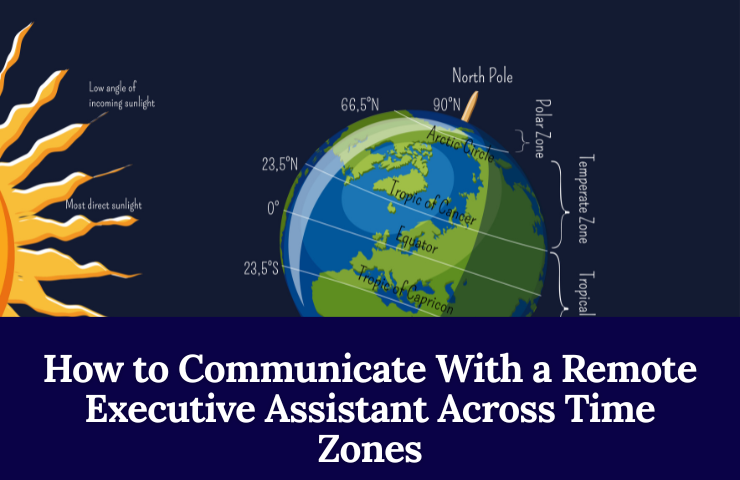
Location shapes the overlap. South Africa runs on SAST (UTC+2), so it shares a full working day with the UK and Europe and the morning with the US East Coast. Many assistants in the Philippines already work US hours. Our Philippines executive assistant guide compares both options.
Which KPIs Should You Track for an Outsourced Executive Assistant?
You judge your EA by gut feel, which only notices problems after weeks of small failures.
A KPI (key performance indicator) is a number that shows whether work is on track. Five KPIs cover most EA roles:
| KPI | Target example |
|---|---|
| Response time on VIP messages | Under 30 minutes during working hours |
| Scheduling conflicts caught early | 90% caught before they reach you |
| Weekly task completion rate | 90% or higher |
| Hours returned to you each week | Track against your pre-hire time audit |
| Your quality rating (1 to 5) | 4 or higher |
- Track themin a shared spreadsheet
- Review themin a 15-minute weekly meeting
Goodhart’s law says that when a measure becomes a target, it stops being a good measure.
If you reward speed alone, you’ll get fast, sloppy replies. Pair every speed metric with your quality rating.
Should You Hire a Freelancer, Use an Agency or Hire Directly?
You pick the lowest hourly rate.
The rate hides the real cost, which is a bad hire. The US Department of Labor estimates a bad hire costs at least 30% of the person’s first-year earnings. For an EA paid $1,800 a month ($21,600 a year), that’s at least $6,480, before you count your own lost hours.
What a bad hire costs you
- $1,800Monthly salary
- $21,600First-year earnings
- 30%Minimum bad-hire cost
- $6,480+Before your lost hours
Source: US Department of Labor estimate of at least 30% of first-year earnings.
| Model | How you pay | Main risk |
|---|---|---|
| Freelance marketplace | Hourly rate plus platform fees | You do all the vetting; high turnover |
| Managed agency | Monthly fee with a markup | Higher monthly cost; the agency employs your EA |
| Direct placement | One-time recruitment fee; you pay the salary | You manage the EA, so you need the systems above |
The right model depends on how much vetting and management you want to own. Compare the total cost over 12 months, including the risk of a rehire. Our virtual executive assistant salary and cost guide shows typical salaries by country.
What Are the Warning Signs Your Outsourced Executive Assistant Isn’t Working Out?
Your scorecard usually shows trouble before it turns into a crisis. Watch for:
- Response times rising for three weeks in a row
- Task completion falling with no explanation
- Your EA waiting for instructions on tasks the RACI chart already gives them
- The same mistake after you’ve documented the fix in an SOP
- Missed check-ins without notice
The fix: a two-week reset. Name the problem in writing. Agree on one or two measurable targets. Review them in two weeks. If nothing improves, plan a replacement before the problem spreads into your client relationships.

How Exec Assistants Helps You Avoid These Mistakes
Exec Assistants finds, vets, and shortlists executive assistants from South Africa and the Philippines. Every candidate passes three stages:
- Experience and English screening
- Practical skills tests, including real inbox and calendar tasks and a confidentiality scenario
- A structured interview with reference checks
You interview the finalists and hire your pick directly. You pay a one-time fee of $1,997 USD, and your assistant’s salary goes straight to them. Most clients see a shortlist in 7 to 10 days, and every placement includes a 3-month replacement guarantee. You also get onboarding guidance, so your first 90 days start with a plan.
Learn about our dedicated executive assistant service or book a free discovery call.
Frequently Asked Questions
What is the biggest mistake when outsourcing an executive assistant?
The biggest mistake is giving full account access before setting clear rules. Write a RACI chart, have your EA sign an NDA, and share logins through a password manager before they touch your inbox or calendar.
How long does it take an outsourced executive assistant to become productive?
Most EAs handle routine tasks within 30 days and own your inbox and calendar by day 90. A written 30/60/90-day plan and recorded SOPs speed this up.
How do I stop an executive assistant candidate from cheating with AI?
Use a live, screen-shared scenario test. Ask follow-up “why” questions and verify ID on camera. AI tools handle scripted questions well but struggle with real-time problem-solving.
How many hours of overlap do I need with a remote executive assistant?
One to two hours a day covers most real-time needs. Handle everything else asynchronously through daily wrap-ups, task tools, and recorded walkthroughs.