

Most leaders do not feel overwhelmed because they lack discipline. They feel overwhelmed because modern work punishes attention. One Harvard Business Review piece, citing a McKinsey analysis, notes the average professional spends 28% of the workday reading and answering email, about 2.6 hours per day for a full-time worker. Microsoft’s Work Trend Index research adds a harsher detail: during core work hours, employees can be interrupted every two minutes by meetings, emails, or chats. When that is your environment, “just stay focused” becomes a motivational poster, not a strategy.
Hiring a virtual executive assistant should be treated like designing a role in your operating system, not like buying generic help. The title “VEA” can describe eight different functions, and each one solves a different kind of administrative overhead. Pick the wrong type,e and you get motion without progress, plus frustration on both sides. Pick the right type, and you reduce context switching, create workflow automation through process, and free executive capacity without adding chaos. Here are the eight role types most companies actually hire, written in the language people search for, and the outcomes leaders care about.
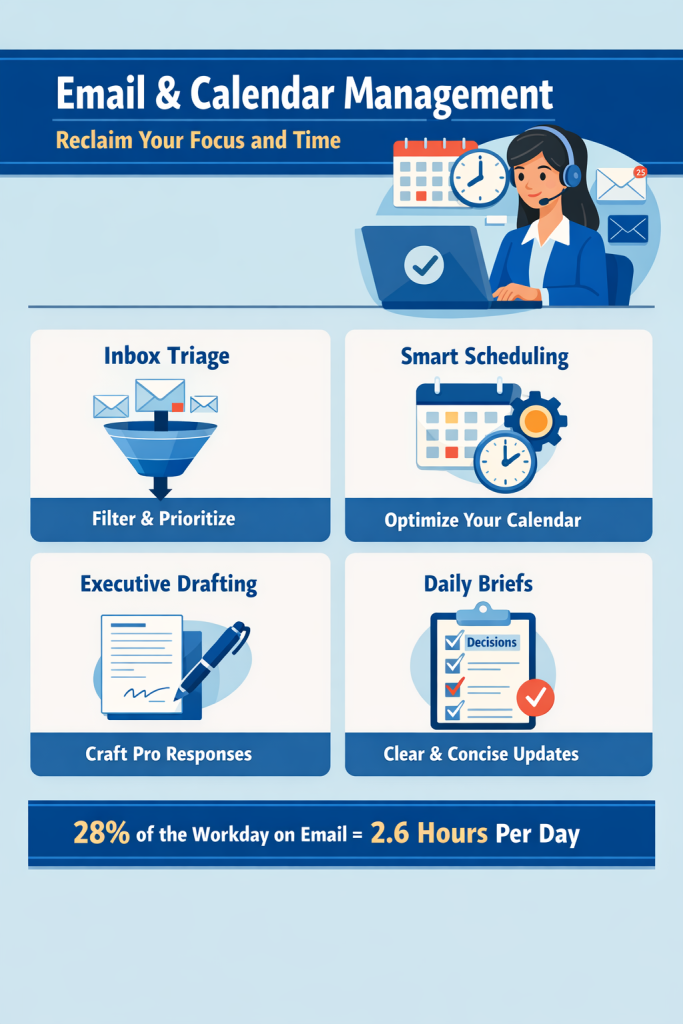
Email and Calendar Management
If your inbox feels like an unfiltered task list, you do not need a reactive executor. You need a function owner who can run inbound triage and protect decision bandwidth. Email and calendar management assistants build rules, labels, and response standards so you stop scanning for landmines. The 28% email statistic matters because it frames the opportunity: if even a portion of that time becomes structured, you reclaim real leadership hours. A simple example is a daily inbox brief that surfaces only decision items, drafts replies in your voice, and routes everything else into “delegate,” “schedule,” or “archive” with a clear rationale.
The strongest candidates treat your calendar like a budget, not a diary. They shorten meetings, enforce buffers, and decline on your behalf with tact, while keeping stakeholders respected. They also reduce the number of micro-decisions you make by building preference documents, like “how we schedule,” “what gets a meeting,” and “what can be handled async.” If you want an interview question that predicts performance, ask: “Walk me through your triage logic when 30 urgent messages arrive before 10 a.m.” Once your schedule stops bleeding, the next friction usually shows up in coordination, especially around meetings and travel.
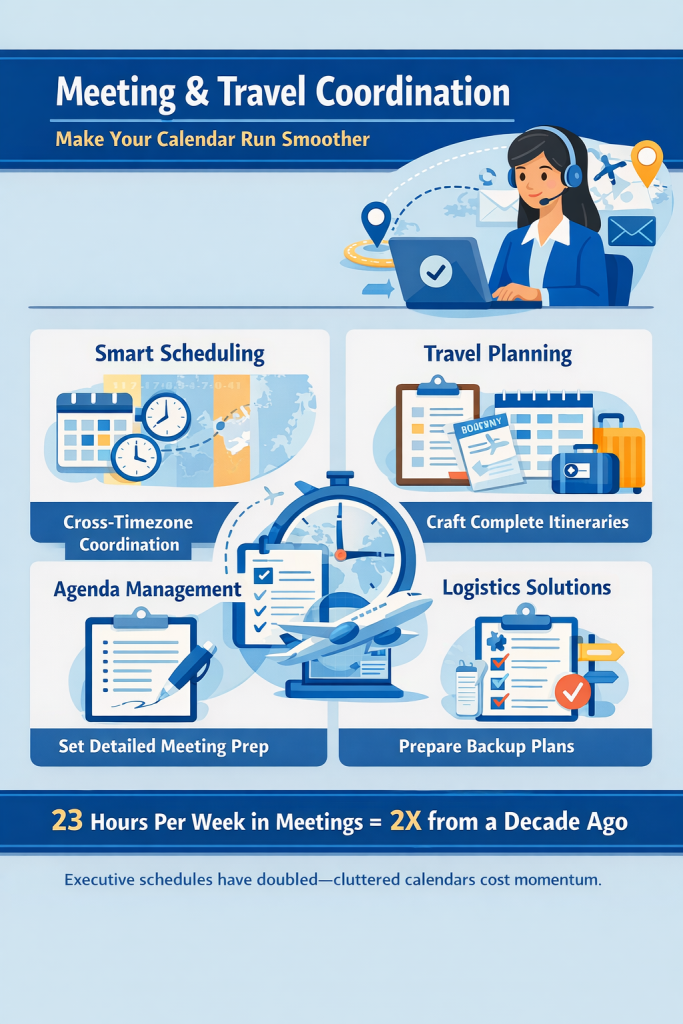
Travel and Meeting Coordination
A packed calendar is not automatically a productive week. Meeting and travel coordination specialists reduce the cognitive switching penalty caused by fragmented scheduling, and they do it through structure. Microsoft’s research describing interruptions every two minutes explains why leaders feel mentally exhausted even when the tasks are minor. This assistant standardizes agendas, prep packets, links, and desired outcomes so every meeting starts with context and ends with clarity. A practical example is a “meeting readiness checklist” that ensures pre-reads are attached, decisions are defined, and the right people are invited for the right reasons.
Travel is where precision matters because failure is expensive. Great coordinators build itineraries that account for time zones, transfers, contingency plans, loyalty programs, and meeting locations, then package everything into one clean brief. They also keep the travel workflow auditable, which matters for finance and compliance later. A helpful question to test competence is: “Tell me how you handle last-minute reschedules across three time zones without derailing the rest of the week.” When logistics becomes smooth, communication becomes the next performance multiplier because stakeholders do not just need meetings; they need alignment.
Stakeholder Relations and Executive Communications
Miscommunication is a silent tax. Stakeholder relations and executive communications assistants reduce that tax by managing executive messaging, follow-ups, and relationship hygiene across clients, leadership teams, investors, and partners. Their work often looks simple until it is missing, then you see the cost in re-litigated decisions, missed commitments, and avoidable tension. Gallup reports that about three in four employees experience burnout at least sometimes, which is a reminder that clarity and load management are not “soft.” When communication is unclear, work expands, stress rises, and leaders get pulled back into problems they thought were resolved.
This role often includes executive ghostwriting and brand voice, but the deliverable is not pretty emails. The deliverable is fewer loops. A strong communications EA writes recaps that capture decisions, owners, and deadlines, then closes the loop with the right people without you being the reminder engine. They also manage sensitive interactions carefully, using a firm tone without being abrasive and concise without being cold. Ask candidates for a writing sample that includes a complex boundary, like declining a meeting or escalating a missed deadline, because that reveals judgment. When your messaging stops leaking energy, you start noticing deeper operational issues: the work itself still lacks consistent systems.
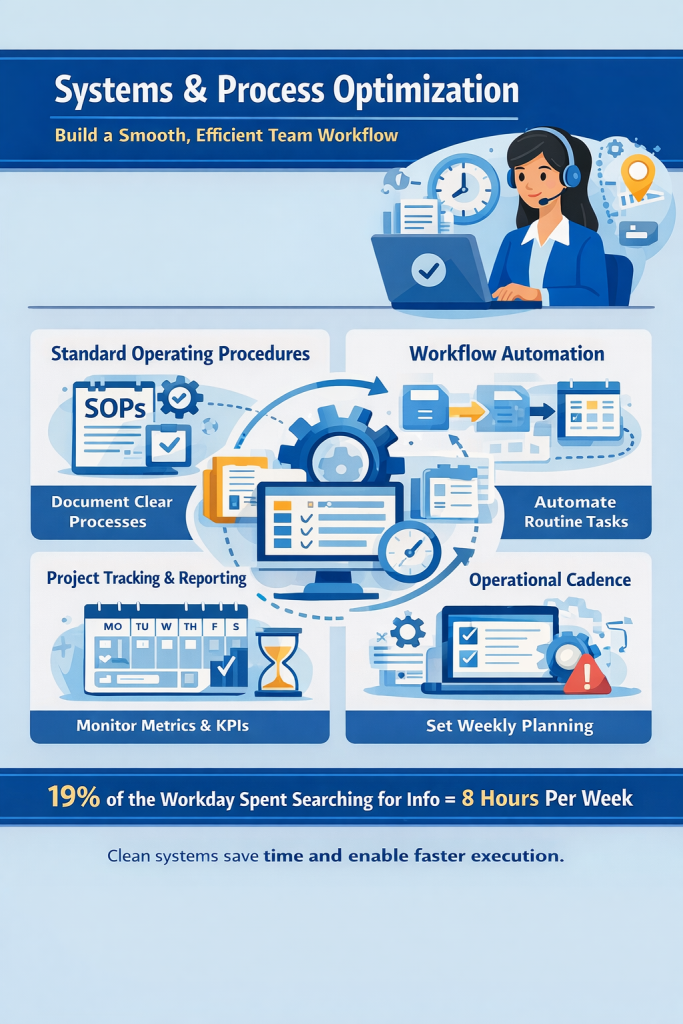
Systems and Process Optimization
Some teams are busy because the work is hard. Many teams are busy because the work is undefined. Systems and process optimization assistants reduce business process friction through SOPs, workflow documentation, and operational cadence. They build the “how we do work” layer so tasks are repeatable, handoffs are consistent, and knowledge is searchable. This role is especially valuable in business process outsourcing environments where clarity and audit trails matter, because remote teams scale on documentation, not memory. A concrete example is turning a recurring mess, like onboarding or weekly reporting, into a checklist with owners, timelines, and templates.
The best process assistants think in systems, not tasks. They clean up your project tool, establish naming conventions, create templates for recurring workflows, and build a simple KPI snapshot so you can see where work is stuck. They also reduce dependency on you by writing “decision rules,” like what requires executive approval and what can be handled autonomously. If you want to assess fit quickly, ask: “Show me an SOP you created and explain how it reduced errors or cycle time.” Once the system is built, execution still fails if accountability is soft, which is why many leaders need the next role.
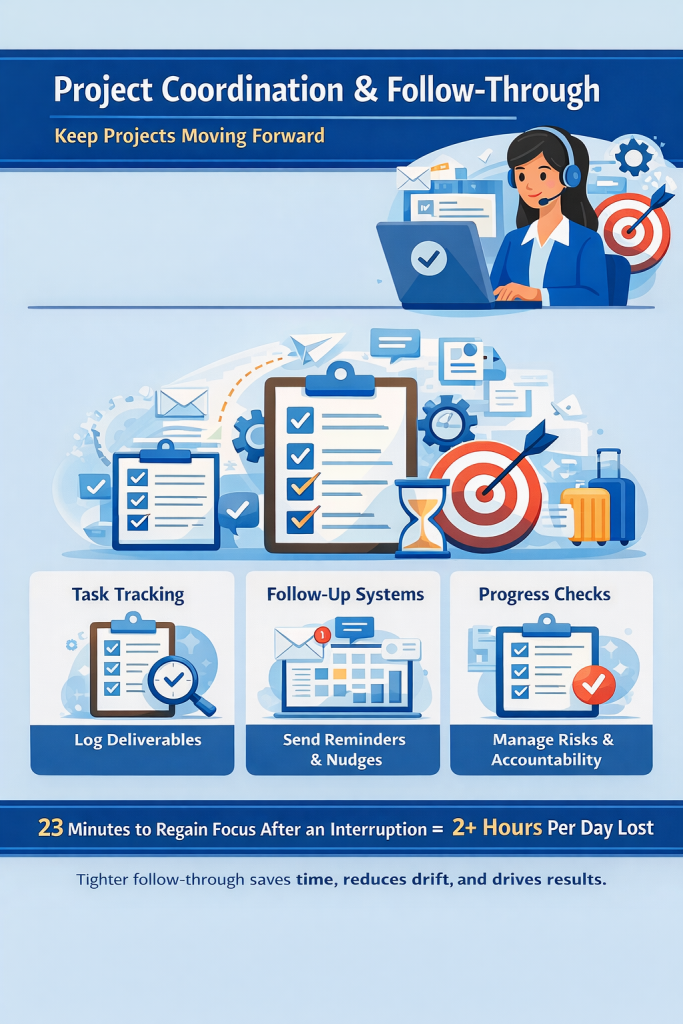
Project Coordination and Delivery Follow-Through
If you have a lot of “almost done,” you do not have a motivation problem. You have an operational accountability problem. Project coordination assistants keep initiatives moving by maintaining action logs, tracking owners, escalating blockers, and ensuring deadlines mean something. The cognitive cost is real: research highlighted via UC Irvine’s references to Gloria Mark’s work suggests it can take over 23 minutes to regain focus after an interruption fully. When projects drift, leaders end up context switching to chase updates, and that switching compounds into lost days.
This role provides operational accountability, ensuring initiatives reach “done” without executive intervention. A strong coordinator runs a weekly “open loops” review, publishes a concise status update, and ensures decisions from meetings become tasks with owners and due dates. They also know when to escalate and when to handle it quietly, which prevents you from being the bottleneck for every micro-decision. A good example is a launch tracker that shows dependencies and risks in one view, paired with a habit of proactive nudges that keep work moving without drama. Once delivery tightens, the following constraint often appears in revenue operations, where speed and consistency decide outcomes.
Sales Support and CRM Management
Revenue does not usually leak because the product is bad. It leaks because follow-ups are slow, notes are missing, and pipeline hygiene is inconsistent. Sales support and CRM management assistants own those details, so leads do not die from inattention. This role includes scheduling, proposal coordination, CRM updates, and follow-up sequences, but the outcome is pipeline velocity. A strong example is a system where every call generates a same-day recap, the next step is scheduled before the energy fades, and the CRM reflects reality instead of hope.
This role should be evaluated like an operations role, not like a “sales admin” role. Look for people who understand CRM data quality, lifecycle stages, and process adherence, because those are the levers that stabilize forecasting. Ask: “How do you prevent deals from stalling when the sales calendar is overloaded?” and “What fields must be mandatory for handoffs to work?” When sales operations become consistent, leaders often notice the next friction point: money ops, approvals, invoicing, and the financial fog that appears when admin is messy.
Financial Admin and Bookkeeping Support
Financial admin does not need to be complicated to be dangerous. A missed invoice, a late approval, or messy expense capture can quietly distort cash flow and make planning unreliable. Financial admin and bookkeeping support assistants manage accounts payable and receivable workflows, invoice follow-up, expense categorization prep, approvals routing, and month-end readiness, usually in partnership with a bookkeeper or accountant. This role is about control, documentation, and audit trails, not doing professional accounting without credentials. A helpful example is a weekly “money ops” snapshot that shows bills due, invoices outstanding, approvals pending, and exceptions that require your decision.
Good candidates understand basic financial workflows and internal controls. They can explain the separation of duties, approval thresholds, and how to reduce fraud risk through simple processes, like two-step approvals and locked vendor lists. They also keep records clean, so cycles run faster and reporting becomes trustworthy. Ask: “How would you design an approvals workflow that prevents bottlenecks without sacrificing control?” Once the finance admin is stable, many executives face the final distraction category that still steals focus: personal logistics and burnout risk.
Lifestyle and Personal Concierge Support
Personal concierge support is not a luxury role in a high-interruption world. It is a burnout prevention and energy protection role. Gallup’s burnout research shows how widespread strain is, and leaders are not exempt from that reality. Lifestyle support assistants manage personal scheduling, travel planning, renewals, household vendors, family calendar coordination, and the recurring tasks that create mental load. The ROI comes from reducing the number of personal “pings” that break your workday into fragments.
The best personal concierge assistants run life admin like an operations function. They build checklists for renewals, schedule recurring appointments proactively, manage inbox spillover, and surface only decisions that truly require you. A strong example is a monthly personal ops plan that handles travel, appointments, and household tasks in one cadence, so your brain stops being the reminder system. This role also requires trust and discretion, so hiring should prioritize judgment and confidentiality over speed. Once personal and business support are both designed intentionally, you can choose the right mix with a simple selection framework.
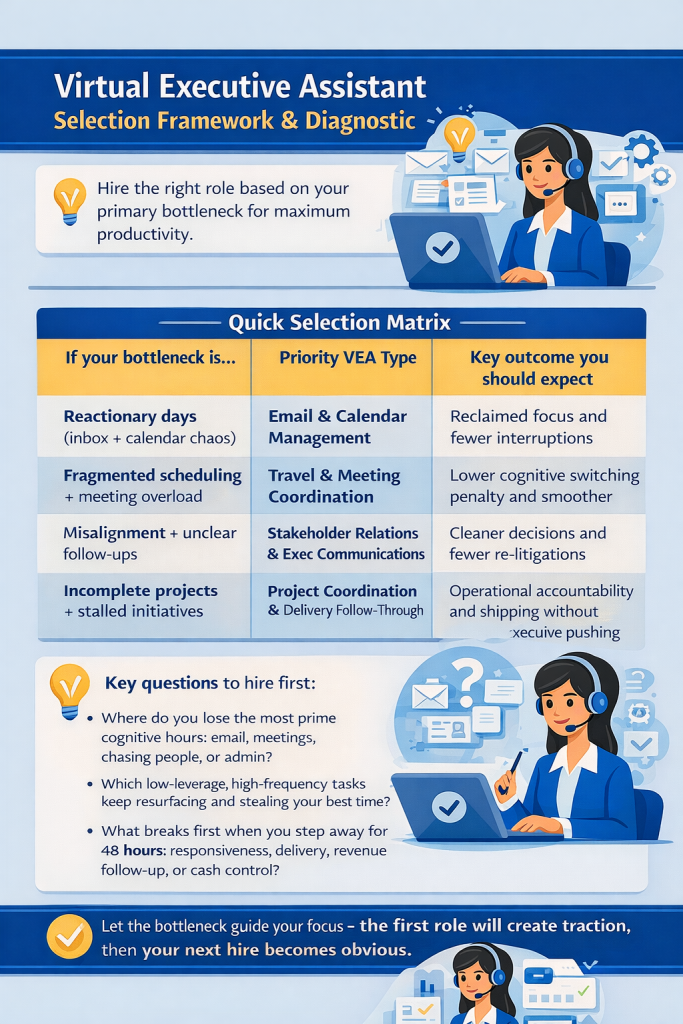
Virtual Executive Assistant Selection Framework and Diagnostic
A valid selection rule is simple: hire the role that eliminates your biggest recurring bottleneck, not the role that sounds impressive. If you try to hire one person to do all eight functions, you often get shallow execution and constant reprioritization. Many leaders get better results using fractional support, for example, one specialist for email and scheduling, and another for operations and projects. The goal is executive productivity, not a lengthy task list.
Quick Selection Matrix
| If your bottleneck is… | Priority VEA type | Key outcome you should expect |
|---|---|---|
| Reactionary days (inbox + calendar chaos) | Email & Calendar Management | Reclaimed focus and fewer interruptions |
| Fragmented scheduling + meeting overload | Travel & Meeting Coordination | Lower cognitive switching penalty and smoother cadence |
| Misalignment + unclear follow-ups | Stakeholder Relations & Exec Communications | Cleaner decisions and fewer re-litigations |
| Repeated mistakes + inconsistent execution | Systems & Process Optimization | SOPs, workflow automation, predictable handoffs |
| Incomplete projects + stalled initiatives | Project Coordination & Delivery Follow-Through | Operational accountability and shipping without executive pushing |
| Leaking revenue from slow follow-ups | Sales Support & CRM Management | Pipeline velocity and higher responsiveness |
| Financial fog + approvals bottlenecks | Financial Admin & Bookkeeping Support | Cash flow clarity and a clean audit trail |
| Personal admin bleeding into work hours | Lifestyle & Personal Concierge | Lower burnout risk and fewer distractions |
To choose quickly, ask three diagnostic questions and answer them honestly.
- Where do you lose the most prime cognitive hours: email, meetings, chasing people, or admin? Which low-leverage, high-frequency tasks keep resurfacing and stealing your best time?
- What breaks first when you step away for 48 hours: responsiveness, delivery, revenue follow-up, or cash control?
Your answers tell you which role type to hire first, and once that constraint is removed, the “next” role becomes obvious without guesswork.
Ready to Stop Losing Hours to Admin Overhead?
If you’re done spinning in email, meetings, follow-ups, and low-leverage tasks, let’s fix the bottleneck at the source. Book a quick call, and we’ll map your most significant constraint to the proper virtual executive assistant role, outline what they should own, and share the exact hiring profile that will actually move the needle. You’ll leave with a clear plan for coverage, priorities, and a simple onboarding rhythm that creates traction in the first week. Book your call now and get the clarity you need to hire with confidence.
Frequently Asked Questions
How do I know which of the 8 VEA types I should hire first?
The best way to decide is to run a Bottleneck Diagnostic. Track your time for one week and identify where you lose the most “Prime Cognitive Hours.” If you are drowning in unread emails, start with Email & Calendar Management. If incomplete projects stall your growth, you need Project Coordination. Always hire to remove the constraint that is currently capping your leadership capacity.
Can one person perform all 8 roles effectively?
While many high-level Executive Assistants have a broad skill set, asking one person to handle all eight functions often leads to “shallow execution.” For example, the detailed, repetitive nature of Financial Admin requires a different mental state than the high-pressure, reactive world of Email Triage. For scaling businesses, we often recommend a “Support Layer” of fractional specialists rather than a single overburdened generalist.
What is the difference between a “Project Coordinator” and a “Systems Specialist”?
A Systems Specialist focuses on the infrastructure, building the SOPs, choosing the tech stack, and designing the workflows. A Project Coordinator focuses on the execution, tracking deadlines, chasing stakeholders, and ensuring the initiatives move toward “Done.” One builds the engine; the other drives the car.
Why is “Stakeholder Relations” considered a high-level EA role?
Stakeholder relations go beyond sending emails; they involve managing executive messaging and protecting your reputation. A great EA in this role knows how to decline a meeting without offending a partner or escalate a missed deadline without creating drama. This requires a high level of “Digital EQ” and an understanding of the political landscape within your industry.
Is “Lifestyle Support” really necessary for a business leader?
Lifestyle support is a burnout prevention tool. When personal admin like travel renewals, household logistics, or family scheduling—bleeds into your workday, it creates “Micro-Interruptions” that destroy deep work. By delegating these tasks, you protect your energy and ensure that 100% of your professional hours are spent on high-leverage growth activities.