

Most CEOs do not run out of time because they lack discipline. They run out of time because the day fragments their attention into dozens of micro-decisions, and each one steals momentum. Dwight D. Eisenhower captured the pattern with a line leaders still quote because it stays true: “What is important is seldom urgent and what is urgent is seldom important.” A Delegation Matrix turns that principle into a practical operating system you can execute, not just admire.
The cost is not abstract; it shows up in complex numbers. McKinsey estimated that the average “interaction worker” spends about 28% of the workweek managing email and close to 20% searching for information or tracking down colleagues. Microsoft reported an average of 117 emails per day, which forces shallow scanning instead of focused processing. Axios, citing Microsoft’s “infinite workday” reporting, noted that app notifications interrupt knowledge workers about every 1.75 minutes, which can equal hundreds of pings a day. Those interruptions create decision fatigue, and decision fatigue pushes leaders toward reactive choices that feel fast but cost more later.
Meeting sprawl turns that attention drain into a structural problem. Harvard Business Review highlights research suggesting roughly 70% of meetings keep employees from completing their real tasks. When your calendar fills with status updates, you lose time blocking, deep work, and the quiet thinking that produces strategy. You also train the organisation to treat your presence as the path to progress. That dynamic reduces operational efficiency because people wait for your input instead of using clear rules and authority levels.
The matrix in one sentence
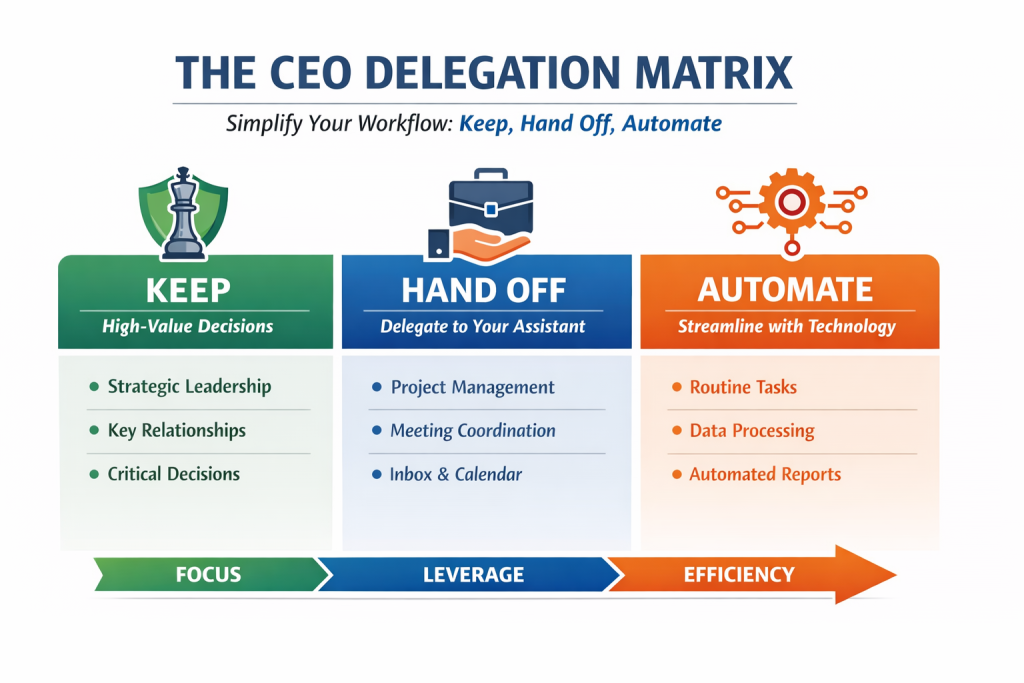
The CEO Delegation Matrix sorts your work into three buckets: Keep, Hand Off, and Automate. You make decisions where your authority, judgment, or relationships create the value. You hand off execution that depends on coordination, follow-through, and communication, often to a remote executive assistant who can run workflows end-to-end. You automate repeatable tasks that follow clear rules, then you treat exceptions as the only reason a human should touch them.

You can build it from reality, not intention.
Start with a five-day capture, because memory lies and calendars hide the invisible work. Track every task you touch, including quick replies, meeting preparation, document reviews, Slack pings, and context you provide to unlock someone else’s work. Then score each item across four lenses: strategic leverage, judgment, repeatability, and risk. You do not need perfect scoring; you need consistency that reveals patterns you can act on.
Here are the four lenses in plain language. Strategic leverage asks whether the task moves revenue, retention, hiring quality, product velocity, or brand trust. Judgment asks whether the task needs your specific context, taste, or authority, not just competence. Repeatability asks whether the task follows steps you can document and reuse. Risk asks what happens if the task goes wrong, and whether you can contain damage with approvals, thresholds, and audit logs.
Keep: Authority, judgment, and relationship capital.
Treat “Keep” as a protection zone for work that only the CEO can do. Strategy choices, executive hiring decisions, investor relations, partner negotiations, and culture-setting require your authority and your accountability. If you delegate these, you do not remove risk; you multiply it by creating ambiguity about who owns outcomes. You should still design these responsibilities so you make fewer decisions with higher-quality inputs. That is how you preserve cognitive bandwidth without stepping away from leadership.
A clean example is executive hiring. You should own the final decision, because the long-term cost of a wrong leader dwarfs the short-term cost of extra interviews. You do not need to personally coordinate every interview, chase references, or compile feedback. An executive support partner can schedule panels, collect structured scorecards, and surface decision-ready summaries. You keep the judgment, they remove the friction.
Another “Keep” category is narrative control in high-stakes communication. You should decide the message to your board, your leadership team, and external stakeholders, because tone and intent matter as much as facts. You can still delegate the work around the message, including gathering inputs, formatting drafts, and ensuring distribution follows your approval workflow. This separation reduces decision fatigue because you only engage where you add unique value. It also speeds execution because the machine runs while you focus on the thinking.
Hand Off: Execution, follow-through, and operational leverage
Most CEOs try to delegate tasks, but they should delegate workflows. Workflows include intake prioritisation, scheduling, escalation, and closure, which means they produce finished outcomes rather than half-done pieces. This bucket often creates the fastest results because it removes “attention residue,” the mental drag that lingers after you switch contexts repeatedly. It also reduces bottlenecks, because fewer tasks bounce back to you with “quick questions” that are not quick at all.
This is where a virtual executive assistant earns their keep, because coordination is a skill, not a side activity. They can enforce time blocking by protecting deep work, batching low-value calls, and using meeting hygiene rules like agendas, attendee limits, and clear outcomes. They can triage your inbox by routing newsletters and FYIs away from your attention, drafting replies in your voice, and flagging only the threads that require a decision. They can also manage stakeholder communication, which prevents relationships from degrading simply because your week got busy.
Consider a product launch with multiple owners, shifting timelines, and frequent dependencies. If you touch every update, you become the nervous system, and your team waits for your attention to move. A capable assistant can run “project traffic control,” maintain a single source of truth, chase owners for updates, and escalate only true blockers. They can deliver a daily brief that answers three questions: what shipped, what slipped, and what needs a decision today. You stay informed without becoming the bottleneck.
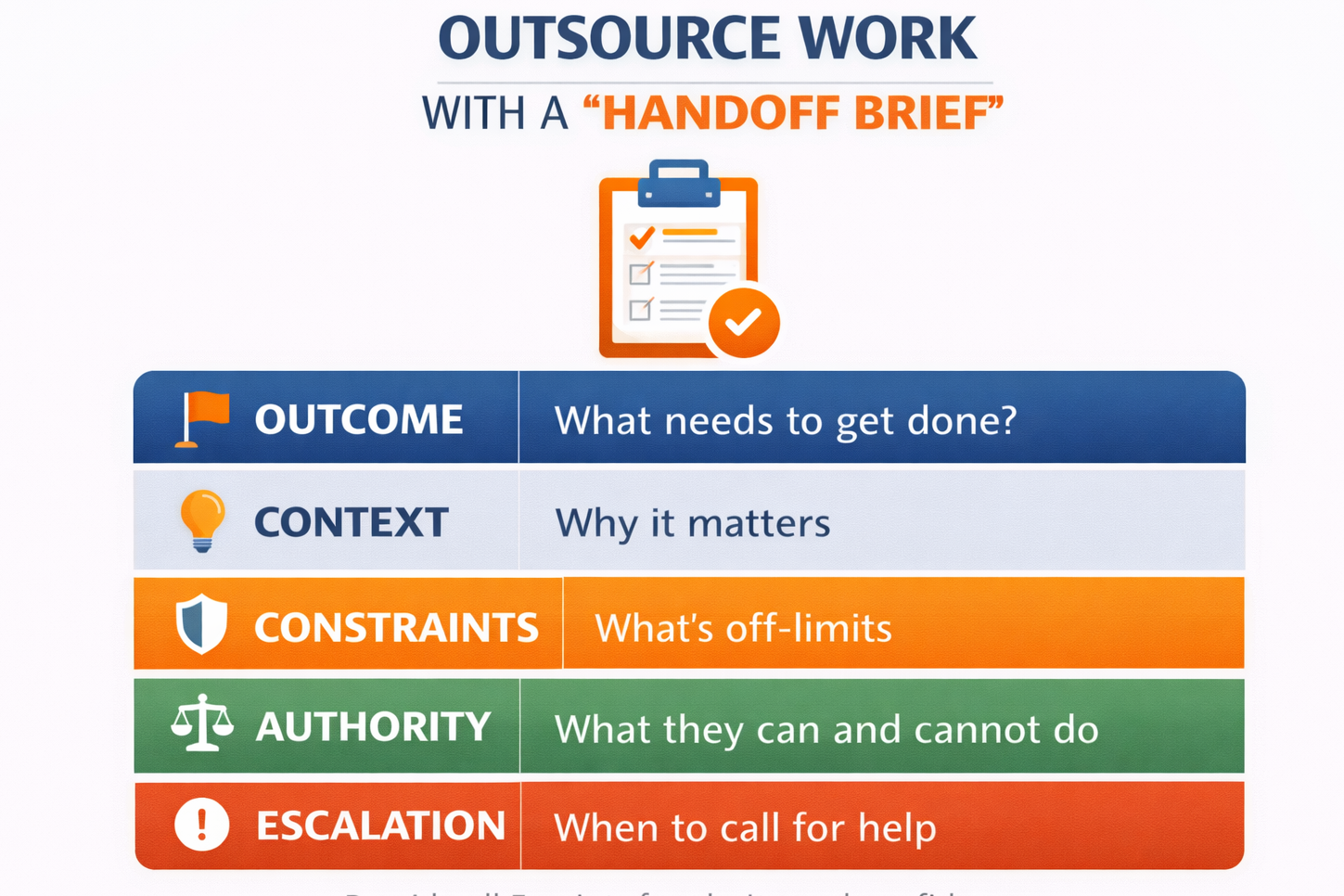
Hand-offs fail when they lack a clear contract. Use a five-part Handoff Brief to prevent the boomerang effect, where work returns to you because it lacked clarity. Write the Outcomee, context, constraints, authority level, and escalation rules in one tight paragraph. For example:
- Finalise Q1 board deck readiness by Thursday 14:00.
- Context: We need updated KPIs, financials, and three strategic slides.
- Constraints: do not share externally, and route sensitive drafts through our secure folder.
- Authority: reschedule internal meetings, chase owners, and edit formatting.
- Escalation: flag missing inputs by Wednesday 12:00, and bring any content disputes to me with two options.”
Automate: Rule-based work that should not consume a human mind
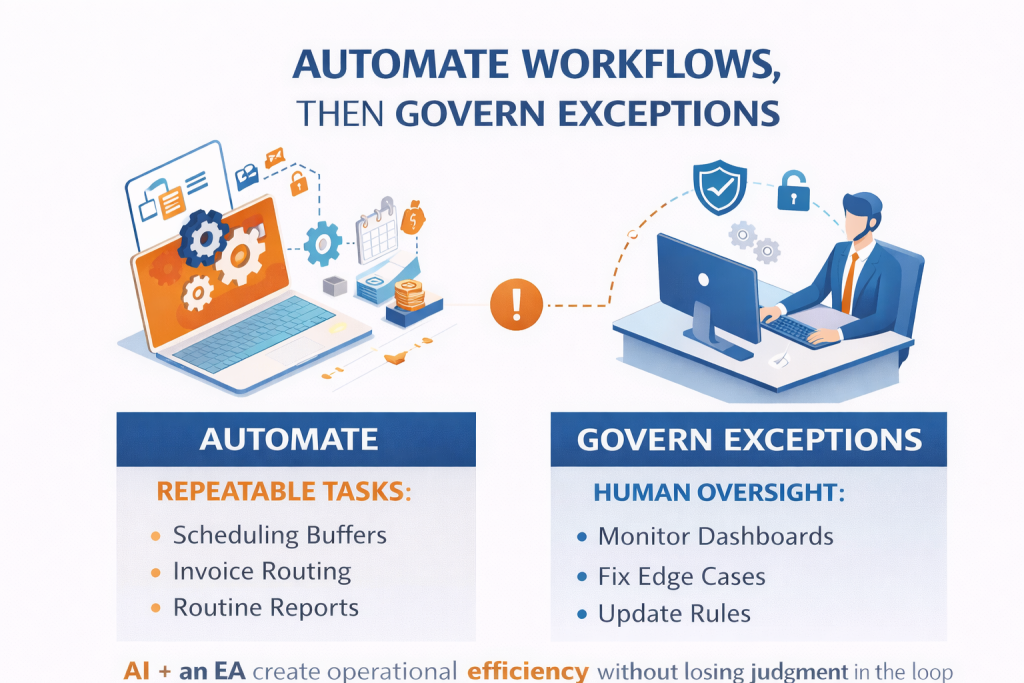
Automation belongs to processes that follow “if this, then that” logic. Scheduling buffers, recurring reminders, invoice routing, report generation, form intake, and data movement between tools qualify because the steps rarely change. When you automate these, you cut error rates and free humans for judgment work. You also create operational efficiency because systems do not forget, get distracted, or improvise. You still need ownership, because automation decays when the business changes and nobody updates the rules.
Treat AI as part of automation, not as a replacement for accountability. Use it to summarise long threads, draft first-pass responses, extract action items from notes, and convert raw ideas into structured outlines. Then, require a human review for accuracy, tone, and confidentiality, because speed without verification creates reputational risk. Adam Mosseri, head of Instagram, summed up the frustration many leaders feel when he wrote that ineffective meetings and overhead slow teams down. AI can reduce overhead, but your process must keep judgment in the loop.
A strong setup pairs automation with a human “governor.” Your assistant can monitor dashboards, check audit logs, and handle exceptions before they reach you. They can also maintain the workflow library, which prevents the organisation from rebuilding the same process repeatedly. This combination scales better than either approach alone. Systems handle volume, people handle nuance.
Governance: Approvals, thresholds, and decision rights
Delegation collapses when governance stays implicit. Define approval thresholds for money, legal commitments, customer promises, and hiring offers, and write them down. Decide which actions require explicit sign-off and which only require notification. Build escalation like an emergency room, where only real “code red” issues reach you immediately. Everything else follows response-time expectations that match the risk.
You can also use meeting reduction as a governance lever. Research from the University of Reading described outcomes where cutting meetings by 40% correlated with a 71% increase in productivity, along with improvements in employee satisfaction. A remote executive assistant can operationalise this by auditing recurring meetings, requiring agendas, converting updates into async briefs, and cancelling meetings that lack a decision. This change improves time blocking and reduces context switching across the organisation. It also signals that focus matters, which strengthens culture.

A practical 7-day rollout
Start small and move fast, because the goal is behaviour change, not a perfect system. On day one, track tasks and identify your top three attention leaks, usually email, calendar, and follow-ups. On day two, write three Handoff Briefs for the biggest recurring workflows, and on day three, set up two automations for obvious rule-based tasks, such as intake forms and recurring reports. On day four, implement meeting hygiene rules and cancel one recurring meeting that lacks a purpose.
Finish the week by locking in measurement. Track reclaimed deep work hours, the number of decisions made from briefs rather than meetings, and the count of follow-ups handled without your intervention. If you see work bouncing back, tighten authority levels and escalation rules instead of blaming the person. If you see confusion, write the missing SOP and attach it to the workflow. Over time, you will feel the shift: fewer interruptions, faster execution, and more transparent decision-making.
The quarterly reset that keeps it working
The Delegation Matrix is not a one-time exercise because the business evolves. Every 90 days, review your task list, your meeting load, and your operational bottlenecks. Keep three responsibilities that require the CEO’s judgment. Hand off four workflows that drain attention but do not require your authority, and ensure your executive support partner owns closure. Automate three repeatable processes, then monitor them with logs and exception handling.
When your calendar reflects these choices, you stop reacting and start directing. You reduce decision fatigue because you reserve your brain for work that creates leverage. You increase operational efficiency because systems and workflows move without constant executive touch. That is what modern delegation should deliver: a CEO who does less noise and more leadership.
Frequently Asked Questions
What are the three buckets of the CEO Delegation Matrix?
The matrix simplifies all work into three categories: Keep, Hand Off, and Automate. You Keep work that requires your specific authority, judgment, or relationship capital (e.g., investor relations). You Hand Off entire workflows—not just tasks—that require coordination and follow-through (e.g., meeting prep). You Automate rule-based tasks that follow “if this, then that” logic (e.g., invoice routing).
How do I decide what to “Hand Off” versus what to “Keep”?
To decide, evaluate each task through four lenses: Strategic Leverage, Judgment, Repeatability, and Risk. If a task moves the needle on revenue or brand trust but follows a repeatable process and has manageable risk through approval thresholds, it is a prime candidate for a hand-off. If a task requires your unique “taste” or specific context that cannot be documented, you should keep it.
What is a “Handoff Brief” and why is it necessary?
A Handoff Brief is a five-part contract that prevents the “boomerang effect” (where work returns to you unfinished). It includes the Outcome, Context, Constraints, Authority Level, and Escalation Rules. By providing this level of clarity upfront, you empower your executive assistant to move a project to completion without needing to ask you “quick questions” every hour.
4. How does “Governance” fit into the delegation matrix?
Delegation is not abdication. Governance involves setting clear Approval Thresholds—deciding what your team can sign off on independently and what requires your explicit notification or approval. This creates a “Safety Net” that allows you to step away from daily operations while maintaining control over high-stakes financial or legal commitments.
Why is a “Quarterly Reset” important for the Delegation Matrix?
Business needs and leadership roles evolve. A task you had to “Keep” six months ago might now be “Repeatable” enough to “Hand Off” or even “Automate.” By reviewing your delegation matrix every 90 days, you ensure your time is always focused on the current highest-leverage activities, preventing the “Founder Bottleneck” from reforming as the company scales.