

Behind every thriving company stands a leader who learned how to let go.
In the early days, founders win by doing everything. They sell, hire, market, manage, and fix problems fast. That same strength turns into a ceiling when the business grows. Founder capacity becomes the constraint, not market demand.
Strategic delegation solves that constraint. It means you assign outcomes (precise results) to the right people, supported by repeatable systems. You stop trading hours for progress and start building operational leverage.
Harvard Business Review reports that leaders who delegate effectively generate 33% higher revenue than those who try to do everything themselves. Many owners still struggle, not because they lack effort, but because they never install a delegation operating system.
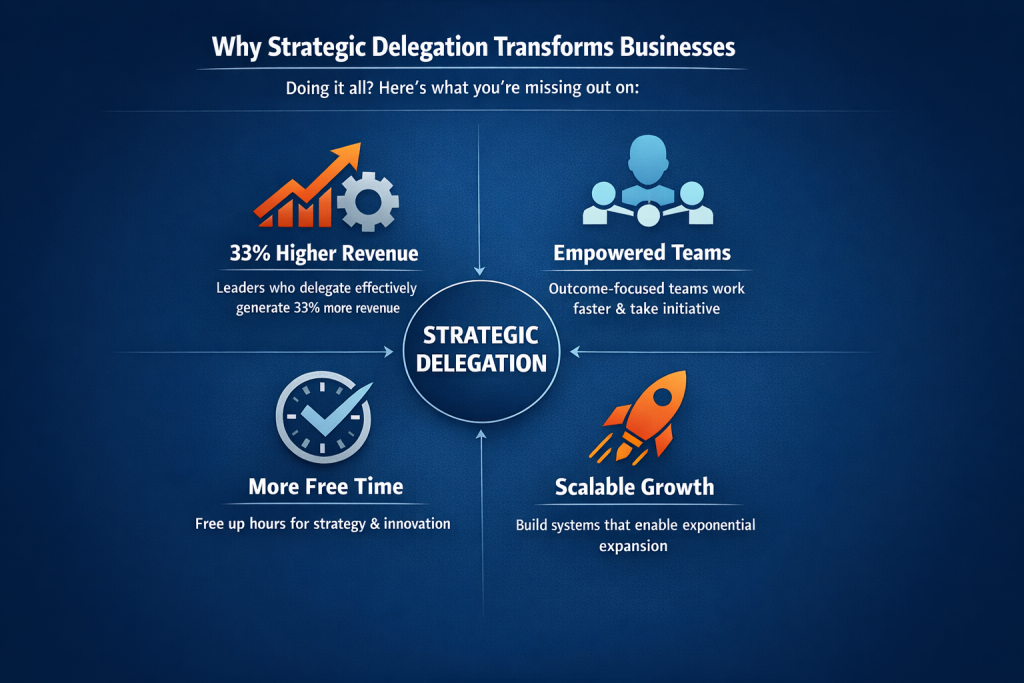
Delegation Drives Scalability, Not Relief
Many leaders delegate when pressure forces their hand. That approach creates reactive hiring, unclear handoffs, and constant rework. Strategic leaders delegate early to create bandwidth for decisions only they can make.
Productivity expert Michael Hyatt frames a practical rule: if someone can do a task 80% as well as you, hand it off. That rule protects your focus and breaks the perfection loop that traps founders in low-leverage work.
When you treat delegation like an investment, you gain compounding returns. You trade personal output for organizational capacity.

Run a Time Value Audit and Protect Your Highest Leverage Work
You cannot delegate well until you know what deserves your attention.
Audit a typical week. List your recurring tasks and meetings, then tag each item by value:
- $10 tasks: admin, email triage, scheduling, follow-ups
- $100 tasks: coordination, reporting, project management, vendor communication
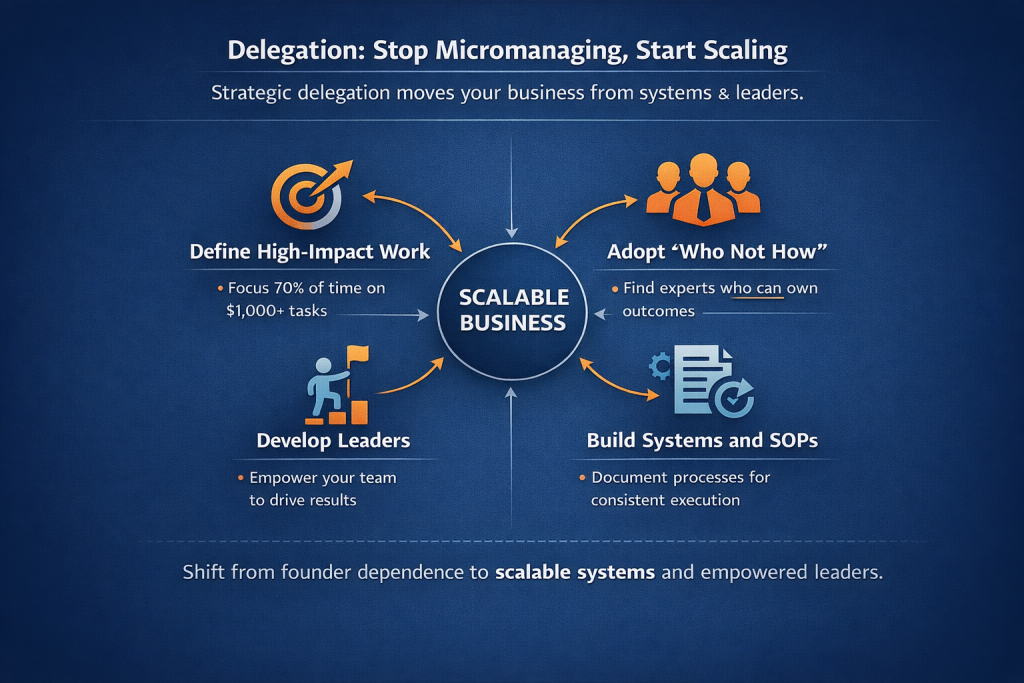
- $1,000+ tasks: strategy, vision, key relationships, high-stakes decisions, innovation
Your goal: spend 70 to 80% of your time in the $1,000+ category.
McKinsey & Company found that executives who focus most of their time on high-value work outperform peers by 50% in profitability. Delegation does not reduce work. Delegation shifts work to the right owner so you can concentrate on the decisions that accelerate revenue and expansion.
Delegate Outcomes and Standards, Not Step-by-Step Instructions
Founders often micromanage because they want quality. Micromanagement produces the opposite. It slows execution and trains your team to wait for you.
Delegate outcomes with standards and context.
Instead of:
- “Send the proposal by Friday.”
Say:
- “Get the client a polished proposal by Friday that reinforces our positioning and addresses their decision criteria. Walk me through your plan.”
This wording does three things:
- It defines the outcome.
- It sets a quality bar.
- It forces ownership and thinking.
Deloitte reports that teams working with outcome-based delegation perform 26% better and report higher engagement. You build initiative when you delegate the “what” and “why” and let your team own the “how.”
Steve Jobs modeled this style. He did not tell the iPod team every step. He set a clear outcome: “A thousand songs in your pocket.”
Adopt “Who Not How” and Build Human Capital Leverage
Most founders respond to problems by asking, “How do I do this?”
Strategic leaders ask a different question: “Who can own this?”
Dan Sullivan, founder of Strategic Coach, calls this the “Who Not How” principle. You multiply capacity when you find the right “who,” then give them an outcome to own.
This principle connects directly to Human Capital Management: you do not “add help.” You design roles, accountability, and decision rights so the company can execute through people, not through founder heroics.
Richard Branson credits delegation as a core driver of Virgin’s scale. He says he surrounds himself with people smarter than him and lets them do their work. That mindset creates operational velocity without founder burnout.
Implement Business Systems and SOPs for Scalability
Delegation collapses when knowledge lives in your head.
Build a basic business playbook, even if it starts ugly. You can refine later. You need something your team can follow without guessing.
Use a simple system stack:
- Documentation: Notion or Google Docs for SOPs and checklists
- Process walkthroughs: Loom videos for fast training
- Execution tracking: ClickUp, Asana, or Trello for ownership and deadlines
Add decision boundaries:
- What can the team decide without you?
- What requires approval?
- What triggers escalation?
You remove friction when you clarify authority. PwC reports that businesses with defined decision frameworks improve execution speed by 31% and cut rework by nearly a quarter.
Systems make delegation repeatable. Without systems, delegation becomes constant re-explaining.
Build a Support Layer That Protects Your Calendar and Focus
Many leaders underestimate the impact of a strong support role, especially a strategic executive assistant (EA).
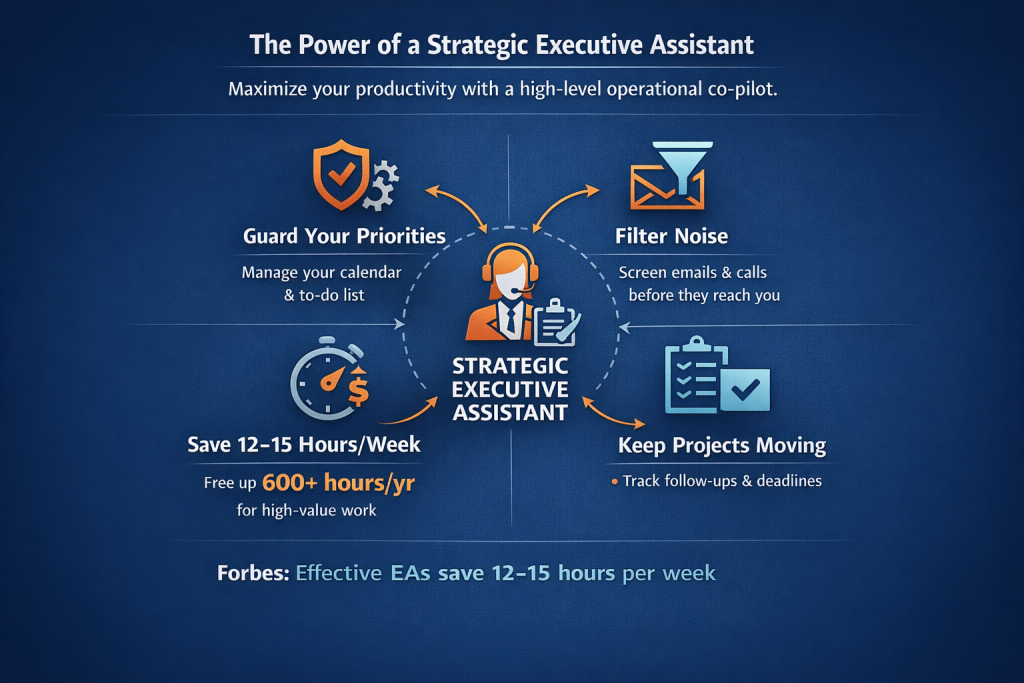
An excellent EA does more than schedule meetings. They run an operating system around you:
- They guard your priorities.
- They filter incoming communication.
- They manage follow-ups.
- They keep projects moving and prevent drift.
Forbes reports that leaders with strong EA support save 12 to 15 hours per week, which can exceed 600 hours per year.
Elon Musk delegates central scheduling and communication workflows to assistants so he can focus on innovation and high-impact decisions.
If you feel “too busy to hire an assistant,” you have your clearest signal that you need one.
Use Delegation to Develop Leaders and Strengthen Retention
Delegation can also shape leadership development.
When you hand someone a meaningful outcome, you expand their capability. You also reduce dependency on yourself. Indra Nooyi described delegation as a way to grow people. She delegated assignments that stretched them slightly beyond their comfort zone.
That approach creates a leadership pipeline instead of a founder bottleneck. Gallup reports that organizations that empower people through delegation build 33% stronger leadership pipelines and improve retention.
You do not just have free time. You grow managers who can run parts of the business, even a small business, without constant oversight.
Measure Delegation ROI Like You Measure Financial ROI
Treat delegation as a performance process, not a one-time decision.
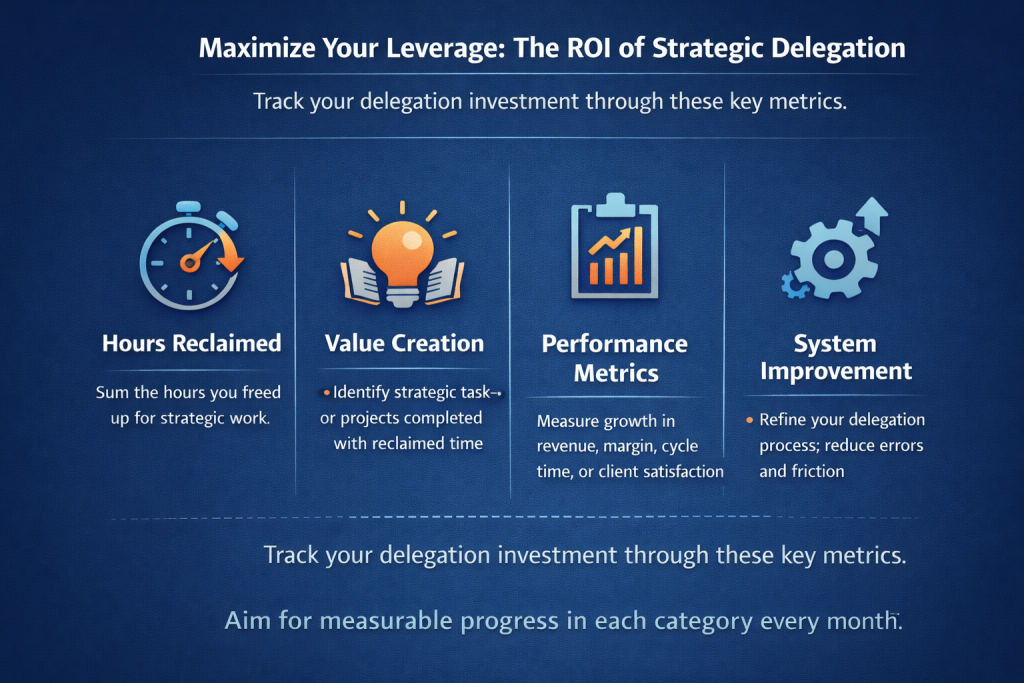
Run a monthly or quarterly review:
- What did I delegate?
- How many hours did I reclaim?
- What decisions or projects did I complete during that time?
- What measurable results followed (revenue, margin, cycle time, customer experience, strategic clarity)?
MIT Sloan reports that executives who review time allocation quarterly improve strategic impact by 29% in 90 days.
Track delegation like you track money. Your calendar shows your real investment strategy.
Expect Imperfection and Keep the System Improving
Delegation rarely feels smooth at first. Your team will make mistakes. They will choose different methods than you would choose. That does not mean delegation failed. That means your system needs refinement.
Jeff Bezos captured a useful truth: success comes from making many decisions with imperfect information. You do not need perfect execution. You need consistent execution that improves over time.
Aim for “done well and improving,” not “done exactly like I would do it.”
Final Thoughts: Letting Go Creates Operational Leverage
You cannot scale yourself.
Strategic delegation separates companies that rely on founder heroics from companies that grow through systems, people, and clear ownership.
Stop asking, “How can I get more done?”
Start asking, “Who can own this outcome?”
That shift moves you from operator to architect. It turns linear output into compounding capacity.
“If you can’t step away and trust your business to run, you don’t have a business,” says Mads Singers. “You have a job with extra stress.”
Delegation is not a shortcut. Delegation is a strategy.