

Many executives believe their biggest challenge is market competition, hiring, or strategy. In reality, the biggest constraint often sits much closer to home.
Leadership attention becomes the bottleneck.
Emails demand responses. Calendars fill with meetings. Internal questions pile up faster than decisions. Microsoft’s Work Trend Index shows that communication and coordination now consume nearly 49% of the workday, leaving little uninterrupted time for strategic thinking.
This creates a structural problem inside many organizations. When every decision, update, and approval flows through the executive, the business begins to slow.
A remote executive assistant solves this problem by managing operational flow around leadership. Instead of simply handling tasks, the role reduces operational drag, structures information, and protects the executive’s cognitive bandwidth.
In modern companies, this role acts less like administrative help and more like leadership infrastructure.
Key Takeaways
- A remote executive assistant manages the executive’s cognitive load and information hierarchy.
- The role protects leadership focus by filtering communication and coordinating execution.
- Remote EAs support asynchronous work environments common in distributed companies.
- Executives often recover 10–20 hours per week after implementing structured executive support.
- Strong EAs convert meetings into decisions, follow-ups, and execution.
- Hiring for judgment and communication matters more than hiring for software knowledge.
- The right EA expands leadership capacity without adding management complexity.

Why Remote Executive Assistants Matter More Than Ever
Executives today operate in an environment defined by information overload. Digital communication platforms such as Slack, Zoom, and email enable fast collaboration, but they also create constant interruptions.
Research from Microsoft shows that workers receive an average of 153 messages per workday, which fragments attention and reduces deep work capacity.
Harvard Business Review highlights a similar trend. One executive described the modern workday bluntly: “I cannot get my head above water.”
This pattern reflects a broader phenomenon known as operational drag. Work slows because coordination consumes time that leaders should spend on strategic decisions.
A remote executive assistant addresses this challenge by organizing communication flow, maintaining operational structure, and ensuring the executive focuses on the highest-value responsibilities.
Instead of reacting to every message or meeting request, leaders regain control of their time.
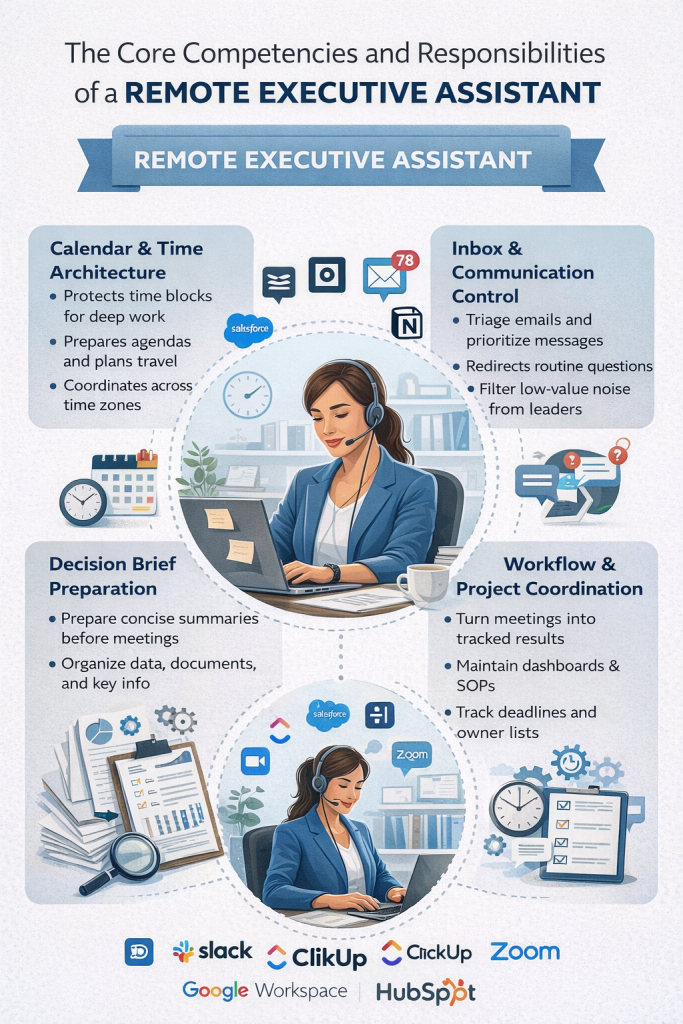
The Core Competencies and Responsibilities of a Remote Executive Assistant
A remote executive assistant operates as the operational layer around leadership.
Rather than completing isolated tasks, the assistant manages the information hierarchy surrounding the executive. This system determines which issues demand immediate attention and which can move forward without leadership involvement.
Calendar and Time Architecture
A strong executive assistant does not simply schedule meetings. They design the executive’s calendar around priorities.
This includes:
- protecting deep work blocks
- clustering similar meetings
- coordinating across time zones
- preparing meeting agendas
The result creates a calendar that supports decision-making instead of constant interruption.
Inbox and Communication Control
Executives often receive hundreds of messages per week across multiple platforms.
A remote EA implements structured communication filters using tools like Google Workspace, Slack, and HubSpot. They prioritize urgent issues while routing operational questions to the correct team members.
This process dramatically reduces the executive’s daily message load.
Decision Brief Preparation
Executives rarely need more information. They need organized information.
A remote executive assistant prepares decision briefs before meetings by compiling:
- supporting documents
- previous decisions
- stakeholder input
- relevant data
Instead of sorting through scattered materials, the executive receives a concise overview that enables faster judgment.
Workflow and Project Coordination
Modern businesses operate across multiple tools such as ClickUp, Notion, Salesforce, and Zoom.
Without coordination, tasks disappear between platforms. A remote executive assistant ensures that meetings produce clear action items, deadlines, and accountability.
This discipline keeps projects moving forward without requiring constant executive supervision.
Documentation and Knowledge Management
Fully remote companies rely heavily on documentation. GitLab, one of the largest fully distributed organizations, built its operations around a documentation-first culture.
Remote executive assistants often manage:
- standard operating procedures (SOPs)
- shared documentation libraries
- meeting records
- decision logs
This documentation prevents knowledge from becoming trapped inside individual employees.

Why Remote Executive Assistants Provide a Strategic Advantage
The remote model introduces advantages that traditional executive support roles rarely match.
Global Talent Access
Remote hiring allows companies to recruit experienced executive assistants from a global talent pool. This dramatically increases the probability of finding professionals with specific industry expertise.
Companies no longer depend solely on local hiring markets.
Time-Zone Coverage
Distributed teams create the opportunity for time-zone arbitrage. Administrative coordination can occur while executives sleep or travel.
When the executive begins their day, schedules, follow-ups, and documentation may already be organized.
Documentation-First Operations
Remote teams depend on written communication rather than spontaneous hallway conversations.
Remote executive assistants naturally support this system by maintaining knowledge bases in tools such as Notion and Google Drive. These systems ensure that information remains accessible across the organization.
Reduced Operational Overhead
Hiring remotely eliminates office costs and geographic limitations.
Companies gain flexibility to scale support capacity without expanding internal infrastructure.

How Remote Executive Assistants Reduce Executive Cognitive Load
Every decision requires mental processing.
Psychologists refer to this demand as cognitive load, the amount of information a person must process at any given time.
Executives constantly manage competing responsibilities:
- leadership decisions
- team management
- customer communication
- financial oversight
- operational planning
Without support, administrative tasks accumulate and compete for attention.
A remote executive assistant reduces cognitive load by structuring the executive’s information flow.
Requests get categorized into:
- urgent decisions
- strategic discussions
- operational updates
- delegated tasks
This structure ensures executives focus their attention on decisions that move the business forward.
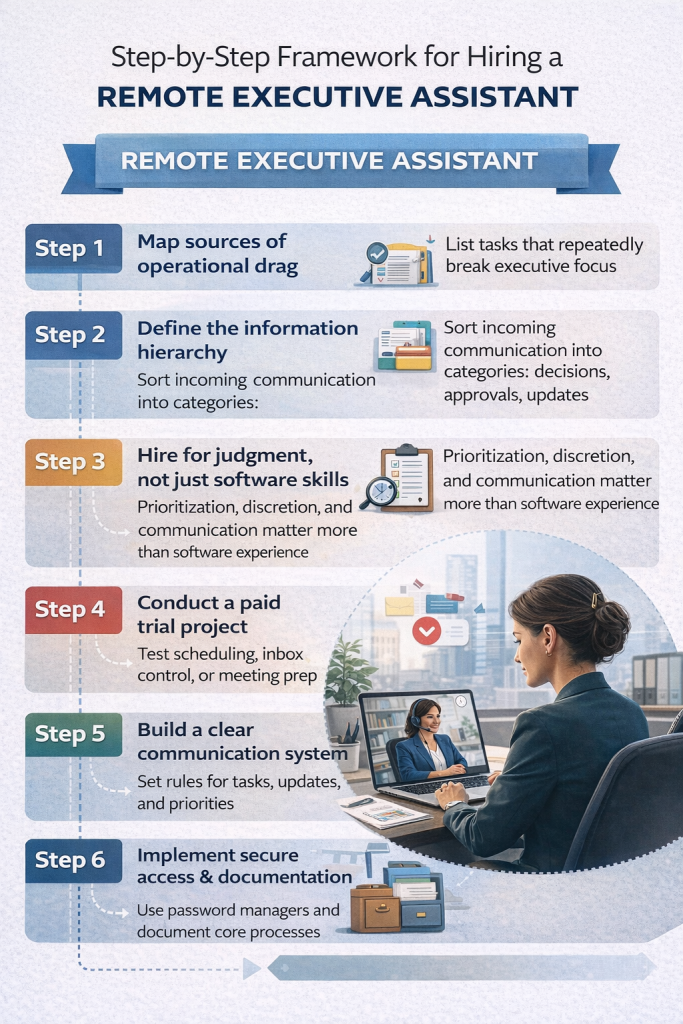
Step-by-Step Framework for Hiring a Remote Executive Assistant
1. Identify Sources of Operational Drag
Start by mapping the tasks that repeatedly interrupt leadership focus.
Common examples include:
- inbox management
- scheduling conflicts
- meeting preparation
- document coordination
- follow-up tracking
Implementation:
An executive who spends two hours daily managing email may recover nearly ten hours per week once an EA handles inbox triage.
2. Define the Information Hierarchy
Clarify which communications require executive involvement.
Typical categories include:
- approvals
- decisions
- informational updates
- delegated actions
The shift:
Instead of reviewing every message, the executive reviews only critical decisions.
3. Hire for Judgment, Not Just Software Skills
Most candidates understand common productivity tools.
However, the best assistants demonstrate strong prioritization and communication skills.
They typically work comfortably with platforms such as:
- Google Workspace
- Slack
- Notion
- ClickUp
- Salesforce
- Zoom
These tools support workflow management, but judgment determines how effectively they are used.
4. Conduct a Paid Trial Project
A short trial project reveals practical capability.
Example assignments might include:
- organizing a meeting agenda
- summarizing documents into a decision brief
- coordinating a small project timeline
Performance during real work provides more insight than interviews alone.
5. Build a Clear Communication Protocol
Define how communication should flow.
Decide:
- Which issues require immediate escalation
- Where updates should appear
- Which tools track projects
Clear communication rules prevent confusion and reduce unnecessary interruptions.
6. Implement Secure Access and Documentation
Executives often share sensitive information with their assistants.
Use structured security tools such as 1Password or Dashlane to manage account access.
Maintain process documentation within shared knowledge systems to ensure continuity.
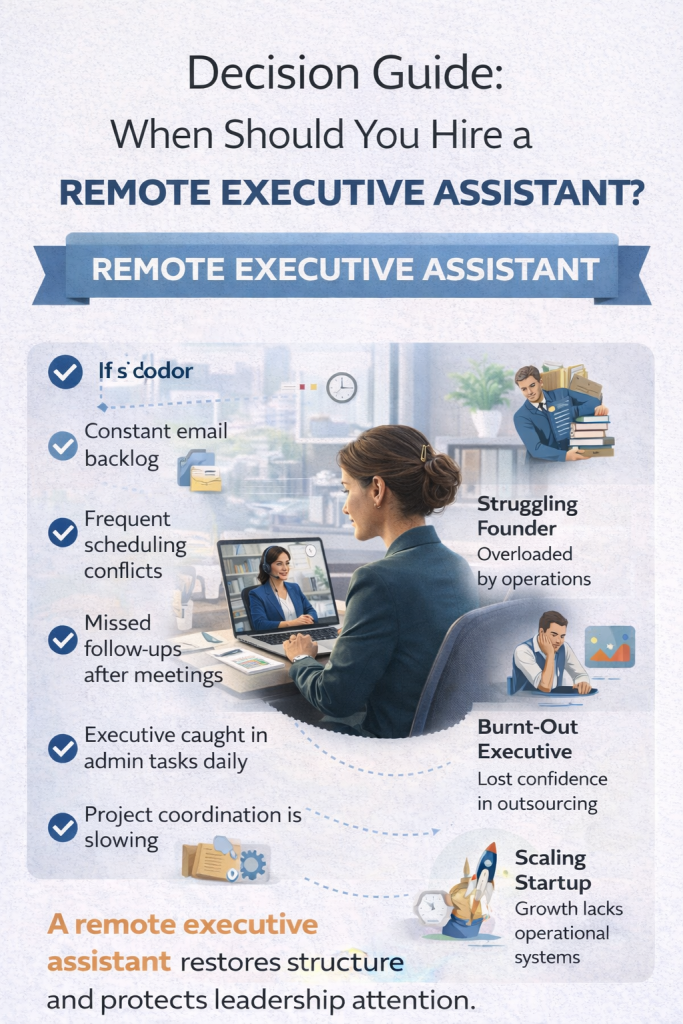
Decision Guide: When Should You Hire a Remote Executive Assistant?
Organizations benefit most from executive support when leadership time becomes fragmented.
Typical indicators include:
- constant email backlog
- frequent scheduling conflicts
- missed follow-ups after meetings
- executives performing administrative tasks daily
- Projects are slowing down due to coordination issues
Founders, consultants, law firms, and startup leaders often experience these challenges as their organizations grow.
Hiring a remote executive assistant restores operational structure before these problems escalate.
Common Mistakes When Hiring a Remote Executive Assistant
Hiring Based Only on Hourly Cost
Low hourly rates often lead to higher supervision demands. Evaluate candidates based on judgment and communication ability.
Failing to Define Role Scope
Ambiguous job descriptions produce reactive assistants instead of proactive partners.
Define clear responsibilities from the beginning.
Treating the Role as Basic Administration
A remote executive assistant should manage workflow coordination, not just isolated tasks.
Overloading the Executive with Tools
Too many platforms create confusion.
Assign clear purposes to each tool to maintain operational clarity.
Skipping a Trial Period
A short test project provides real insight into communication quality and work standards.
Examples of Remote Executive Support in Practice
A consulting firm founder struggled with constant scheduling changes and email overload. After hiring a remote executive assistant, the assistant implemented inbox triage, managed Calendly scheduling, and prepared weekly leadership briefs. Within weeks, the founder regained time for client strategy and business development.
A startup CEO faced repeated project delays because follow-ups from meetings disappeared. The EA introduced a structured decision log and action tracking system inside ClickUp. Teams gained clarity on ownership and deadlines, reducing coordination confusion.
An agency owner previously hired inexpensive freelancers who required constant supervision. The next hire focused on judgment, communication, and workflow management. The assistant coordinated internal updates, prepared client briefings, and ensured deadlines stayed visible across the organization.
The business began operating more smoothly because leadership’s attention was no longer focused on every operational detail.
FAQ
What is the difference between a fractional executive assistant and a remote executive assistant?
A fractional executive assistant supports multiple executives part-time. A remote executive assistant works outside a traditional office and may operate either full-time or part-time.
How much executive time can a remote EA recover?
Many executives regain 10–20 hours per week once an EA manages scheduling, communication filtering, and meeting preparation.
What skills define a strong remote executive assistant?
Strong assistants demonstrate:
- executive communication skills
- prioritization ability
- discretion
- workflow management expertise
- documentation discipline
These competencies help maintain professional executive presence.
Can remote executive assistants support startup founders?
Yes. Startup founders benefit significantly from executive support because early-stage companies often lack operational structure.
What tools should a remote executive assistant understand?
Most remote EAs regularly use tools such as Google Workspace, Slack, Notion, Zoom, Calendly, HubSpot, and Salesforce.
Do remote executive assistants help with meetings?
Yes. They often prepare agendas, gather materials, record meeting outcomes, and track follow-up tasks.
Scale Your Leadership Capacity
A remote executive assistant does far more than complete administrative work.
They structure communication, reduce operational drag, and protect leadership attention. This support enables executives to focus on strategy, relationships, and growth instead of routine coordination.
If your schedule, inbox, and internal communication continue to consume leadership time, it may be time to rethink how executive support functions inside your organization.
Scale your leadership capacity with a vetted remote executive assistant and discover how structured executive support transforms productivity.