

The leadership bottlenecks signal it’s time to delegate
Many executives assume they need better productivity systems.
A new task manager.
A more structured calendar.
Another email management method.
But productivity tools solve the wrong problem when a company begins to grow.
The real constraint is leadership capacity.
As organizations expand, the number of decisions, conversations, and operational details increases rapidly. Researchers at McKinsey estimate that executives spend nearly 40% of their time on tasks that could be delegated.
At a certain stage, the issue is no longer organizational.
It is cognitive load.
Cognitive load refers to the amount of information the brain must process at any given time. When leaders absorb too much operational information, their ability to make high-quality strategic decisions declines.
This is why many founders and executives eventually introduce executive support roles.
But how do you know when that moment has arrived?
Below are five signals that leadership capacity has become the bottleneck.

Operational Decisions Dominate Your Day
Every leadership role involves decisions.
But when a leader becomes the default decision-maker for everything, productivity starts to decline.
Typical examples include:
- approving routine operational requests
- answering internal questions from team members
- confirming meeting logistics
- reviewing documents before they move forward
- resolving small scheduling conflicts
None of these tasks is difficult individually.
However, together they create decision fatigue.
Psychologist Roy Baumeister, whose research popularized the concept, found that decision quality deteriorates as the number of daily decisions increases.
This phenomenon appears in many industries.
A managing partner at a law firm may spend hours approving documents and coordinating client meetings.
A SaaS founder may field constant Slack questions about product timelines.
A consulting executive may spend large portions of the day confirming travel and scheduling.
The work feels productive, but it slowly consumes leadership capacity.
An experienced executive assistant acts as a decision filter, often described as information triage.
Instead of answering 50 operational questions per day, the leader answers the five that actually require executive judgment.
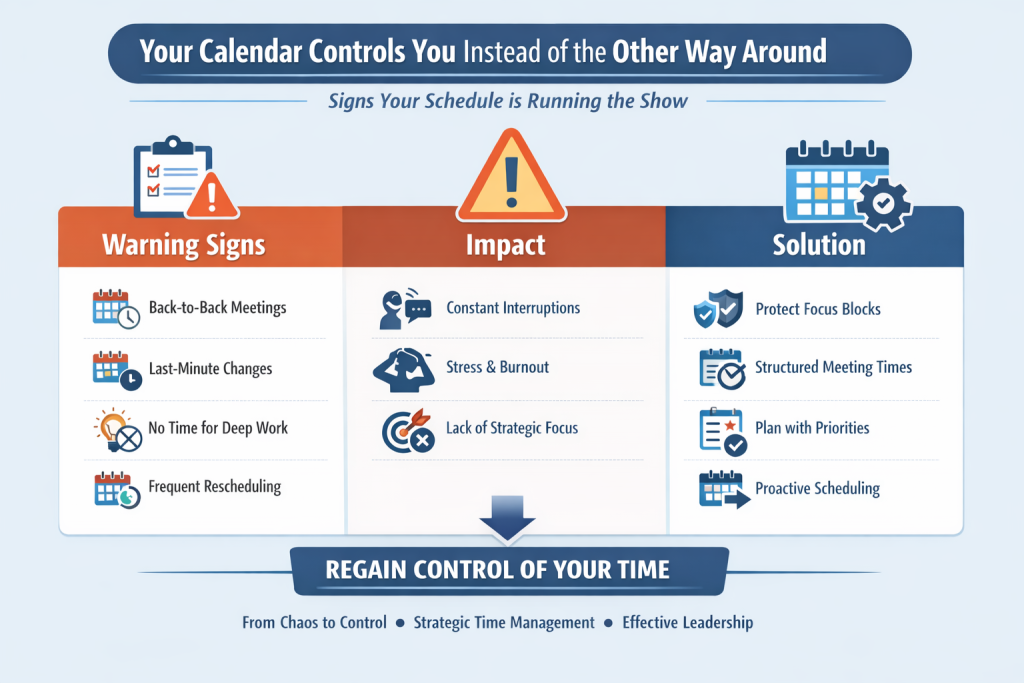
Your Calendar Controls You Instead of the Other Way Around
A leader’s calendar reveals how the organization actually operates.
When the calendar becomes chaotic, it signals deeper operational problems.
Common warning signs include:
- back-to-back meetings with no thinking time
- last-minute scheduling conflicts
- meetings without clear objectives
- constant rescheduling
- important work pushed to late evenings
According to Harvard Business Review, senior executives spend an average of 23 hours per week in meetings. Yet many report that a significant portion of those meetings produces little value.
Without coordination support, calendars turn into communication overflow systems.
Meetings multiply because scheduling and preparation are fragmented.
A strong executive assistant restructures the calendar into a strategic planning tool rather than a reactive booking system.
This includes:
- protecting deep-work blocks
- enforcing meeting preparation standards
- grouping similar meetings together
- creating structured scheduling windows
The result is not simply fewer meetings.
It is intentional time allocation.
Communication Volume Is Creating Operational Drag
As organizations grow, communication increases exponentially.
Slack threads expand.
Email conversations multiply.
Internal updates flow across multiple platforms.
Each message demands attention.
Individually, these interruptions seem small, but collectively they create operational drag.
Operational drag occurs when communication consumes so much time that it slows decision-making and execution.
This is where many leaders experience what can be called the Readiness Gap.
The Readiness Gap occurs when:
- The organization has grown in complexity
- Communication volume has increased
- But leadership support structures remain unchanged
The leader becomes the central communication hub.
Everything flows through one person.
This structure creates three predictable problems:
- slow decision cycles
- missed or fragmented information
- leadership burnout
An executive assistant introduces an information triage layer.
They organize communication streams, prioritize messages, and route information to the appropriate people.
The leader receives clear, filtered information rather than raw noise.
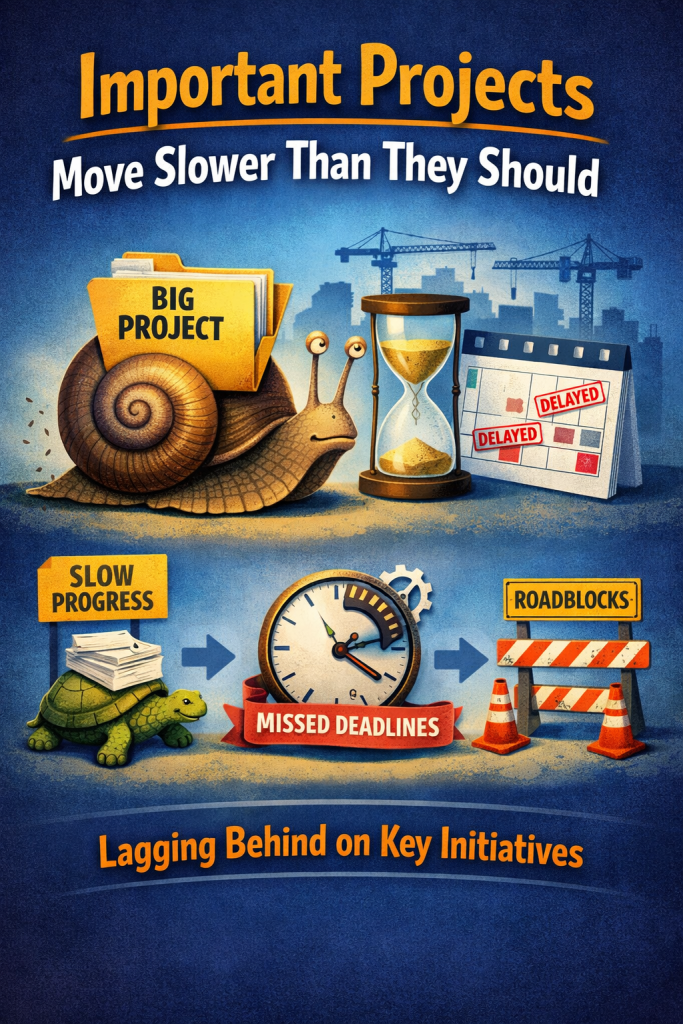
Important Projects Move Slower Than They Should
When projects stall, organizations often assume the issue is performance.
In many cases, the real issue is coordination.
Projects slow down because operational details fall through the cracks:
- Meetings are scheduled too late
- Documents are scattered across platforms
- Action items are not tracked
- Follow-ups never occur
Management researchers often refer to this as execution friction.
Execution friction rarely reflects a lack of talent.
It reflects a lack of operational coordination.
Consider a simple example.
A product launch meeting ends with five action items. Each team member assumes someone else will track progress.
Two weeks later, the project has barely moved.
An executive assistant reduces execution friction by managing the coordination layer:
- tracking deadlines
- scheduling follow-up meetings
- consolidating documents
- ensuring accountability for next steps
The result is faster progress with fewer stalled initiatives.
You Feel the Ceiling of Complexity
One of the least discussed challenges of scaling a business is complexity growth.
As organizations expand, complexity increases faster than revenue.
More employees.
More communication channels.
More stakeholders.
More operational processes.
At a certain stage, leaders encounter what can be described as the ceiling of complexity.
The symptoms are subtle but recognizable:
- Information overload becomes constant
- Strategic thinking time disappears
- Decision-making becomes reactive
- Operational issues dominate the day
Instead of guiding the organization strategically, the leader operates in a constant loop:
respond → resolve → respond → resolve
Leadership requires the opposite cycle:
think → plan → decide → guide
Executive assistants help restore that environment by absorbing operational coordination and communication management.

Leadership Bandwidth: The Real Constraint
Many leaders initially believe their challenge is time management.
But time management assumes the same person continues doing all the work.
The real constraint is leadership bandwidth.
Leadership bandwidth determines:
- How many decisions can a leader handle
- How much strategic thinking can they perform
- How effectively they can guide the organization
Once operational work consumes that bandwidth, strategic leadership declines.
Delegation restores that capacity.
As former Intel CEO Andy Grove famously stated:
“A manager’s output is the output of the organization under their supervision.”
When leaders free themselves from operational drag, the entire organization performs better.
The Hidden Cost of Waiting Too Long
Many executives wait until they feel overwhelmed before introducing executive support.
However, the cost of delay often includes:
- slower company growth
- missed opportunities
- decision fatigue
- leadership burnout
In many organizations, executive assistants function not as administrative support but as operational leverage.
They allow leaders to focus on strategic work while ensuring operational systems continue running smoothly.
Whether managing a growing legal practice, a digital agency, a consulting firm, or a SaaS company, the leadership bottlenecks are remarkably similar.
The difference between organizations that scale smoothly and those that stall often comes down to how early leaders introduce operational support.
The Bottom Line
If several of these signals appear in your daily work, the problem is unlikely to be productivity tools.
It is leadership capacity.
As organizations grow, leaders must transition from doing work to directing work.
That shift almost always requires structured support.
What To Do Next
If you recognized three or more of these signs, you are likely ready for a strategic support partner.
Read our guide:
→ Comprehensive Guide to Hiring a Remote Executive Assistant
This guide explains how leaders structure the role, evaluate candidates, and integrate executive support effectively.

Frequently Asked Questions
What is the difference between a Virtual Assistant and a Remote Executive Assistant?
While a Virtual Assistant (VA) typically focuses on completing specific, isolated tasks, a Remote Executive Assistant (EA) manages operational systems. A VA follows instructions; an EA manages your calendar architecture, prioritizes your inbox, and anticipates needs through high-level judgment and decision-filtering.
How do I measure the ROI of hiring an Executive Assistant?
The ROI is measured by leadership leverage. Calculate your effective hourly rate (based on revenue or strategic value) and multiply it by the 10–15 hours per week an EA recovers for you. If an EA frees you to focus on high-value sales, strategy, or billable work, the return typically far exceeds the cost of the placement.
Will a remote assistant be able to handle sensitive business data securely?
Yes, provided you use a professional trust architecture. High-level remote EAs are trained in security protocols, including using password managers (like 1Password or LastPass) and multi-factor authentication (MFA). Managed placement services ensure that assistants are vetted for discretion and professional ethics.
How much of my day can a remote executive assistant actually manage?
According to industry benchmarks, a well-integrated EA can manage up to 40% of an executive’s workload. This specifically includes “low-leverage” tasks such as travel coordination, inbox triage, meeting preparation, and cross-team follow-ups, leaving the leader with only the most critical decisions.
What is the “Seniority Premium” in remote staffing?
The Seniority Premium refers to the value gained by hiring an assistant with the judgment to operate under ambiguity. Junior assistants require detailed SOPs for every task; senior EAs can build those SOPs for you, reducing the “management tax” on the leader and increasing organizational speed.
Can a remote EA work effectively across different time zones?
Absolutely. Many businesses use time-zone arbitrage to their advantage. For instance, a remote assistant in South Africa or the Philippines can organize your inbox and prepare your daily briefing. At the same time, you sleep, ensuring your workday begins with a clear, prioritized agenda.
How does the “it’s faster if I’ do it myself” trap work?
This is a symptom of a lack of delegation infrastructure. To overcome it, shift from delegating tasks to delegating decision rights. By providing your EA with clear “if-then” rules for your calendar and communications, you remove yourself as the bottleneck and stop the cycle of constant micro-management.
Is it better to hire a full-time or fractional executive assistant?
If your primary bottleneck is consistent operational drag and high-volume communication, a dedicated, full-time EA is usually the most effective choice. Fractional support is useful for basic task management, but true leadership leverage often requires a partner who is fully immersed in your business context and company culture.
Stop Managing the Chaos—Start Leading the Growth
If you recognized three or more of these signals, you have reached the ceiling of complexity where personal productivity tools are no longer enough. To break through, you need more than a task-taker; you need a strategic partner who can absorb your operational drag and restore your leadership bandwidth. Exec Assistants specializes in placing dedicated, high-judgment executive assistants who bridge the readiness gap and allow you to shift from reacting to resolving. Book a free consultation today to define your delegation infrastructure and reclaim 10–15 hours of your strategic time every week.