

You sit down on Sunday night to “get ahead,” and you end up rebuilding your calendar, chasing replies, and cleaning up decisions you already made in your head. You do not feel lazy. You feel overloaded.
That overload has a name: the Owner Bottleneck Tax.
When you become the scheduler, the communications filter, the follow-up engine, and the decision-maker, your business cannot grow beyond your capacity. Executive support is not a luxury hire. It is a scalable infrastructure.
Your inbox turns you into a router. Your business grows more slowly because everything waits for you.

The Owner Bottleneck Tax: The Cost You Don’t See
Admin does not just “take time.” It adds friction to every workflow that needs your attention to move forward.
Team members stall because they cannot get a clear next step. Clients wait longer. Deals cool. Vendor issues drag on. Your best hours disappear into coordination.
Here is the math most founders avoid because it feels too obvious:
- If your time is worth $150/hour
- And you spend 10 hours/week on scheduling, email, meeting admin, and follow-through.
- You burn $1,500/week of executive attention.
- That is $75,000/year (50 working weeks) spent on work that a strong EA can own.
The real damage is not only the hours. It is the context switching. You start a high-value task, then get pulled into a quick reply, then a calendar change, then a decision, then back again. The day becomes fragments. Fragmented days create fragmented leadership.
The bottleneck is not your effort. It is your operating system.
What Executive Support Actually Looks Like
A general virtual assistant completes tasks you hand over.
A true executive assistant builds and runs the operating layer around you so decisions move from intent to execution without constant nudging.
Executive support usually includes:
- Communication gatekeeping: filtering requests, drafting replies, tracking follow-ups
- Calendar governance: rules, priorities, protected blocks, meeting hygiene
- Meeting operations: agendas, pre-reads, notes, action tracking
- Stakeholder follow-through: updates, reminders, relationship continuity
- SOP documentation: turning “how we do it” into a repeatable process
- Coordination and logistics: details handled without draining attention
- Simple reporting: short summaries that keep execution visible
This is not “more help.” This is a better structure.
One morning, two realities
Without executive support:
You open the email quickly. Five threads need attention. You answer two, postpone three, and get pulled into rescheduling. By 11 a.m., you feel busy and behind.
With executive support:
You start with a short daily brief: what moved, what is stuck, what needs your decision. Replies are pre-drafted, approvals are queued, and your calendar reflects priorities instead of interruptions.
Three Signs You Need Executive Support Now
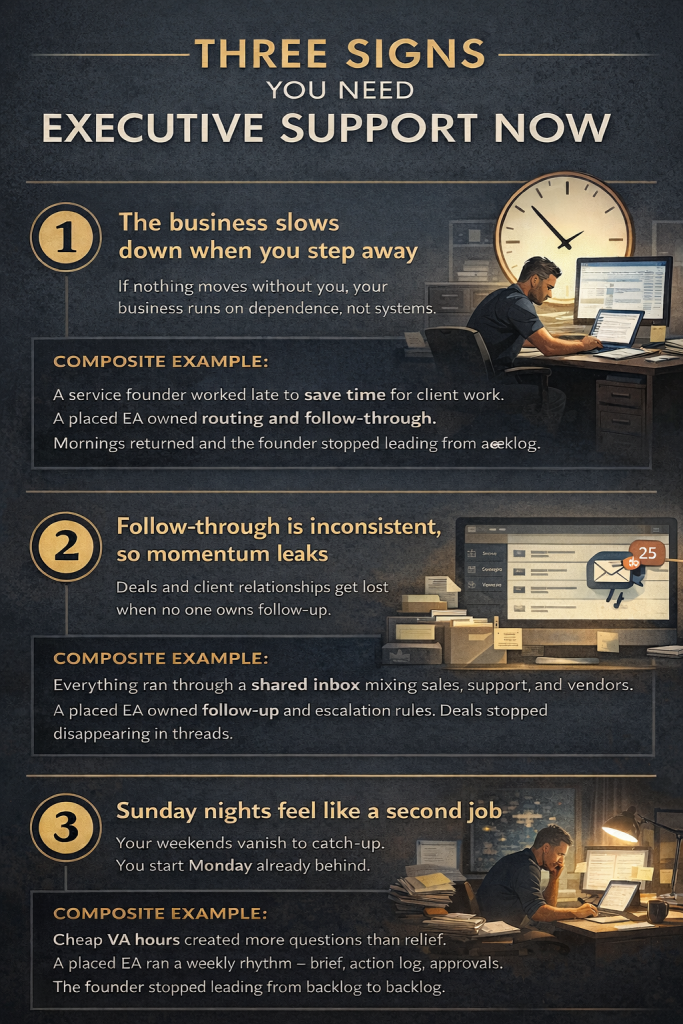
These are structural symptoms, not personal failures. If you recognize even one, you are already paying the bottleneck tax.
1) The business slows down when you step away
If you take a day off and everything stalls, you have an information flow problem. You hold too many approvals, too many dependencies, and too much institutional knowledge in your head.
For example, a service founder handled admin at night so their days stayed “productive.” The business moved, but only through weekend catch-up. Once an EA owned routing and follow-through, mornings returned, and the founder stopped leading from a backlog.
2) Follow-through is inconsistent, so momentum leaks
This is where revenue quietly disappears. When nobody owns follow-ups, deals cool, and clients feel ignored. You do not lose because you lack skill. You lose because consistency is not owned.
For instance, a small team ran everything through a shared inbox. Sales, support, vendors, and approvals are mixed into one stream. When an EA owned correspondence management and escalation rules, response time improved immediately, and issues stopped disappearing in threads.
3) Sunday nights feel like a second job
Sunday catch-up means your week runs on recovery, not preparation. You start Monday reactive because you ended the prior week unfinished.
Example: A consultant tried cheap VA hours and gave up on delegation because it created more questions than relief. The fix was not more hours. The fix was executive-level ownership plus a weekly rhythm: brief, action log, approvals.
The Common Trap: Buying Hours Instead of Buying Ownership
Most founders do not fail at delegation. They buy the wrong structure.
A rented-hours model tends to cap ownership. Work becomes task-based, reactive, and fragile. Continuity suffers. You still hold the system in your head.
Executive support works best when one person owns outcomes. That creates operational efficiency, faster decisions, and cleaner handoffs.
This is also why fractional support can work well. You do not need 40 hours to change your operating system. You need the right ownership lanes.

How Exec Assistants Place Executive Support
Exec Assistants positions itself as a direct-hire placement service, not a managed VA agency.
That matters because direct-hire changes the incentives:
- Your assistant works for you, not a shared queue
- Institutional knowledge stays inside your business
- Accountability becomes clear, week after week
Exec Assistants states:
- A $1,997 one-time recruitment fee
- A vetted shortlist in 7 to 10 days
- 93% hiring success
- A 3-month replacement guarantee for unsuccessful hires at no extra cost
- Hiring from established remote talent hubs such as South Africa and the Philippines
If your goal is long-term leverage, direct-hire tends to beat renting support by the hour.

The Decision Guide: Hours, Scope, ROI
You do not need perfect timing. You need a trigger that forces honesty.
If recurring coordination (calendar, email gatekeeping, meetings, follow-through) steals the hours you need for selling, leading, or building strategy, you are ready.
Full-time or part-time?
Start part-time if budget is a concern or if the scope needs to mature through usage. Many founders begin with 20 hours/week, then expand once the operating rhythm is stable.
Cost of not delegating vs. the cost of a placed EA
Swap in your real hourly value. Keep the logic simple.
Scenario table (example at $150/hour):
- Scenario: 10 hours of admin per week
- Weekly founder cost: 10 hours ($1,500)
- Recovery with EA (70%): 7 hours
- Weekly value reclaimed: $1,050
- Scenario: 20 hours of admin per week
- Weekly founder cost: 20 hours ($3,000)
- Recovery with EA (70%): 14 hours
- Weekly value reclaimed: $2,100
You are not buying help. You are buying back decision quality, focus, and speed.
This is human capital ROI. You reclaim executive bandwidth and reinvest it into the few things that actually grow the company.
Common Hiring Mistakes (And the Fix)
Mistake: Hiring for availability instead of judgment
Fix: Hire for ownership, communication, and follow-through
Mistake: Delegating tasks but keeping outcomes
Fix: Define outcomes like “calendar protected,” “follow-ups closed weekly,” and “weekly brief delivered.”
Mistake: No onboarding system, so delegation stays risky
Fix: Start with least-privilege access, a password manager, and an approvals queue
Mistake: Measuring hours instead of decision velocity
Fix: Track loop closure, response time, and calendar alignment
Mistake: Keeping a weak fit too long
Fix: Set expectations early, give clear feedback, and replace quickly if the match fails.
What does executive support include?
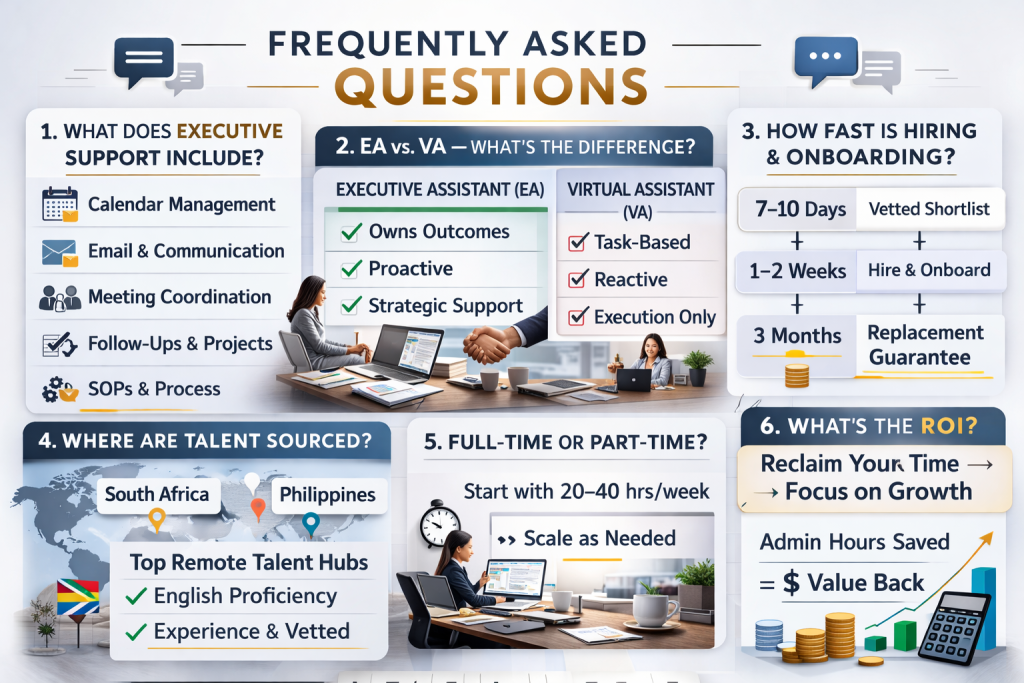
Communication routing, calendar control, meeting ops, follow-through, and SOP documentation. The best EAs also run a weekly rhythm that keeps execution visible.
EA vs VA: What’s the difference?
A VA executes tasks you assign. An EA owns outcomes and protects executive bandwidth by running systems around you.
How long does placement take?
Exec Assistants states that they can deliver a vetted shortlist in 7 to 10 days, depending on role scope and availability.
What if it doesn’t work out?
Exec Assistants states it offers a replacement guarantee within the first 3 months for unsuccessful hires at no extra cost.
Next Step
If you want the business to move faster without you pushing every part of it, place executive support inside the business.
The goal is not more activity. The goal is leverage.