

Startup founders wear a thousand hats: visionary, recruiter, marketer, problem-solver, therapist.
In the early days, doing everything yourself feels noble. It’s proof of your commitment.
But over time, the same strength that helped you build momentum becomes the weakness that stops you from scaling.
According to CB Insights, 42% of failed startups cite burnout and poor delegation as major contributing factors. Not competition. Not capital. Overload.
If you’re constantly working late, drowning in decisions, and losing the spark that started it all, it’s not a sign you’re weak. It’s a sign you’re doing too much that others could do just as well, if not better.
The founders who build lasting companies aren’t superhuman. They’re strategic. They learn early that delegation isn’t surrender; it’s survival.
Here’s how the best founders avoid burnout by building the delegation mindset that keeps startups alive — and thriving.
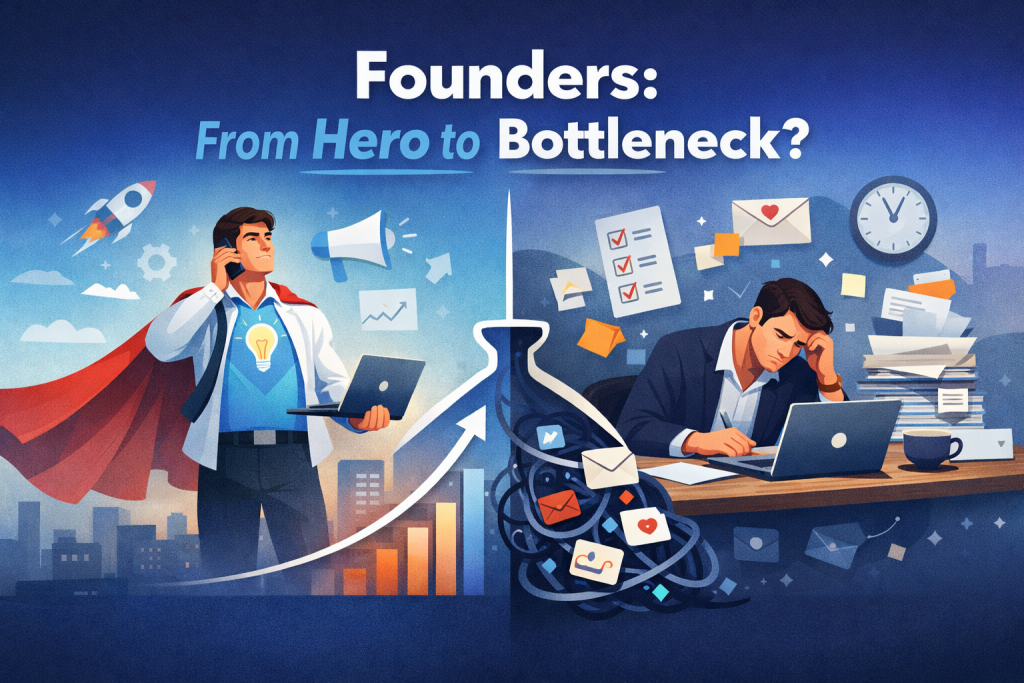
The Hard Truth: You’re the Bottleneck
In the early stages, your ability to do everything is an advantage. But as your company grows, it becomes your most significant constraint.
A Harvard Business Review study found that founders who maintain control over every business function grow 34% slower than those who delegate early.
It’s not because you lack skill; it’s because your time and cognitive capacity are finite.
When you’re the only one who can approve, decide, and fix, your startup stops being scalable. It becomes a mirror of your exhaustion.
“If you’re making every decision, you don’t have a company you have a job,” says Basecamp founder Jason Fried.
Leadership isn’t about carrying everything. It’s about designing systems that have themselves.
Audit Your Time Like an Investor
Investors demand clarity on where every dollar goes. You should demand the same of your time.
Track your tasks for a week and sort them into three categories:
- Low-value: Repetitive or administrative tasks (emails, scheduling, tracking).
- Mid-value: Operational oversight (status checks, short-term decisions).
- High-value: Strategic work (vision, partnerships, fundraising, growth).
If you’re spending most of your week in categories one and two, you’re not leading; you’re managing.
A McKinsey report found that founders who delegate at least 30% of their tasks achieve up to 2.5x faster growth than those who don’t.
Delegation isn’t an expense; it’s a performance multiplier.
“The best founders don’t protect tasks,” says investor Paul Graham. “They protect momentum.”
Every hour you reclaim from operations is an hour you can spend building something that lasts.
Delegate Outcomes, Not Instructions
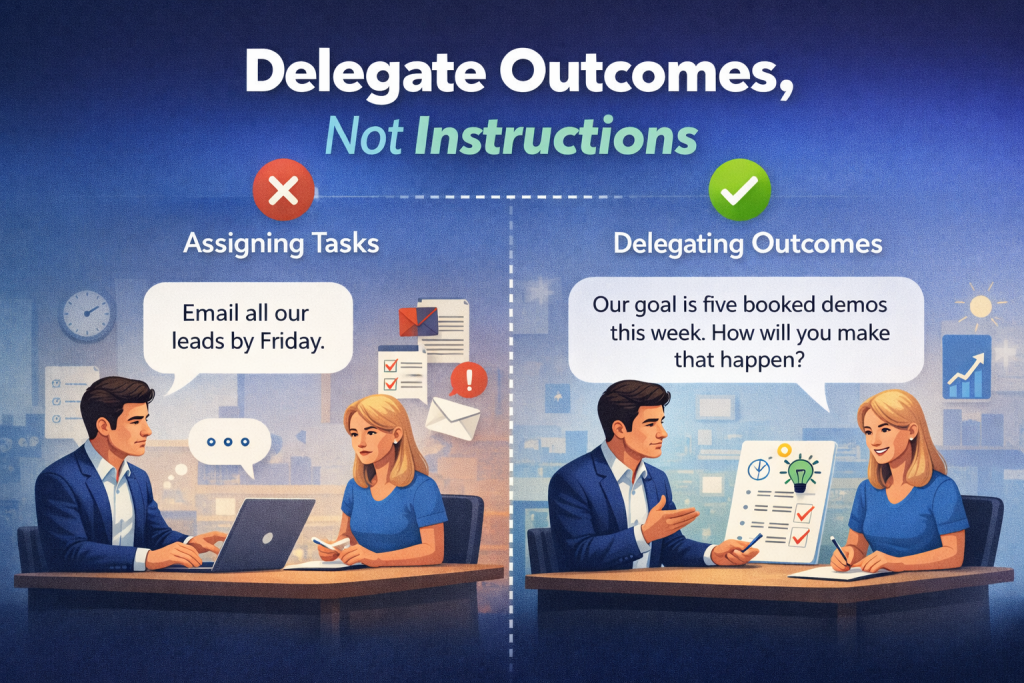
One of the most prominent delegation mistakes founders make is assigning tasks instead of outcomes.
When you tell people how to do everything, you train them to wait for permission. When you tell them what result you want, you train them to think.
For example:
❌ “Email all our leads by Friday.”
✅ “Our goal is five booked demos this week. How will you make that happen?”
This simple shift empowers autonomy. It replaces dependency with ownership.
A Gallup study found that employees trusted to make independent decisions are 43% more engaged and perform 27% better.
Trust your people to figure out the how. Your job is to define the why and the what.
That’s how you scale thinking, not just doing.
Hire for Trust, Not Just Talent
Skills are teachable. Judgment isn’t.
Many founders hire technically brilliant people but refuse to let go because they don’t trust their decision-making. The solution is to hire for alignment first.
“We hire adults,” says Netflix co-founder Reed Hastings. “People who don’t need rules to act responsibly.”
Hire people who share your values, not just your skill gaps. Look for evidence of ownership in interview moments where they made independent calls, solved problems without direction, or improved systems proactively.
When you hire people you trust, you delegate with confidence, not anxiety.
And confidence, more than control, is what builds sustainable leadership.
Systemize Before You Scale
Delegation without structure creates confusion. Delegation with systems creates freedom.
Start documenting how things get done, even informally.
- Use Notion, ClickUp, or Google Docs for processes.
- Use Loom to record walkthroughs instead of explaining tasks repeatedly.
- Use Slack for quick alignment, and Asana or Trello for accountability.
Then define what requires your input and what doesn’t.
Stripe co-founder Patrick Collison credits Stripe’s scalability to “asynchronous alignment.” Every project had clear documentation, so no one needed constant approvals.
A PwC Operations Report found that companies with clear SOPs and communication rules reduce wasted time by 23% and errors by 27%.
Systems don’t replace trust; they reinforce it.
Hire a Strategic Executive Assistant Early
The most overlooked scaling hire is a world-class executive assistant (EA).
Not a task-taker, a decision filter.
An excellent EA doesn’t just manage your calendar; they manage your focus. They decide what deserves your attention, prepare you for meetings, and keep operations flowing while you think strategically.
According to Forbes, executives with top-performing EAs save 12–15 hours per week, the equivalent of an entire workday.
Buffer’s CEO, Joel Gascoigne, credits his assistant with helping him avoid burnout during the company’s early hypergrowth phase:
“I didn’t need another hour in the day. I needed a partner who could protect the hours I already had.”
If you think you’re too busy to hire an assistant, that’s precisely why you need one.
Build a Culture of Ownership, Not Obedience
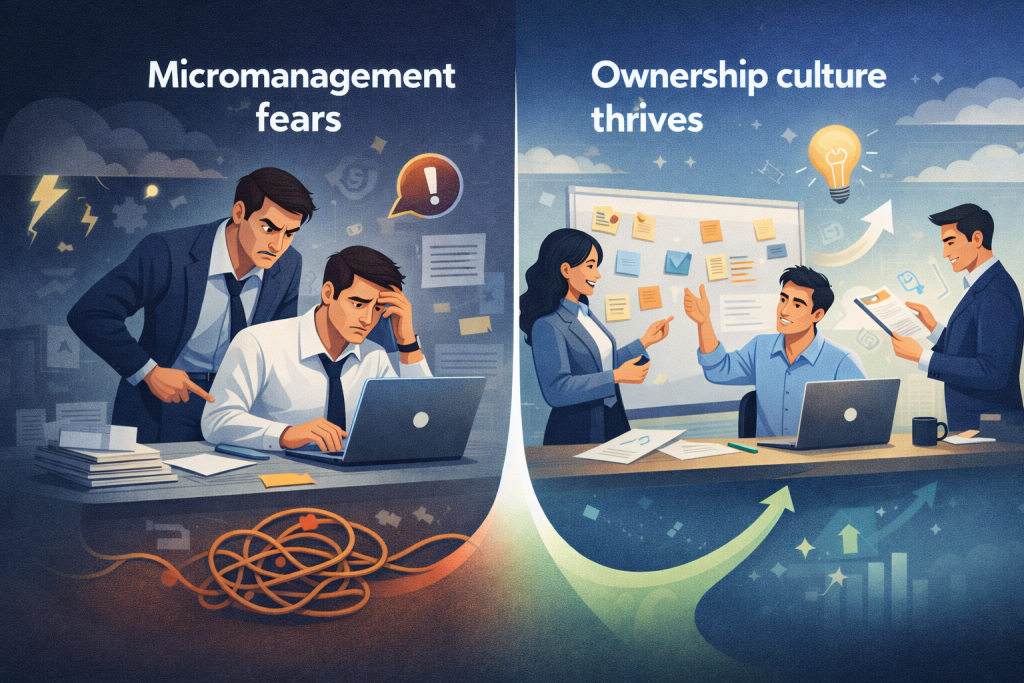
Startups built on control collapse under pressure. Startups built on trust expand under it.
When mistakes happen, they will resist the urge to jump back in. Instead, turn every error into a learning moment.
A Harvard Business School study found that teams encouraged to make and learn from mistakes improve performance 28% faster than those managed through fear.
Create an environment where initiative is celebrated, not punished.
As Basecamp’s Jason Fried says:
“If you want people to act like owners, you have to treat them like owners.”
You don’t scale through micromanagement. You scale through mastery, shared, distributed, and trusted.
Protect the Founder as the Asset
Founders are often their startup’s most significant competitive advantage but also its most fragile one.
No investor, mentor, or co-founder can replace your vision. That means your energy, focus, and health are business-critical resources.
Set boundaries.
- Define work hours and stick to them.
- Schedule rest before you schedule meetings.
- Take one “think day” per week for reflection.
“You can’t lead on an empty tank,” says Arianna Huffington. “Sleep and recovery are leadership tools, not luxuries.”
Your startup can survive a bad month. It can’t survive a burned-out founder.
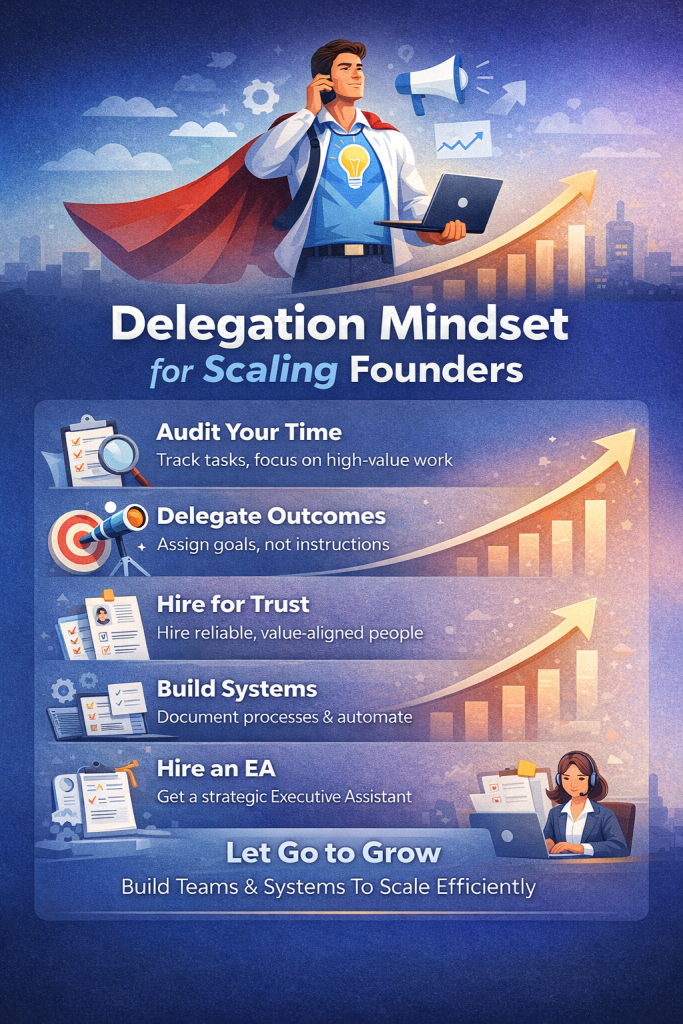
Final Thoughts: Let Go to Grow
Every founder eventually faces a choice:
Keep doing it all, or build something that does it without you.
Delegation isn’t a luxury for later. It’s the foundation for scaling now.
The best founders, from Stripe’s Patrick Collison to Basecamp’s Jason Fried, don’t aim to control every detail. They build teams and systems that can thrive without them in the room.
Because outstanding leadership isn’t about working harder.
It’s about creating structures where complex work compounds even when you’re resting.
“The job of a founder,” says Mads Singers, “is to make yourself less necessary every month.”
So stop trying to be everywhere.
Start building the people, systems, and mindset that make burnout impossible and growth inevitable.
That’s not letting go. That’s scaling up.
To maximize the NLP and Semantic SEO for this burnout-focused article, the FAQs should target the psychology of delegation and the specific “Founder Bottleneck” themes you value.
Frequently Asked Questions
Why is the “Founder Bottleneck” so common in early-stage startups?
The founder bottleneck occurs because the same traits that lead to startup success—high agency, extreme ownership, and technical mastery—become liabilities as the company grows. When every decision must pass through a single person, the organization’s speed is capped by the founder’s physical and mental capacity. Transitioning to a delegation mindset is a mechanical necessity for scaling beyond a solo-operated business.
What is the difference between delegating tasks and delegating outcomes?
Delegating a task means giving someone a set of instructions to follow (e.g., “Post this on LinkedIn”). Delegating an outcome means giving them ownership of a result (e.g., “Increase our inbound leads by 10%”). The latter requires higher trust but generates more leadership leverage because it frees the founder from supervising the “how” and focuses the team on the “what.”
How do I start delegating if I feel I’m too busy to train someone?
This is a classic “time debt” paradox. To break it, start with asynchronous training tools like Loom or Notion. Record yourself performing a recurring task once, explain the logic behind your decisions, and store it in an SOP (Standard Operating Procedure) library. This initial 10-minute investment prevents dozens of hours of future repetitive work and creates a scalable delegation infrastructure.
What are the first tasks a burned-out founder should delegate?
The highest ROI comes from delegating low-value, high-frequency tasks. This typically includes inbox triage, calendar architecture, travel logistics, and basic data entry. Reclaiming just 12–15 hours a week from these administrative “energy drains” provides the mental clarity needed to focus on high-value strategic work like fundraising or product vision.
How does a “Culture of Ownership” prevent leadership burnout?
A culture of ownership is built on the principle that employees should act like owners, not just workers. When team members are empowered to make independent decisions and learn from mistakes, the founder is no longer the “central communication hub.” This distributed decision-making reduces the founder’s cognitive load and ensures the company continues to move forward even when the leader isn’t in the room.