

Behind many high-performing executives is a quiet advantage: an executive assistant who protects focus, removes friction, and keeps the operation moving.
This is not a “nice-to-have” role. Harvard Business Review’s long-running reporting on executive leverage makes the point clearly: a strong assistant is a productivity booster with real ROI when deployed correctly.
The numbers explain why. In HBR’s landmark research on how CEOs spend time, leaders averaged 62.5 hours a week, and about 36% of that time was spent reacting to unfolding issues instead of driving the agenda. Another HBR analysis estimated that about 25% of CEOs’ time is spent on activities that machines could do, meaning much of a leader’s week is still tied up in work that can be delegated, systemized, or automated.
That gap is where a great EA creates leverage. Not just by doing more, but by making the executive more effective.
So what separates “helpful” from “indispensable”? These seven traits show up again and again in top-tier C-suite support.

1) Proactive, pattern-driven execution
A great EA does not wait for instructions. They learn the executive’s priorities, notice the patterns that create stress, and fix problems before they become visible.
What it looks like in practice:
- Calendar architecture that protects deep work, decision windows, and preparation time
- Meeting briefs prepared in advance (context, attendees, desired outcome, risks)
- Travel coordination with contingencies (tight connections, backups, documents, ground transport)
- Deadlines surfaced early, not discovered late
Proactivity is not a personality trait. It is a system: anticipate, prepare, confirm, and follow through.
2) Emotionally intelligent communication
Great EAs manage relationships as much as they manage schedules. They can read tone, adjust style to the stakeholder, and keep communication clean when pressure rises.
They become a stabilizing force because they:
- Know when to push back, when to escalate, and when to absorb noise
- Prevent avoidable conflict by clarifying intent early
- Protect the executive’s reputation by keeping messages crisp and consistent
- Navigate strong personalities without drama
This is stakeholder management in action, and it is one of the fastest ways an EA increases a leader’s influence without adding meetings.
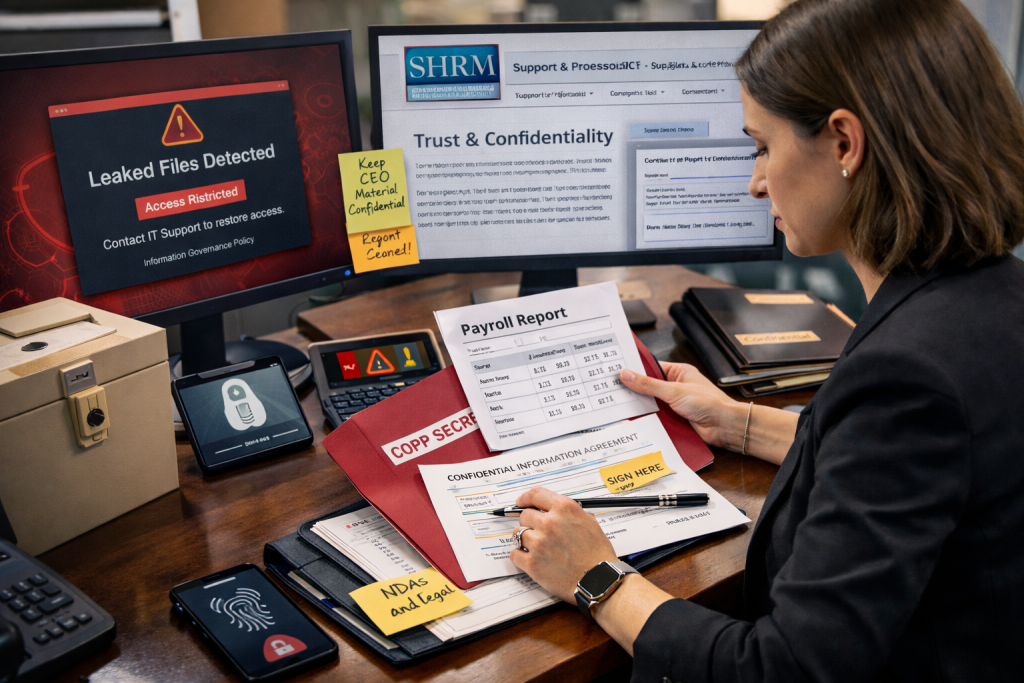
3) Trust, discretion, and Information Governance (OPSEC)
Trust is the operating system of the executive assistant relationship. Without it, delegation collapses.
High-level assistants treat confidentiality like information governance, not like “being careful.” Think OPSEC: who has access, what gets shared, where it lives, and how it is protected.
What this includes:
- NDA awareness and strict handling of sensitive topics (people issues, legal, finance, deals)
- Access control and least privilege (only what is needed, nothing more)
- Clean document hygiene (permissions, version control, secure sharing, audit trails)
- Strong judgment on what should never be forwarded, repeated, or casually discussed
Discretion is not silence. It is disciplined information handling.
4) Systems thinking, not just organization
Organization is baseline. Great EAs design systems that scale.
Instead of juggling tasks, they build repeatable workflows:
- Inbox management and triage rules (priority filters, draft responses, escalation tiers)
- “Inbox zero” habits that reduce executive context switching
- SOPs for recurring processes (travel, expenses, hiring coordination, vendor onboarding)
- Templates and automation that shrink repetitive work
When the system is right, the executive feels calm even when the business is moving fast.
5) Business acumen that improves decisions
Top EAs understand why something matters, not just what the next step is. They can track priorities, spot risk, and support decision-making with context.
Examples of business-aware support:
- Knowing which meetings are revenue-critical vs. noise
- Tracking KPIs, deadlines, and deliverables that tie to strategy
- Pre-screening vendors, flagging contract friction, coordinating approvals
- Building decision hygiene (briefs, options, tradeoffs, next steps)

The EA to Chief of Staff career path
This is also why “EA to Chief of Staff” is such a common progression—the skill set overlaps: prioritization, stakeholder management, operating cadence, and execution against strategy. A strong EA is often a Chief of Staff in training because they already sit at the intersection of context and action.
6) Calm adaptability under pressure
Plans change. Leaders get pulled into urgent issues. Calendars explode.
A great EA stays steady and makes the next best option obvious:
- Fast re-planning without panic
- Clear comms and minimal back-and-forth
- Backup plans ready (alternate attendees, revised agendas, new time blocks)
- A consistent tone that keeps the team confident
This calm is contagious. It reduces friction across the entire organization.
7) Ownership and closed-loop follow-through
This is the multiplier trait.
Ownership-driven EAs do not just “handle tasks.” They close loops:
- Follow-ups that actually get outcomes, not vague check-ins
- Dependency tracking across stakeholders so nothing stalls silently
- A bias toward finishing, documenting, and improving the system after the fact
- Accountability measured by results, not activity
When an EA operates with ownership, the executive gains capacity. When they do not, the executive inherits hidden stress.
Key Traits for Executive Assistants: A Quick Reference
Assessing executive assistant strengths and weaknesses usually starts with three linked clusters: proactivity, organization, and communication, the professional traits that separate a good hire from a great one most consistently. Framed: An executive assistant requires proactivity as a baseline; a great executive assistant exhibits strong communication skills that turn a status update into a usable decision, and a good executive assistant lacks strategic foresight, reacting to requests instead of anticipating them. These key traits for executive assistants sit alongside a separate, teachable layer, administrative skills, and hard skills for executive assistant work, such as scheduling platforms, travel systems, and document management, and together the two layers shape both the executive assistant duties listed in a job posting and the executive support and administrative excellence that are harder to write down. Employers who track this distinction tend to build executive assistant skills development and executive assistant salary bands around it directly, paying for demonstrated judgment rather than task volume alone.
Executive Assistant Mental Clarity: The Overlooked Outcome
Most conversations about this role focus on what the assistant does. Fewer focus on what the executive gets back, and the clearest version of that return is executive assistant mental clarity: the reduced cognitive load a leader experiences once low-value decisions, interruptions, and half-finished threads stop reaching their desk. A leader operating with this kind of clarity is not just less busy. They are making fewer decisions per day, and the decisions that remain get more attention because there is more mental bandwidth left to give them. An executive who trusts the filtering process stops mentally tracking loose ends themselves, freeing up working memory that would otherwise go toward half-monitoring tasks they have technically delegated. That shift, from decision fatigue to executive assistant mental clarity, is hard to put on a scorecard. Still, it is often the difference leaders describe when asked what actually changed after a strong assistant joined.

Final thought: the modern EA is executive leverage
The role has moved far beyond scheduling. Today’s best executive assistants are operational partners: they manage attention, run workflows, protect OPSEC, and keep priorities moving.
In a world where leaders already work long hours and still spend a large share of time reacting, the right EA does something rare. They turn busy into effective.
If you want, I can also convert this into a tighter SEO page version (shorter paragraphs, more skimmable headings) and add an FAQ block targeting “executive assistant vs chief of staff,” “C-suite executive assistant skills,” and “how to measure EA ROI.”
Frequently Asked Questions
What is the difference between an Executive Assistant and a Chief of Staff?
While the roles overlap in priority management, an Executive Assistant (EA) primarily focuses on the executive’s personal productivity, schedule, and administrative infrastructure. A Chief of Staff (CoS) operates at a higher strategic level, often managing cross-departmental projects, overseeing the executive’s direct reports, and acting as a proxy in high-level meetings. Many “great” EAs eventually evolve into the CoS role.
How do you measure the ROI of a high-level Executive Assistant?
ROI is measured by reclaimed strategic time. A top-tier EA should recover at least 10–15 hours of an executive’s week by removing “operational drag.” If a leader’s hourly value is $500/hour, recovering 40 hours a month creates a $20,000/month return in leadership capacity—far outweighing the cost of a dedicated assistant.
Can a remote assistant effectively manage “Emotional Intelligence” tasks?
Yes. High-level remote EAs excel at digital EQ. This involves reading the tone of emails, adjusting communication styles for different stakeholders, and protecting the executive’s reputation through consistent, professional correspondence. It is not about physical presence, but about the “emotional bandwidth” they provide by filtering noise and preventing conflict.
What does “OPSEC” mean in the context of an Executive Assistant?
In C-suite support, OPSEC (Operations Security) refers to strict information governance. A great EA doesn’t just “keep secrets”; they manage who has access to sensitive data, enforce password security (using tools like 1Password), ensure document permissions are correct, and maintain a bias toward “least privilege” access to protect the firm’s legal and financial interests.
How long does it take for an EA to move from “Good” to “Great”?
The transition usually happens within the first 90 days as the EA moves from learning tasks to recognizing patterns. “Greatness” occurs when the assistant stops asking “What do I do next?” and starts saying “I’ve already handled this, here is the result.” This shift requires the executive to provide clear context and the “decision rights” necessary for the assistant to act with ownership.
What qualities make a great executive assistant?
The qualities that consistently separate a great executive assistant from a good one are proactive pattern recognition, emotionally intelligent communication, strict discretion with sensitive information, systems thinking rather than task juggling, business acumen that informs priorities, composure under shifting pressure, and ownership through closed-loop follow-through. The breakdown of each trait, with practical examples, is covered in the sections above.
What are the 5 SMART goals for an executive assistant?
SMART goals for an executive assistant work best when tied to measurable outcomes rather than task counts. Five common examples: reduce the executive’s weekly meeting load by a set percentage within a defined quarter, cut email response turnaround to a specific target time, document and launch a standard operating procedure for one recurring process by a set date, reduce scheduling conflicts to zero over a defined stretch, and complete a relevant skills certification within a set number of months. Each goal should specify what changes, by how much, and by when.
What makes you stand out as an executive assistant?
Evidence stands out more than adjectives. An executive assistant who can point to a specific process they built, a conflict they prevented before it escalated, or a decision they supported with a clear brief stands out more than one who lists traits like “organized” or “detail oriented” without backing them up. Executives respond to concrete examples of judgment exercised under real conditions.
What three words characterize a great executive assistant?
Proactive, discreet, and adaptable capture the core of the role most consistently. Proactive covers anticipating needs before being asked, discreet covers the trust required to handle sensitive information, and adaptable covers staying effective when plans change without notice.
How can an executive assistant improve their skills?
Improvement tends to progress fastest through three channels: seeking direct feedback from the executive on communication style and priorities rather than guessing, deliberately practicing systems thinking by documenting and improving one recurring process at a time, and studying business context, financial basics, and strategic priorities so that decisions carry more informed judgment. Structured courses help with specific tools, but most meaningful improvement comes from applying feedback inside the actual role.
Why is proactivity important for an executive assistant?
Proactivity is the difference between an assistant who reduces a leader’s workload and one who adds to it by requiring constant direction. An executive who has to specify every task before it gets done is still managing, just at one more remove. An assistant who anticipates needs and acts within a clear scope actually returns time and attention to the leader, which is the core value case for the role.