

Microsoft reports the average worker receives 117 emails a day and 153 Teams messages per weekday.
That volume turns leaders into routers. You approve calendars, reply to threads, chase updates, and patch scheduling conflicts. Your business keeps moving, but your attention pays the bill.
A Fractional Executive Assistant changes the architecture. They build an executive operating system that filters noise, protects uninterrupted strategy time, and keeps every commitment moving.
Key Takeaways
- A Fractional Executive Assistant buys decision bandwidth, not extra hands.
- The fractional model runs on a shared services mindset with clear scope and standards.
- You unlock leverage fastest when you hand over inbox triage, calendar gatekeeping, meeting ops, and follow-through.
- You can run modern support through human-in-the-loop workflows with Notion, Slack, Zapier, and AI meeting recorders.
- You should not hire fractional support if you refuse boundaries or avoid delegation decisions.
- A short discovery call should confirm fit, scope, and your first 30-day operating plan.

Why this matters now
Task switching burns real capacity. David Meyer: “Even brief mental blocks created by shifting between tasks can cost as much as 40 percent of someone’s productive time.”
Leaders rarely lose time in one dramatic failure. They lose it through:
- small decisions that stack all day
- follow-ups that slip because nobody owns the loop
- meetings that expand because nobody enforces standards
- context switching that drains energy before lunch
Fractional support works because it removes low-value decisions from your attention and replaces reactive communication with repeatable workflows.
The core concept explained.
A Fractional Executive Assistant delivers senior executive support on a defined weekly cadence, usually through a retainer. The model fits leaders who need high-trust operational leverage without full-time overhead.
The best way to understand the model: you buy variable overhead for executive operations. You dial support up during heavy travel, launches, or investor cycles. You dial support down when the week quiets.
That model differs from “part-time admin.” A strong fractional EA:
- designs systems that reduce decision fatigue
- runs the week without constant instruction
- keeps stakeholders aligned through clean follow-through
- uses asynchronous communication to reduce meetings
This also maps to a real cognitive principle. Researchers define cognitive offloading as “the use of physical action to alter the information processing requirements of a task so as to reduce cognitive demand.”
Your Fractional Executive Assistant acts as your offloading system. They capture, sort, route, and close loops so you decide fewer trivial things and act faster on the few that matter.
If you already evaluated Outsourced Executive Assistant options, the fractional model often delivers the cleanest path to structure because it prioritizes systems over task lists.
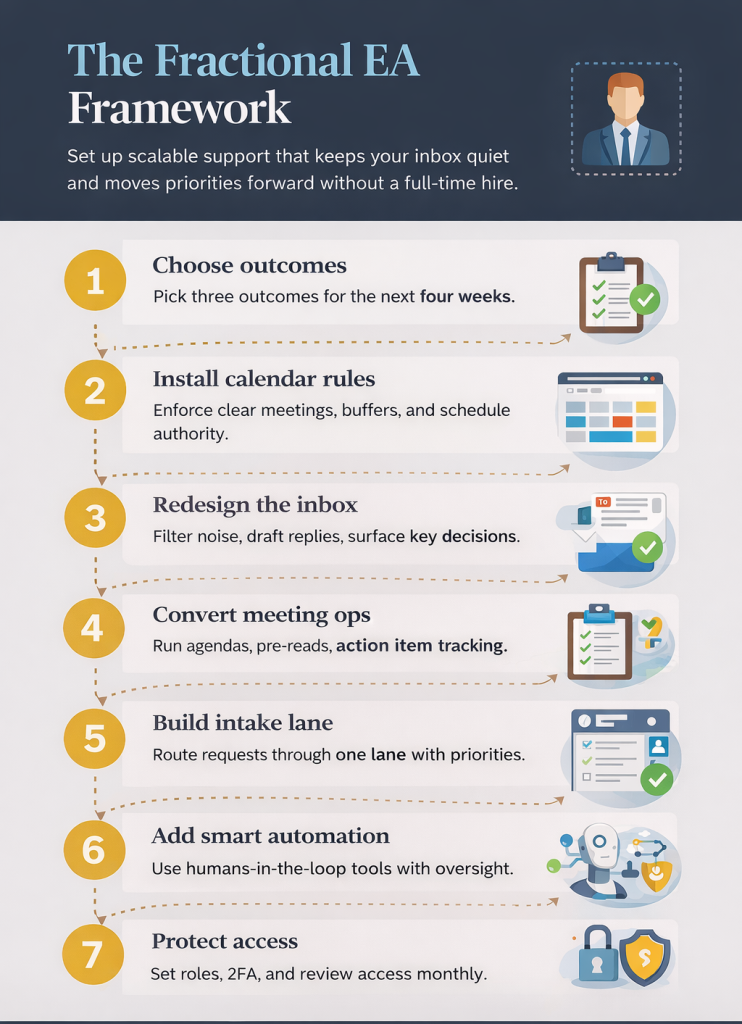
Step-by-step framework
Use this framework to set up fractional support that delivers leverage fast. You can publish this section as a How-To and earn rich results when you pair it with a clean structure and clear steps.
1) Choose outcomes that force clarity
What to do: Pick three outcomes for the next four weeks.
Why it matters: Outcomes prevent busywork and protect leverage.
Quick example: “Protect three uninterrupted strategy blocks each week” beats “help with my inbox.”
2) Install calendar gatekeeping rules
What to do: Set rules that define what deserves live time.
Why it matters: Your calendar shapes your decisions, energy, and speed.
Quick example: Your EA enforces buffers, meeting types, and scheduling authority so you stop renegotiating your week.
3) Redesign the inbox around decisions
What to do: Treat email like a decision engine, not a task pile.
Why it matters: Email creates hidden work and constant interruption.
Quick example: Your EA drafts replies, routes FYI items into a digest, and surfaces only true decisions at set times.
4) Convert meetings into a follow-through machine
What to do: Run a consistent meeting ops system.
Why it matters: Meetings fail when nobody owns outcomes.
Quick example: Your EA sets agendas, requests pre-reads, captures decisions, assigns owners, and updates an action register.
If you want a reference model, build a page called Service Standards and document your scope rules, SLAs, response times, and escalation triggers. That page gives your team and your clients one source of truth.
5) Build one request intake lane
What to do: Route requests through one lane with priority and deadline fields.
Why it matters: Random pings destroy cognitive flow.
Quick example: Your EA routes non-urgent items into an intake form and batches reviews twice a day.
6) Add automation with human judgment
What to do: Use tools that speed capture and routing, then keep a human in the loop for judgment.
Why it matters: Automation scales speed, but judgment protects quality.
Quick example stack:
- Notion stores SOPs, preferences, and decision logs
- Zapier routes form inputs into tasks and reminders
- Slack workflows capture requests and approvals
- Otter or Fireflies generate transcripts and first-pass summaries
IBM defines human-in-the-loop this way: “a system or process in which a human actively participates in the operation, supervision or decision-making of an automated system.”
Your Fractional Executive Assistant reviews outputs, corrects nuance, and turns summaries into clear actions.
7) Protect confidentiality with a zero-trust routine
What to do: Set a single security protocol and follow it every time.
Why it matters: Fractional work demands clean separation and clean access discipline.
Quick example: Use role-based permissions, MFA on critical accounts, and a password manager for credential handoff, then run a monthly access review.
If you want a deeper system, publish an Access Controls for Executive Support guide and standardize who can see what.
8) Run a weekly executive ops review
What to do: Hold a 15-minute weekly review with your EA.
Why it matters: Small improvements compound into a calmer week.
Quick example: You review open decisions, remove low-ROI requests, tighten rules, and add one SOP that removes repeated friction.
When you transition into Virtual Executive Assistant Services, this framework gives you the fastest path to predictable leverage.
Decision guide
Leaders often ask one question: “Do I need a Fractional Executive Assistant or a Virtual Assistant?”
Ask these instead.
Choose a Fractional Executive Assistant when you need
- a self-managing operator who runs executive ops
- calendar gatekeeping and inbox triage that protect leverage
- follow-through across stakeholders without constant chasing
- flexibility without full-time headcount risk
Choose a traditional VA when you need
- Task execution with tight instructions
- Low ambiguity work with stable scope
- Support that rarely touches executive judgment
Choose a full-time EA when you need
- Daily coverage plus constant coordination
- Heavy meeting volume and high live-touch scheduling needs
- Enough recurring load to fill most weeks
Choose a Chief of Staff when you need
- Cross-functional leadership and program ownership
- Strategy execution across teams
- Decision forcing across leaders
Add one more filter. Cost and value behave differently across models. Full-time executive admin roles often command strong compensation. O*NET reports a $74,260 median annual wage for executive secretaries and executive administrative assistants.
Fractional support often wins as the ROI sweet spot when you need senior leverage without the full-time lock-in.
If you want the clean comparison, publish an Executive Assistant vs Chief of Staff guide and use it as your decision hub.

Common mistakes and fixes
Mistake 1: You buy hours instead of outcomes
Fix: Set weekly outcomes and review them every week.
Consequence if ignored: Scope expands, and results flatten.
Mistake 2: You refuse to grant scheduling authority
Fix: Give your EA rules and real control.
Consequence if ignored: Calendar churn continues, and planning never settles.
Mistake 3: You keep everything synchronous
Fix: Move updates into async digests and written briefs.
Consequence if ignored: Meetings expand and attention fragments.
Mistake 4: You skip the action register
Fix: Track owners and due dates in one list.
Consequence if ignored: Follow-ups slip and trust leaks.
Mistake 5: You delegate personal tasks without boundaries
Fix: Set approval thresholds and define what needs your sign-off.
Consequence if ignored: Rework grows, and friction rises.
Mistake 6: You automate without review
Fix: Keep human judgment in summaries, drafts, and stakeholder messages.
Consequence if ignored: Automation spreads errors fast.
Mistake 7: You never train the system
Fix: Build a small SOP library and update it weekly.
Consequence if ignored: You repeat the same explanations forever.
Cal Newport captures the cost of constant switching in one line: “Treat cognitive context shifts as ‘productivity poison.’”
Mini case studies
Case 1: Scale-up founder who stalled decisions
A founder ran a growing team and handled every thread and calendar conflict. They answered late, missed follow-ups, and slowed decisions.
Their Fractional Executive Assistant installed a daily decision digest, enforced scheduling rules, and ran a weekly ops review. The founder reclaimed predictable strategy blocks and moved decisions faster.
Case 2: Portfolio professional with multiple worlds
A leader ran two ventures, served on a board, and maintained a speaking calendar. They double-booked meetings and missed personal commitments because systems lived in separate tools.
Their Fractional EA unified calendars, built one request intake lane, and created a Notion dashboard that held preferences, travel rules, and stakeholder notes. The leader reduced context switching and showed up prepared.
Case 3: High-end solo consultant who refused headcount
A consultant billed high rates and hated admin. They delayed invoices, missed follow-ups, and lost momentum after travel.
Their Fractional EA installed a weekly cadence for follow-ups, billing coordination, and travel prep. The consultant maintained independence and gained operational calm.

What is a Fractional Executive Assistant?
A Fractional Executive Assistant is a part-time professional who provides senior executive support. A Fractional EA manages calendar control, inbox triage, and meeting follow-through.
How many hours should you start with a Fractional Executive Assistant?
Start with 5–10 hours per week for calendar gatekeeping, inbox management, and task follow-up. Increase hours when meetings and stakeholder coordination increase.
What tasks should you delegate first to a Fractional Executive Assistant?
Delegate calendar rule enforcement, inbox sorting, meeting operations, and action tracking. These tasks create leverage and reduce executive context switching.
How does a Fractional Executive Assistant handle confidentiality?
A Fractional Executive Assistant ensures confidentiality by using role-based access, multi-factor authentication, and secure password managers. Monthly access reviews maintain system hygiene.
Can a Fractional Executive Assistant use AI and automation safely?
Yes. A Fractional Executive Assistant uses AI safely by keeping a human in control. Tools like Notion, Zapier, Slack workflows, Otter, and Fireflies are used for automation with human oversight.
Does the fractional model support personal life tasks?
Yes. A Fractional Executive Assistant can support personal life tasks with clear rules, scheduling boundaries, and approval thresholds. The model works when business and personal systems are integrated.
When should you hire a full-time Executive Assistant?
Hire a full-time Executive Assistant when daily support and real-time coordination are required. Full-time EAs are necessary for executives with constant operational demands.
Can a Fractional Executive Assistant support ADHD-style overwhelm?
Yes. A Fractional Executive Assistant supports ADHD challenges through task capture, calendar structure, inbox sorting, and consistent follow-through. The system reduces decision fatigue and maintains work momentum.
Next step
If you hit a capacity crossroads, fractional support can restore leverage without a full-time bet. Book a free consultation with Exec Assistants and map your scope, workflows, and service standards. You should leave the call with a clear first-month plan and a simple path to reclaim decision bandwidth.