

Companies no longer hire executive assistants only to manage calendars. Modern organizations hire virtual executive assistants to protect leadership time, organize operations, and keep strategic initiatives moving.
Executives operate inside complex environments: investor updates, distributed teams, and constant decision-making. A strong assistant removes operational friction so leaders focus on growth.
Research from McKinsey & Company shows that organizations that redesign leadership workflows improve executive productivity by 20–30%. Another study from Gartner found that executives spend almost 40% of their week on tasks that someone else could manage.
That gap explains why demand for remote executive support continues to grow.
This guide explains:
- What a virtual executive assistant actually does
- Strategic outcomes companies expect
- Tools and skills required
- Salary expectations
- A copy-and-paste job description template
- Interview questions companies use
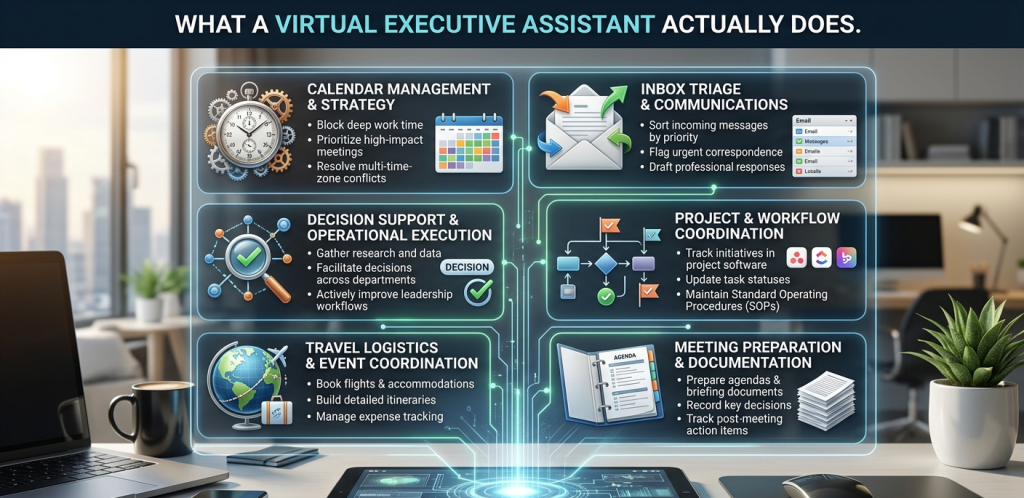
What a Virtual Executive Assistant Actually Does
A virtual executive assistant supports senior leaders remotely and manages operational systems that affect leadership productivity.
The role focuses on outcomes, not just tasks.
Strategic Outcomes Companies Expect
A high-level assistant improves how leadership operates by:
Protecting Executive Focus
- Implement calendar strategy and time-blocking
- Remove low-value meetings
- Prepare leaders for important decisions
Improving Communication Flow
- Perform inbox triage
- Filter urgent messages
- Maintain communication clarity across teams
Keeping Projects Moving
- Track initiatives
- Maintain task accountability
- Coordinate deadlines across departments
Supporting Global Operations
- Manage multi-time-zone schedules
- Coordinate international meetings
- Align distributed teams
A report from Harvard Business Review found that executives who delegate operational coordination reclaim up to 8 hours per week.
Leadership expert Michael Hyatt summarizes the role clearly:
“An executive assistant should function as a force multiplier for the leader.”
Example: How a Virtual Executive Assistant Supports a Founder
Consider a startup founder raising funding.
A skilled assistant would:
- Organize investor meeting schedules
- Prepare briefing notes before calls
- Track follow-ups in CRM tools
- Coordinate meetings across countries
- Maintain fundraising documentation
Instead of reacting to requests, the assistant structures the executive workflow.
Productivity researcher Cal Newport explains:
“Professionals produce better results when they protect uninterrupted work time.”
Executive assistants create that environment.

Core Responsibilities in a Virtual Executive Assistant Role
Companies expect clear, action-driven responsibilities.
Calendar Management
Executives lose productivity when meetings dominate their schedules.
- Plans weekly calendars strategically
- Protects deep work time
- Coordinates leadership meetings
- Resolves scheduling conflicts
Productivity research from RescueTime shows knowledge workers lose over 2 hours per day to interruptions and inefficient scheduling.
Inbox Triage and Executive Communication
Executives receive large volumes of communication.
Assistants:
- Prioritize emails
- Draft responses
- Flag urgent issues
- Maintain structured communication systems
Productivity expert David Allen explains:
“Your mind works best when it focuses on decisions, not storage.”
Inbox management supports decision-making.
Workflow and Project Coordination
Many assistants manage operational execution behind the scenes.
They use tools such as:
- Asana
- ClickUp
- Trello
- Notion
Research from Asana shows employees spend 58% of their day coordinating work instead of doing work.
A strong assistant reduces that overhead.
Travel Planning and Executive Logistics
Assistants coordinate complex travel plans that include:
- Multi-leg flights
- Executive itineraries
- Meeting coordination
- Expense tracking
The Global Business Travel Association reports that structured travel planning reduces corporate travel costs by 12–18%.
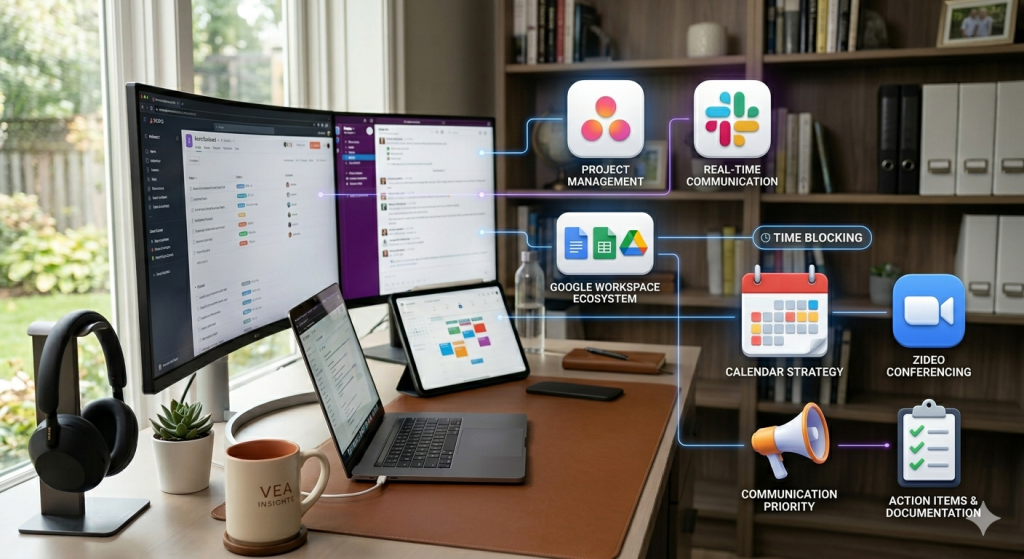
Tools Virtual Executive Assistants Use
Most companies expect assistants to work inside a defined tech stack.
Communication
- Slack
- Microsoft Teams
- Zoom
Productivity
- Google Workspace
- Microsoft 365
Scheduling
- Calendly
- Acuity Scheduling
These tools form the operational infrastructure behind leadership teams.
Salary for Virtual Executive Assistants
Companies searching for job descriptions often want salary benchmarks.
Here is a realistic range based on current remote hiring markets.
| Experience Level | Typical Salary (Annual) | Hourly Equivalent |
|---|---|---|
| Entry-Level EA | $35,000 – $50,000 | $18 – $25/hr |
| Experienced EA | $50,000 – $75,000 | $25 – $40/hr |
| Specialized Executive EA | $75,000 – $95,000+ | $40 – $55/hr |
According to labor market data from the U.S. Bureau of Labor Statistics, executive assistant roles continue to grow as companies adopt remote operations.
Many organizations now hire global talent from locations such as South Africa, where businesses find experienced remote professionals with strong executive support skills.
Remote executive support roles have increased by over 40% since 2020.
Standard Virtual Executive Assistant Job Description Template
This section serves as the practical hiring resource.
Job Title
Virtual Executive Assistant
Role Overview
We are hiring a virtual executive assistant to support senior leadership by managing schedules, communication workflows, and operational coordination.
Daily Tasks
- Manage executive calendars
- Coordinate meetings and calls
- Perform inbox triage
- Prepare reports and briefing notes
- Maintain task tracking systems
- Organize travel itineraries
- Document processes and SOPs
Requirements
- 3+ years supporting executives
- Experience working remotely
- Strong written communication skills
- Ability to maintain confidentiality
- Proficiency with productivity tools
Preferred
- Startup or operations experience
- Experience supporting founders or CEOs
- Project coordination background
Common Interview Questions for Virtual Executive Assistants
Companies hiring this role often ask structured questions to evaluate candidates.
Examples include:
- How do you manage competing executive priorities?
- Describe a time you solved a scheduling conflict across time zones.
- How do you organize inbox triage for a busy executive?
- Which tools do you use to track leadership tasks?
- How do you maintain confidentiality while supporting senior leaders?
- How do you prepare executives for important meetings?
- What systems do you use to prevent workflow breakdowns?
Why the Role Continues to Grow
Companies increasingly rely on structured operational support.
Research from PwC shows that organizations that improve administrative productivity increase operational efficiency by 25%.
The modern executive assistant often becomes:
- An operations coordinator
- A leadership workflow manager
- A strategic support partner
Businesses that invest in strong executive support scale faster and operate with less internal friction.
Final Insight
A strong virtual executive assistant does more than manage schedules. They improve how leadership works.
Companies that understand this hire assistants who:
- Protect executive time
- Maintain operational clarity
- Coordinate decisions across teams
That shift explains why this role continues to expand across industries worldwide.