

In the modern business environment, the most valuable skill is not multitasking. It is managing complexity.
High-level leaders do not rely on willpower to manage nonstop digital touchpoints. They rely on operating systems. The difference is simple: tools accelerate work, but a human operator protects priorities.
This is where a strategic Executive Assistant matters. An EA you hire does not just “use tools.” They apply executive judgment, manage nuance, and keep your leadership operating rhythm intact. AI can process information fast. A skilled EA decides what matters, what can wait, and what requires your attention today.
Below is the executive tech stack, rewritten the right way: tools as instruments, and the human intelligence layer as the system owner.
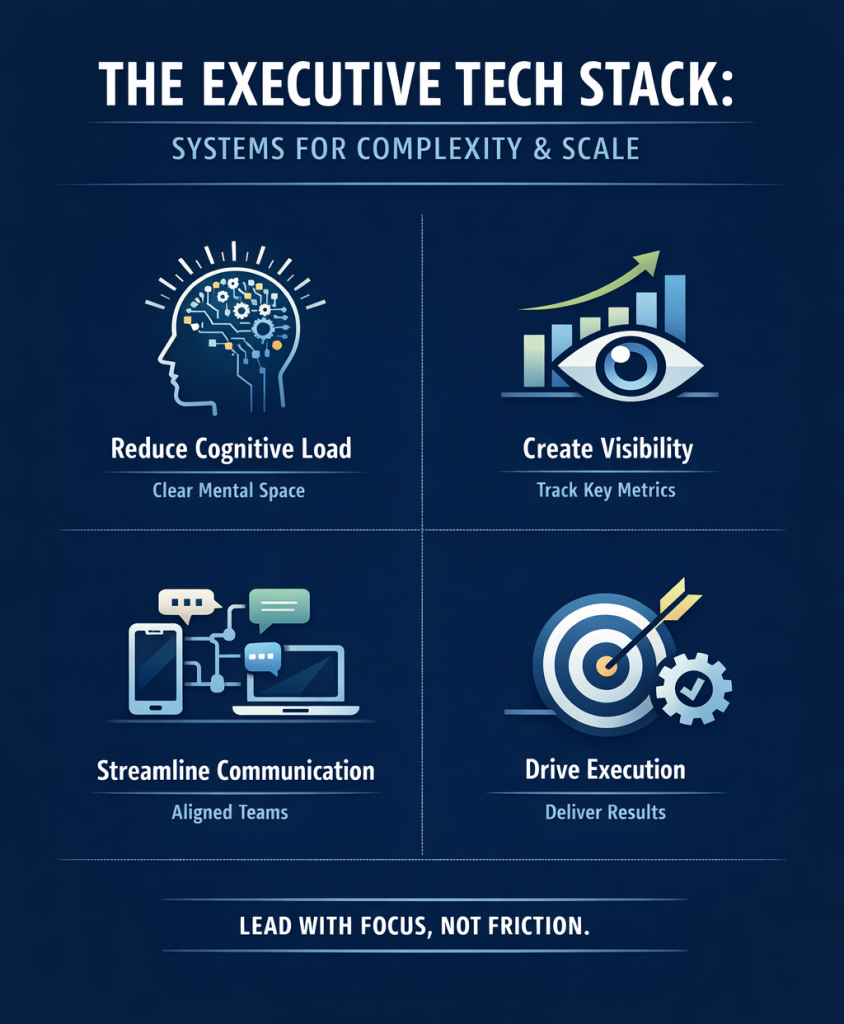
The Single Source of Truth: Notion or Coda
Knowledge Management System (KMS) and Operational Hub
How a strategic EA uses it:
- Consolidates scattered information into executive dashboards for KPIs, OKRs, and weekly priorities
- Maintains decision logs so the team remembers why a strategy shifted
- Builds a second brain that links initiatives to owners, deadlines, and outcomes
Strategic advantage: Your EA eliminates information scavenger hunts and protects decision context.
Time Orchestration: Motion or Reclaim.ai
AI-driven calendar protection
How a strategic EA uses it:
- Architect your week around deep work, preparation, and recovery blocks
- Resolves calendar conflicts based on stakeholder priority and business impact
- Protects buffers for travel, negotiation prep, and high-stakes calls
Strategic advantage: Your EA designs your schedule so it reflects priorities, not pressure.
Executive Judgment in the Inbox: Superhuman or Missive
High-velocity communication and triage
How a strategic EA uses it:
- Triage email based on your current priorities, not generic rules
- Draft responses in your voice and escalate what requires executive judgment
- Coordinates sensitive threads across stakeholders without misalignment or forward chains
Strategic advantage: Your EA turns the inbox from a backlog into a controlled pipeline.
Portfolio Visibility Without Micromanagement: Asana or ClickUp
Work management and accountability
How a strategic EA uses it:
- Runs weekly executive reviews and maintains a live “risks and blockers” view
- Chases owners, clears bottlenecks, and surfaces slippage early
- Keeps initiatives aligned to outcomes without dragging you into task management
Strategic advantage: You delegate execution while staying connected to reality.
High-context Async Alignment: Slack and Loom
Alignment without interruption
How a strategic EA uses it:
- Records Loom briefings that add context and decision rationale, not just updates
- Maintains Slack channel hygiene so communication stays searchable and low-noise
- Replaces status meetings with structured async updates and clear next steps
Strategic advantage: Your EA reduces meeting load while increasing clarity and follow-through.
Institutional Memory for Leaders: Fireflies.ai or Otter.ai
Automated meeting transcription and synthesis
How a strategic EA uses it:
- Produces summaries with decisions, owners, and action items within hours
- Tags risks and commitments from board, investor, and client calls
- Stores searchable transcripts so the organization does not lose critical context
Strategic advantage: Meetings become reusable assets instead of memory tests.
Capture That Feeds Execution: Apple Notes or Evernote
Cognitive offloading
How a strategic EA uses it:
- Captures voice notes, travel ideas, and in-the-moment decisions instantly
- Converts notes into tasks, agendas, or briefing docs inside the KMS
- Maintains an idea pipeline so valuable input does not disappear
Strategic advantage: Your EA translates sparks into execution, not clutter.
Automation With Oversight: Zapier or Make
Workflow integration
How a strategic EA uses it:
- Automates handoffs so work moves without manual chasing
- Builds lightweight workflows that support the team without creating tool sprawl
- Monitors exceptions so automation never creates silent operational risk
Strategic advantage: You reduce operational friction without sacrificing quality control.
Cognitive Regulation Under Pressure: Calm or Headspace
Mindfulness and recovery
How a strategic EA uses it:
- Protects reset windows between negotiations and high-stakes conversations
- Builds simple routines you will actually use, not aspirational habits
- Reduces context switching by enforcing structured breaks and focus blocks
Strategic advantage: You maintain the operating capacity that drives goosoundcisions.
The Human Intelligence Layer: The Strategic Executive Assistant
Managed executive support and strategic business partner
AI can summarize meetings and sort messages. It cannot reliably handle political risk, interpret nuance, or manage sensitive relationships. A strategic EA fills that gap.
What a human EA does that tools cannot:
- Applies judgment when priorities conflict
- Navigates nuance in stakeholder dynamics
- Handles ethics, discretion, and escalation decisions
- Manages up when the calendar lies about reality
Real scenarios where an EA matters:
- Reconciling conflicting stakeholder schedules without damaging relationships
- Managing a sensitive board-level conflict with discretion and careful sequencing
- Preparing executive briefings that frame trade-offs, risks, and recommended decisions
- Protecting focus time during crises while keeping execution moving
Strategic advantage: Tools amplify systems. An EA amplifies judgment.
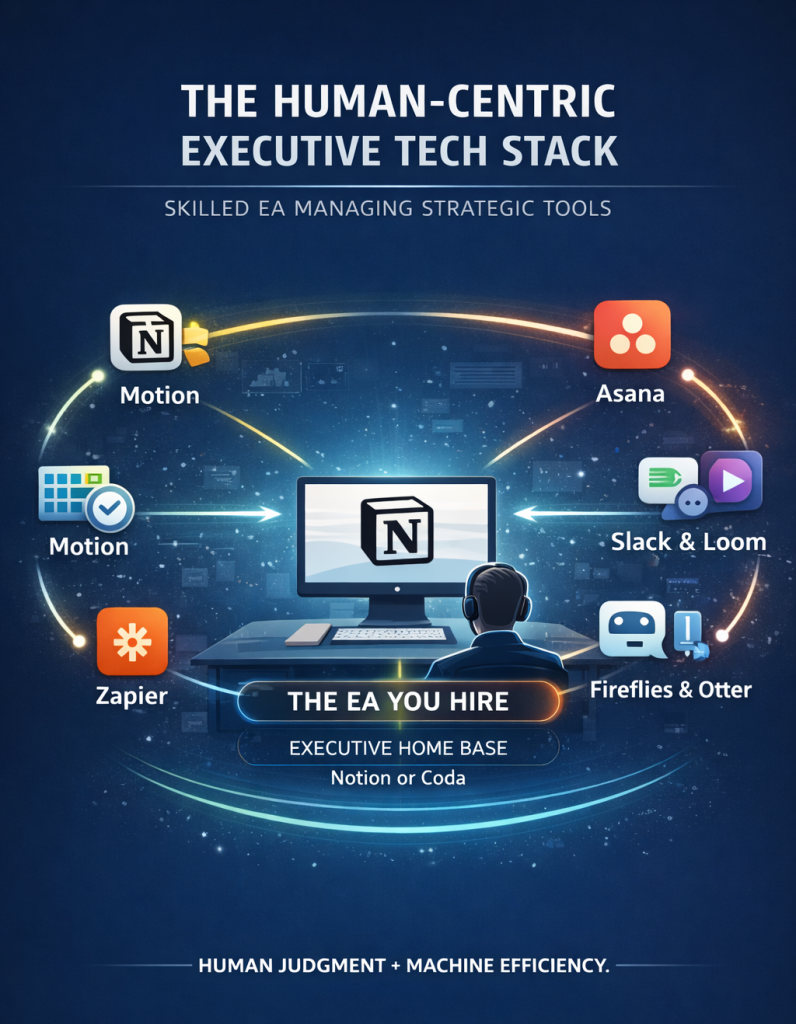
Implementation: Build Your Home Base
To avoid tool sprawl, pick one home base (Notion or Coda) and connect specialized tools to it. Then let your EA operate the system.
A streamlined setup looks like this:
- Operating system: Notion
- Time management: Motion
- Execution: Asana
- Automation: Zapier
- Operator: The EA you hire
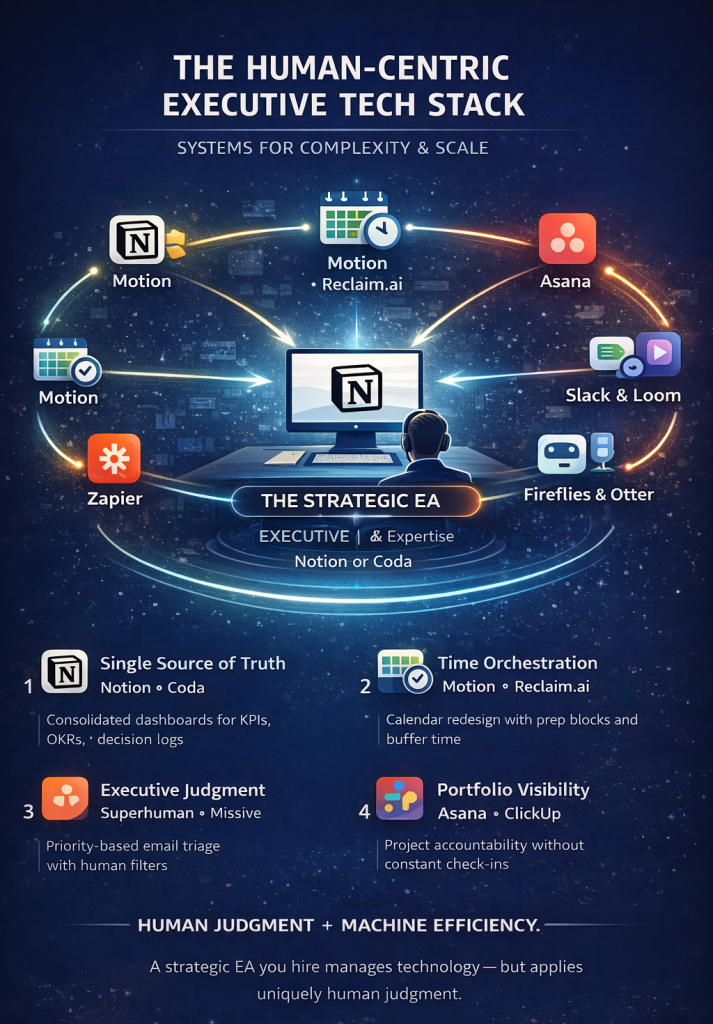
Final Thought
Organization is not about being busy. It is about being free to lead.
When your systems handle the noise and your EA protects priorities, you gain the space to focus on what only you can do: vision, strategy, and people.
These FAQs are designed to highlight the intersection of high-end software and the human intelligence required to operate it, creating a strong semantic link between tech and strategic outsourcing.
Frequently Asked Questions
What is a “Human-in-the-Loop” system in executive support?
A Human-in-the-Loop (HITL) system is an operational model where AI and automation handle data processing and repetitive tasks. At the same time, a human Executive Assistant provides the judgment, nuance, and ethics that algorithms lack. In an executive tech stack, the “loop” ensures that sensitive decisions such as prioritizing a board member’s request over a general inquiry are handled with professional discretion and contextual awareness.
Can an Executive Assistant manage my tech stack remotely?
Yes. In fact, remote EAs are often more tech-native and experienced in managing cloud-based stacks like Notion, Asana, and Slack. A strategic EA acts as the system architect, ensuring that your different tools communicate effectively (often via Zapier or Make) and that information doesn’t get siloed in a single platform.
How does a “Single Source of Truth” reduce executive stress?
Executive stress is often caused by “information scavenger hunts” searching through emails, Slack threads, and docs for a single answer. By consolidating all KPIs, project statuses, and decision logs into a platform like Notion or Coda, your EA creates a Single Source of Truth. This reduces cognitive load, as you only need to check one dashboard to understand the state of your entire organization.
Why is AI transcription not enough for effective meeting minutes?
While tools like Fireflies.ai or Otter.ai can transcribe every word, they cannot distinguish between a casual comment and a high-stakes commitment. A strategic EA reviews these transcripts to extract context-aware action items, identify potential risks, and ensure that institutional memory is captured in a way that is searchable and actionable for the leadership team.
How does a “Tech Stack” prevent tool sprawl and burnout?
Tool sprawl occurs when a team adds software without a unifying system, leading to fragmented communication. An executive tech stack, managed by an EA, focuses on integration over accumulation. By picking a “Home Base” (like Notion) and connecting specialized tools to it, you ensure that technology serves your focus rather than demanding more of your attention.