

Every CEO loses strategic capacity not because they lack discipline, but because no one has mapped which tasks genuinely require their Authority and which tasks drain it. A CEO who personally manages inbox triage, schedules their own meetings, and approves low-stakes decisions does not suffer from a time management problem. They suffer from a delegation architecture failure.
The CEO Delegation Matrix solves that failure at the structural level. The Executive Assistant builds the framework, audits the CEO’s full workload, classifies every recurring task by authority requirement and strategic Leverage, and transfers operational ownership in a structure that the EA documents, governs, and permanently maintains. This article explains what the CEO Delegation Matrix is, how to build one, how it compares to a Delegation of Authority and RACI framework, and how Executive Assistants deploy it to reclaim high-leverage hours for their executive.
Why Delegation Determines CEO Performance
Before covering how the CEO Delegation Matrix works, consider what it costs when no framework exists.
Harvard Business Review research by Garton and Mankins found that Fortune 500 CEOs received an average of 200 emails per day and spent 24% of their working hours in reactive administrative mode: Responding to messages, attending meetings with no pre-circulated agenda, and making decisions that belonged at lower levels of the organization. McKinsey research confirms that CEOs who delegate effectively generate 33% higher revenue growth than those who centralize decision-making authority at the top.
The cost extends beyond the CEO’s calendar. When the CEO becomes the decision bottleneck, teams wait. Product decisions stall pending approval. Hiring timelines extend. Clients receive delayed responses. The operational drag multiplies across every function that requires executive sign-off on decisions the authority matrix should have resolved at a lower level.
Three CEOs demonstrated the commercial value of a structured delegation framework at scale.
At Google, Larry Page applied a delegation principle borrowed from Intel founder Andy Grove: every recurring decision belongs to the person closest to the information, provided they operate within a defined authority ceiling. Page used OKRs (Objectives and Key Results) as the delegation framework that allowed him to maintain strategic alignment without involving himself in execution-level decisions as Google scaled to hundreds of millions of users.
Richard Branson built a 400-company group by embedding trusted managing directors in each business unit and governing each MD’s decision-making power through a formal authority matrix. His EA team maintained that matrix, updated authority thresholds as business units scaled, and prepared structured briefings for Branson’s review. He received curated, pre-processed information, not ad hoc requests.
Amazon’s Jeff Bezos developed the single-threaded owner (STO) model to prevent organizational ambiguity from slowing execution. Each initiative received one owner with full Authority and accountability within a defined Delegation of Authority ceiling. Bezos retained sign-off only on decisions affecting Amazon’s core business architecture. The company scaled to over 1.6 million employees while maintaining execution velocity at the operating level because the delegation architecture, not Bezos, governed day-to-day decisions.
The pattern across all three is identical: a defined authority framework, an EA or operational support layer that maintains it, and a CEO who retains strategic focus because the architecture prevents low-leverage decisions from reaching them by default.
What Is a CEO Delegation Matrix?
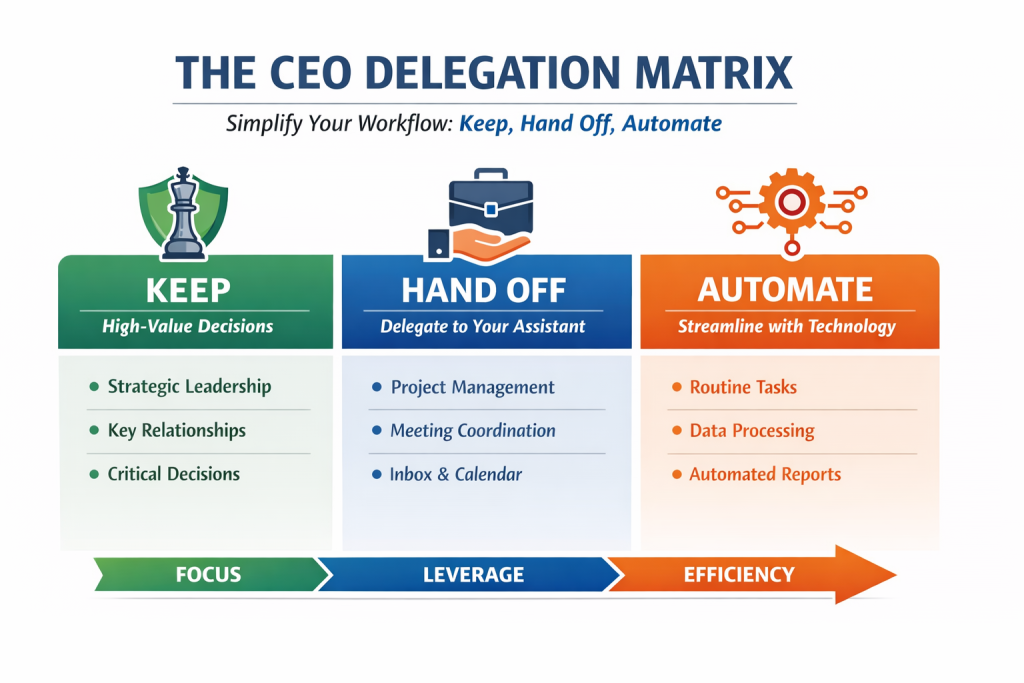
The CEO Delegation Matrix categorizes executive workflows by authority thresholds and strategic Leverage, then assigns every recurring task to one of three operational zones. The Executive Assistant builds and maintains the matrix as the central governance document for CEO workload management.
The framework draws on two management disciplines simultaneously. Delegation of Authority (DoA) defines who holds decision-making power at each organizational threshold, covering financial commitments, signing Authority on contracts, procurement lifecycle decisions, hiring approvals, and corporate resolutions. Task prioritization ranks every recurring activity by direct contribution to revenue, retention, product velocity, and organizational trust.
The CEO Delegation Matrix prioritizes complex tasks by enforcing explicit operational ownership across all three zones. Ambiguous task ownership forces the CEO into low-leverage execution by default. The matrix removes that default permanently.
The Three Delegation Zones
Zone 1: CEO-Only. The CEO owns tasks that require their specific Authority, judgment, or relationship capital. Examples include board communications, investor negotiations, executive team hiring decisions, cultural reset initiatives, power of attorney (PoA) obligations, corporate resolution sign-offs, and public-facing crisis statements. The Delegation of Authority defines the signing authority ceiling for each category in this zone.
Zone 2: EA-Owned. The Executive Assistant executes Zone 2 workflows independently, completely bypassing the need for daily CEO approval. This zone covers complete workflows, not isolated tasks: calendar management with time blocking and calendar density optimization across timezone parity challenges, inbox triage using zero-inbox architecture and batch processing protocols, ghost-writing executive correspondence, meeting preparation and board deck assembly, vendor relationship maintenance, and cross-functional coordination.
Zone 3: Automated. Processes following pure conditional trigger logic with no relationship sensitivity or variable context route to Zone 3. Examples include Calendly routing for discovery calls, invoice processing through accounting automation, Zapier workflows connecting CRM events to Slack notifications, archiving rules applied to Microsoft Outlook or Google Workspace sub-folders, and recurring report generation from business intelligence platforms.

What Is the Difference Between a DoA and an RACI?
Executive Assistants building a CEO Delegation Matrix encounter two governance tools: the Delegation of Authority matrix and the RACI chart. Both clarify ownership, but they operate at different levels and answer different questions.
| Dimension | Delegation of Authority (DoA) | RACI Chart |
|---|---|---|
| Primary purpose | Defines who holds approval power at each decision threshold | Defines who does what on a specific project or process |
| Scope | Governance-level, organization-wide | Project-level or process-level |
| Key question | “Who can authorize this?” | “Who is Responsible, Accountable, Consulted, and Informed?” |
| Applied by | Board, C-suite, legal, finance | Project managers, operations teams, EAs managing cross-functional workflows |
| Frequency | Standing governance document, reviewed quarterly | Created per project or per recurring process |
| Output | Approval threshold register by role and decision type | Responsibility matrix by task and stakeholder |
| Governance anchor | Signing Authority, PoA, procurement lifecycle, corporate resolution | Task ownership, communication flow, stakeholder accountability |
A DoA tells the EA that the CEO approves all contracts above a defined financial threshold while the CFO handles everything below it. A RACI tells the EA that the marketing manager drafts the campaign brief (Responsible), the CEO approves the final budget (Accountable), the EA schedules the review meeting (Consulted), and the board receives the results summary (Informed).
An EA building a CEO Delegation Matrix uses the DoA to set authority boundaries and the RACI to map execution responsibilities within those boundaries. Neither replaces the other. Together, they eliminate the administrative bottleneck that forces low-leverage decisions up to the CEO by default.
How to Build the CEO Delegation Matrix: A Step-by-Step Guide for Executive Assistants
Executive Assistants do not wait for CEOs to hand them a delegation framework. They build one, present it, and manage the rollout.
Step 1: Run a Two-Week Time Audit
The EA requests access to the CEO’s calendar and inbox for two weeks, or books an async briefing session where the CEO narrates their typical week via Loom. The EA logs every recurring task, meeting, and decision across five data points:
- Nature of the task (strategic, operational, administrative, or relational)
- Average time consumed per occurrence
- Frequency per week
- Whether the CEO’s personal Authority was genuinely required
- Whether the task had a documented Standard Operating Procedure (SOP)
Toggl Track, Clockify, or a structured Google Sheets log supports this audit. The EA converts the two-week log into a task inventory spreadsheet that becomes the foundation of the matrix.
Step 2: Score Each Task and Apply Zone Assignment Logic
Each task in the inventory receives a score from 1 to 3 across four dimensions:
- Strategic Leverage: Does this task directly move revenue, retention, hiring quality, product velocity, or brand trust? (1 = no direct impact; 3 = high direct impact)
- Authority requirement: Does this task require the CEO’s specific decision-making power, signing Authority, relationship capital, or legal Authority under a PoA or corporate resolution? (1 = no; 3 = yes)
- Repeatability: Can the EA document the steps in an SOP and replicate them without contextual judgment? (1 = requires constant judgment; 3 = fully repeatable)
- Risk containment: If execution produces an error, can the EA or a system correct it without exposing the CEO? (1 = high CEO exposure; 3 = fully containable)
Zone assignment logic: Scores translate into zone assignments using the following rules.
The EA routes a task to Zone 3 (Automated) when all three conditions are true: Repeatability = 3, a software integration exists that executes the task trigger without human validation, and the task follows pure conditional logic with no relationship sensitivity or variable context. Calendly routing, invoice triggers, and CRM-to-Slack notifications all meet this threshold.
The EA routes a task to Zone 2 (EA-Owned) when Repeatability scores 2 or 3. Still, at least one of the following conditions applies: the task requires contextual judgment that varies between instances (ghost-writing correspondence or managing timezone parity in scheduling), the task involves human communication or representation on the CEO’s behalf, or the output quality depends on relationship nuance that software cannot assess. High-repeatability tasks with a human mediation requirement stay in Zone 2. They receive a documented SOP and a defined SLA, but the EA executes them, not a system.
A task stays in Zone 1 (CEO-Only) when Authority scores 2 or 3 and Leverage scores 2 or 3, regardless of repeatability. Signing Authority and strategic accountability cannot transfer regardless of how well-documented the process becomes.
The EA eliminates tasks that score Authority = 1, Leverage = 1, and Repeatability = 1. No zone assignment applies to work that produces no value and requires no one’s Authority.
Step 3: Map the Visual 2×2 Matrix
The EA maps the scored tasks onto a 2×2 grid with Authority Required on the Y-axis (low to high) and Strategic Leverage on the X-axis (low to high). The four quadrants produce the following assignment structure:
- High Leverage, High Authority: Zone 1 (CEO retains)
- High Leverage, Low Authority: Zone 2 priority handoff (EA owns under SLA, applies contextual judgment)
- Low Leverage, Low Authority: Zone 3 (automate) or Eliminate
- Low Leverage, High Authority: Governance review (the EA flags this quadrant for quarterly authority threshold reassessment)
The fourth quadrant identifies governance inefficiencies where the CEO holds sign-off power on decisions that carry no strategic weight. Procurement lifecycle decisions that required CEO approval when the company had 10 staff members often belong at the department head level when the company reaches 50. The EA surfaces these mismatches at the quarterly review and proposes DoA threshold adjustments.
Step 4: Define Authority Thresholds and Service Level Agreements
For every Zone 2 workflow, the EA documents six elements:
- Scope: Exactly what the EA owns, including ghost-writing Authority, scheduling arbitration, and vendor communication permissions
- Authority ceiling: The exact point at which the EA escalates to the CEO
- SLA: The response or turnaround time the EA commits to per workflow category
- Tools: ClickUp for project tracking, Notion for SOP documentation, Slack for real-time escalation, Calendly for scheduling intake, Loom for async briefings, Google Workspace or Microsoft 365 for calendar and inbox management, email sub-folder architecture for batch processing cycles
- Access requirements: 1Password or LastPass for secure credential sharing, HubSpot or Salesforce for CRM-linked communications, and any PoA or signing authority delegation required
- Gatekeeping protocol: The specific rules governing how the EA handles incoming communications on the CEO’s behalf, including which contacts the EA responds to directly and which require CEO involvement
Step 5: Write the Handoff Brief for Each Zone 2 Workflow
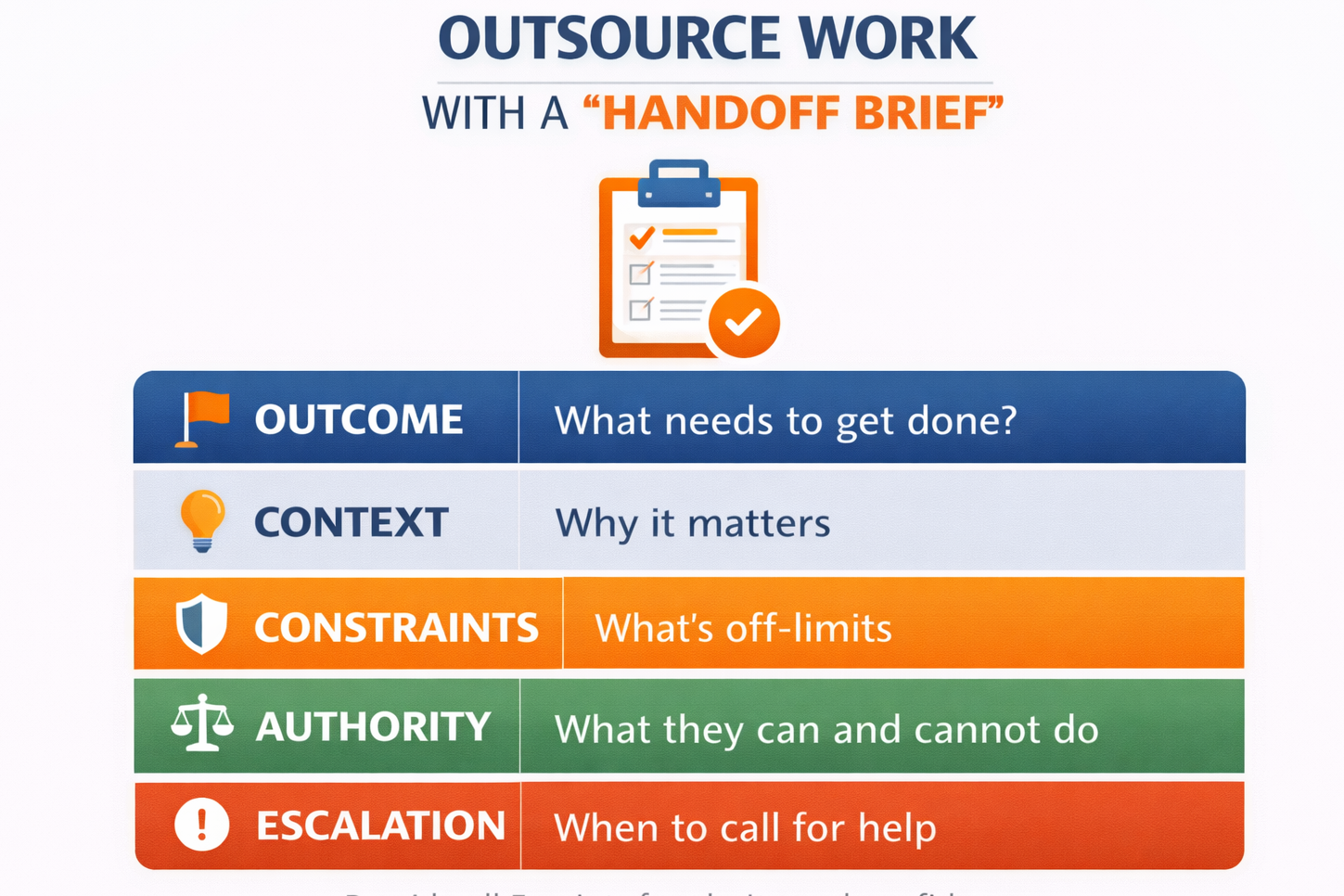
A handoff brief prevents delegated work from returning to the CEO after the transfer occurs. Every Zone 2 workflow receives a brief with five components:
- Outcome: The specific, time-bound deliverable
- Context: Background information; the EA needs to act independently
- Constraints: What sits outside the EA’s Authority and triggers escalation
- Authority level: What the EA decides without checking
- Escalation trigger: The exact condition that brings the CEO back in
An EA running board meeting preparation as a Zone 2 workflow writes a handoff brief that authorizes them to coordinate all logistics, compile materials, and chase outstanding submissions. The escalation trigger covers any board member raising a governance issue requiring direct CEO authority. Everything else the EA resolves without interruption.
How Does the CEO Delegation Matrix Improve Efficiency?
The CEO Delegation Matrix improves efficiency through three mechanisms: It eliminates decision latency, it removes attention residue from low-leverage tasks, and it converts administrative drag into EA-owned workflows with defined SLAs and measurable performance.
Decision latency occurs when a task sits unactioned because the responsible party is unclear. University of California, Irvine researcher Gloria Mark found that a worker interrupted from deep focus takes an average of 23 minutes to return to full cognitive engagement. A CEO who absorbs six administrative interruptions per day loses more than two hours of strategic thinking capacity to interruption recovery alone, not to the interruptions themselves. The matrix eliminates that latency by pre-assigning every task category before it surfaces.
Attention residue, a concept introduced by University of Washington researcher Sophie Leroy, describes the cognitive carry-over that persists when a person switches tasks before completing the first. Contextual switching between a board call, an inbox check, and a strategy session leaves the CEO fractured across all three cognitive threads simultaneously. The matrix removes entire task categories from the CEO’s awareness by transferring the monitoring responsibility, not just the execution, to the EA.
Workflow conversion turns ad hoc requests into repeatable systems with measurable output. An EA who builds a zero-inbox architecture inside Google Workspace or Microsoft Outlook using email sub-folders, archiving rules, label hierarchies, and batch processing cycles converts 90 minutes of daily CEO inbox management into a 20-minute EA review cycle. An EA who implements time blocking on the CEO’s calendar using Calendly intake rules, calendar density analysis, and a weekly scheduling brief structured around timezone parity management reduces the CEO’s scheduling involvement from fragmented throughout the day to a single 15-minute approval window.
The combined effect compounds: each reclaimed hour concentrates the CEO’s time further into Zone 1 work, where every hour produces disproportionate strategic output.
CEO Delegation in Action: Three Case Studies
Case Study 1: Jeff Bezos and the Single-Threaded Owner Model at Amazon
Amazon’s Jeff Bezos developed the single-threaded owner delegation model to prevent organizational ambiguity from slowing execution at scale. Each major initiative received one owner with full Authority and accountability within a defined DoA ceiling. Bezos retained sign-off only on pricing architecture, third-party seller terms, and major infrastructure investments. Amazon’s executive support layer maintained the authority matrix, tracked threshold adherence across business units, and prepared structured briefings that surfaced only Zone 1 decisions for Bezos’s attention. The company scaled to over 1.6 million employees without the CEO becoming the execution bottleneck because the delegation architecture governed decisions, not Bezos’s direct involvement.
Case Study 2: Richard Branson and the Virgin Group Authority Matrix
Richard Branson scaled Virgin to a 400-company group by defining his Zone 1 as brand decisions, cultural direction, and capital allocation above a defined threshold. Every operational decision was transferred to managing directors who held full Authority within their unit, governed by a Delegation of Authority matrix that defined each MD’s signing authority ceiling and procurement lifecycle boundaries. Branson’s EA team maintained the authority matrix, managed escalation triggers, and delivered structured briefings. Branson did not receive unfiltered communication. He received pre-processed, EA-curated briefings that surfaced only decisions requiring his direct Authority.
Case Study 3: The Exec Assistants Delegation Framework in Action
Using the delegation methodology developed and continuously refined by the Exec Assistants team, a 45-person professional services firm in Johannesburg restructured its CEO’s workload across a 12-week engagement. The client remains confidential, but the implementation is proprietary to the Exec Assistants framework.
The CEO entered the engagement, spending 22 hours per week in reactive mode: fielding staff queries, reviewing proposals at every draft stage, attending unstructured internal coordination meetings, and managing all client scheduling personally. The Exec Assistants placement team ran a two-week time audit and identified 19 recurring task categories. The scoring process revealed that the CEO’s Authority was genuinely required for only 4 of them. The remaining 15 are distributed across Zone 2 and Zone 3.
The EA moved proposal reviews to a two-stage SOP: associates draft, senior consultants review, and the CEO receives only the final version with changes flagged for approval. The EA built a Notion-based knowledge base covering 80% of recurring staff queries and handled those responses independently within a defined 4-hour SLA. The EA transferred all client scheduling to Calendly with rules-based routing and managed all rescheduling, confirmations, and pre-meeting briefings. The EA protected two four-hour time-blocked deep work sessions per week on the CEO’s Google Calendar, enforced through a gatekeeping protocol shared with all department heads.
At the six-month review, the CEO’s reactive workload had dropped from 22 hours to 8 hours per week. The Exec Assistants team conducted the quarterly matrix reset, identified 6 new task categories that had entered the CEO’s workflow during the intervening quarter, and extended the Zone 2 handoffs accordingly. This implementation represents the Exec Assistants’ delegation framework operating as designed: EA-driven, continuously maintained, and systematically scaled as the organization grows.
How to Delegate as a CEO: The Executive Assistant Introduces the Framework
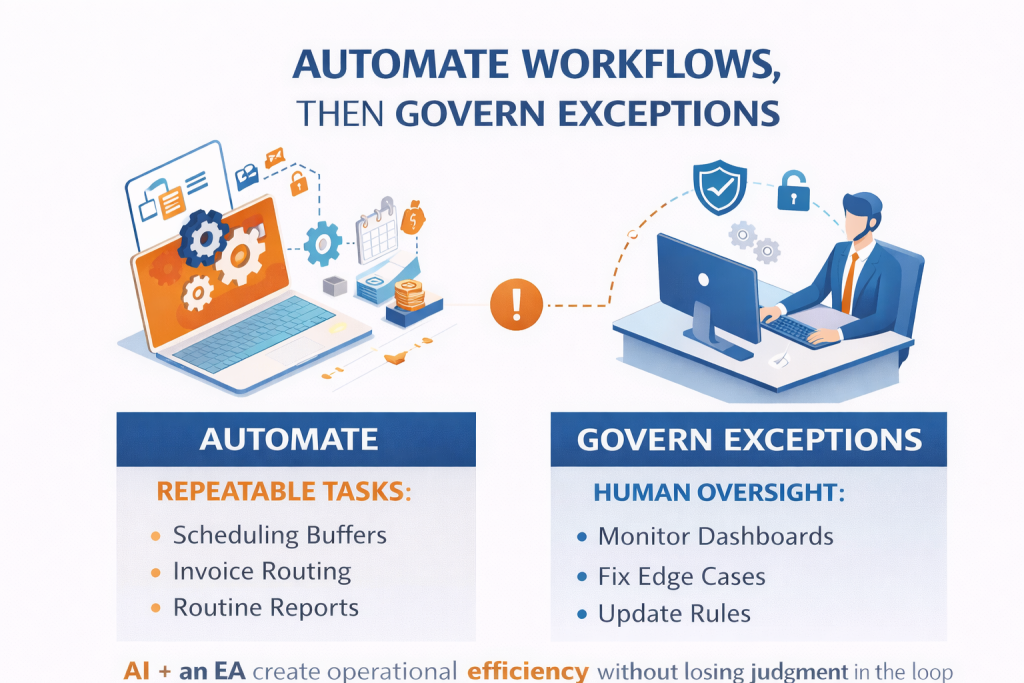
Automation belongs to processes that follow “if this, then that” logic. Scheduling buffers, recurring reminders, invoice routing, report generation, form intake, and data movement between tools qualify because the steps rarely change. When you automate these, you cut error rates and free humans for judgment work. You also create operational efficiency because systems do not forget, get distracted, or improvise. You still need ownership, because automation decays when the business changes and nobody updates the rules.
Treat AI as part of automation, not as a replacement for accountability. Use it to summarise long threads, draft first-pass responses, extract action items from notes, and convert raw ideas into structured outlines. Then, require a human review for accuracy, tone, and confidentiality, because speed without verification creates reputational risk. Adam Mosseri, head of Instagram, summed up the frustration many leaders feel when he wrote that ineffective meetings and overhead slow teams down. AI can reduce overhead, but your process must keep judgment in the loop.
A strong setup pairs automation with a human “governor.” Your assistant can monitor dashboards, check audit logs, and handle exceptions before they reach you. They can also maintain the workflow library, which prevents the organization from rebuilding the same process repeatedly. This combination scales better than either approach alone. Systems handle volume, people handle nuance.
Governance: Approvals, thresholds, and decision rights
Most delegation articles address the CEO as the primary actor. The EA is the person who makes delegation actually work.
An EA who introduces the CEO Delegation Matrix to an unstructured or resistant executive starts with the problem, not the solution. The EA books 20 minutes, presents the time audit data, and asks one question: “Would you like to reclaim this time?” The matrix arrives second, as the solution to a problem the CEO has already confirmed as real.
The EA manages the rollout across three stages.
Stage 1: Build in parallel. The EA documents the first five Zone 2 workflows, creates the SOPs, sets up the tools (Notion for SOP documentation, ClickUp for task tracking, Loom for async context briefings, 1Password for shared credential access, Google Workspace for inbox sub-folder architecture and batch processing rules), and runs the workflows for two weeks before presenting anything to the CEO. The CEO evaluates proven results, not process theory.
Stage 2: Present outcomes, not methodology. The EA shows the CEO what happened across the two-week pilot: decisions handled independently, interruptions avoided, tasks completed within SLA, ghost-written correspondence dispatched, and batch processing cycles that eliminated reactive inbox management. The CEO does not review the SOP documentation. The CEO reviews outcomes.
Stage 3: Expand the matrix quarterly. Every 90 days, the EA reviews what entered the CEO’s direct workload during the prior quarter, rescores emerging task categories using the four-dimension scoring system, and proposes matrix adjustments. Ghost-writing volume, timezone parity challenges from new international hires, and procurement lifecycle complexity typically expand Zone 2 responsibilities as the organization scales. The EA initiates this review proactively. It does not require a CEO-initiated request.
CEO Delegation Matrix Template: Excel, Word, and Free Options
A CEO Delegation Matrix template structures the task inventory, scoring, zone assignment, and authority threshold documentation into a reusable operational system. The format the EA selects depends on the workflow stage.
CEO Delegation Matrix Template Excel
| Worksheet | Contents |
|---|---|
| Task Inventory | Task name, owner, frequency per week, four-dimension scores, zone assignment, SOP link, last reviewed date |
| Visual 2×2 Matrix | Bubble chart mapping tasks by Authority (Y-axis) and Leverage (X-axis) |
| DoA Register | Decision category, authority holder, financial or scope ceiling, signing authority level, procurement lifecycle stage, escalation path, review frequency, last updated |
| SLA Tracker | Zone 2 workflow, EA owner, SLA commitment, last measured performance, breach flag |
The DoA Register tab uses conditional formatting to highlight any decision sitting above its appropriate authority level, surfacing governance mismatches at every quarterly review. Organize DoA rows by department: Finance, Legal, HR, Operations, Marketing, and Technology. Include columns for PoA references and corporate resolution numbers where applicable.
CEO Delegation Matrix Template Word
The Word format covers handoff brief documentation for each Zone 2 workflow. Each document covers: workflow name, outcome definition, context required for independent EA execution, constraints and escalation triggers, authority ceiling, assigned tools, SLA commitment, ghost-writing authority scope, and SOP version date. Use Word for new EA onboarding and for the initial CEO presentation before migrating to Excel for live management.
CEO Delegation Matrix Free PDF
The PDF functions as a static reference for the initial 30-minute CEO alignment session. It shows the 2×2 grid with example tasks mapped across all three zones, the DoA threshold register by role, and the RACI structure for the five most common executive workflows. The PDF opens the conversation. The Excel workbook runs the operational system.
Format Summary by Use Case
| Format | Best Use | Key Advantage |
|---|---|---|
| Excel | Live ongoing matrix management | Dynamic scoring, conditional formatting, SLA tracking |
| Word | Handoff brief documentation and EA onboarding | Structured template per workflow |
| Initial CEO alignment session | Fast, visual, no editing required | |
| DoA Excel | Standalone governance register | Signing Authority, PoA, procurement lifecycle columns |

Delegation Techniques, Task Prioritization, and the Authority Matrix
The CEO Delegation Matrix sits at the center of a broader delegation framework connecting three operational disciplines.
Delegation techniques cover the specific methods an EA uses to transfer and maintain task ownership. The async Loom briefing lets the CEO record a three-minute context video instead of writing a structured brief, which reduces the CEO’s time investment in each handoff. The weekly standing review gives the EA 15 minutes to present decisions made, flags requiring escalation, and upcoming triggers without consuming calendar space. The rules of engagement document defines how the CEO wants to receive information, what urgency labels mean in Slack or Microsoft Teams, what ghost-writing Authority the EA holds across correspondence categories, and what standing Authority the EA exercises across Zone 2 decisions.
The authority matrix prevents two organizational failure modes: Upward delegation, where staff pushes decisions to the CEO that the DoA already resolved at a lower level, and authority overreach, where individuals act beyond their defined signing authority, outside the procurement lifecycle boundaries their role covers, or in excess of any PoA or corporate resolution in effect. The EA reviews the authority matrix quarterly, updates thresholds as the organization scales, and communicates changes to department heads.
Task management connects the delegation framework to daily execution. ClickUp, Asana, Notion, and Monday.com all support visual prioritization tied directly to zone assignments. The EA maintains the CEO’s task backlog inside the chosen platform, applies priority labels linked to the matrix zone classifications, and surfaces only Zone 1 items for the CEO’s attention. Zone 2 items stay inside the EA’s active workflow. Zone 3 items route through automated systems, with exception alerts going to the EA, never the CEO.
Frequently Asked Questions
Why is delegation important for CEOs?
CEOs who retain low-leverage work do not just lose personal hours. They generate operational drag across every function, waiting for their input. McKinsey research confirms that effective delegation correlates with 33% higher revenue growth. When a CEO operates as an execution bottleneck, the cost multiplies simultaneously across product, hiring, client relationships, and finance. The CEO Delegation Matrix resolves the bottleneck by transferring execution authority to the EA within a governed framework, so strategic oversight stays intact while operational velocity increases across the organization.
How does an Executive Assistant introduce the CEO Delegation Matrix?
The EA leads with a two-week time audit and a specific data presentation, not a framework pitch. The EA shows the CEO exactly where their hours currently go and asks whether they want those hours back. Once the CEO confirms the problem, the EA presents the matrix as the solution, pilots five Zone 2 handoffs for two weeks before the presentation, and delivers outcome data at the session rather than process documentation. The EA builds and owns the entire framework. The CEO approves the zone assignments and authority ceilings, then relies on the EA to maintain the system permanently.
The CEO Delegation Matrix works because the EA builds the architecture that makes delegation structural rather than situational. An EA who constructs the matrix, runs the quarterly reset, enforces the gatekeeping protocol, and owns the Zone 2 workflow suite does not simply save the CEO time. The EA builds the operational infrastructure that separates a high-leverage executive from a CEO trapped inside their own business.